

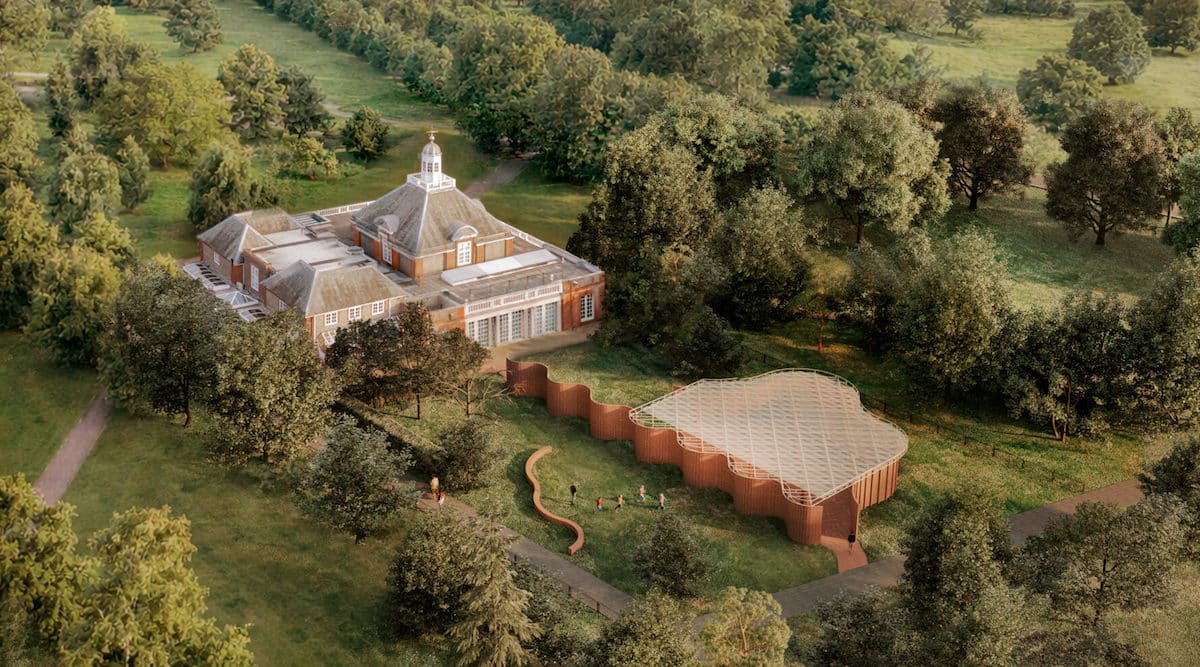
Serpentine has announced that Mexican architecture studio LANZA atelier, founded by Isabel Abascal and Alessandro Arienzo, has been selected to design the 2026 Pavilion. The Pavilion will open to the public at Serpentine South on 6 June 2026, The project coincides with the Pavilion’s 25th edition, a milestone Serpentine will mark through a special collaboration with the Zaha Hadid Foundation.
Since its inception, the Serpentine Pavilion has become one of the most closely watched platforms for architectural experimentation, offering emerging practices a highly visible site for testing ideas in public. Over time, it has expanded beyond a single structure, operating as a participatory space that supports Serpentine’s interdisciplinary, community-focused and educational programmes.
Established in Mexico City in 2015, LANZA atelier works from a collaborative ethos grounded in the everyday and the informal. The studio is attentive to the ways in which technology, craft, and spatial intelligence surface in unexpected contexts, locating value in use, assembly, and encounter. Its projects propose forms of building that prioritise dialogue, shared experience and the social life of architecture.
Drawing, model-making and other hands-on processes play a central role in the studio’s practice, functioning as tools for thinking through material, structure and form. Working internationally, Abascal and Arienzo approach architecture as a fluid discipline, moving between domestic spaces, public infrastructure and furniture design, always with a critical sensitivity to place and culture.
For the 2026 Pavilion, LANZA atelier has taken its cue from the English serpentine, or crinkle-crankle, wall, which defines one side of the structure. Characterised by its alternating curves, this form originated in ancient Egypt before being adopted in England by Dutch engineers. Its sinuous geometry provides lateral stability, allowing a single-brick-wide wall to use fewer materials than a straight one. The reference also gestures toward the nearby Serpentine lake, named for its gentle curves and its long association with the park’s landscape.
Responding closely to its setting, a second wall is designed to sit in harmony with the surrounding tree canopy, while the main structure occupies the northern edge of the site. Above, a translucent roof rests lightly on brick columns, recalling the rhythm of a stand of trees. Light and air move freely through the Pavilion, blurring distinctions between inside and out and lending the space a softened, open character.
Brick has been chosen as the primary material, both as a nod to the English garden tradition and to engage with the brick façade of the Serpentine South Gallery, itself originally built as a tea pavilion. Through a repeated sequence of brick columns that shift from solid to permeable, the structure becomes a symbolic bridge between European and American geographies.
LANZA atelier commented: “Being selected to design the 25th Serpentine Pavilion is a real honour, particularly in such a landmark year for the commission. We are grateful for the opportunity to present our work in a public setting and to contribute to a legacy defined by spatial experimentation and collective encounter. Set within a garden, the Pavilion takes the form of a serpentine wall—an architectural device that reveals and conceals, shaping movement, rhythm and moments of pause.
Drawing on the serpent as a generative and protective figure, we connect this idea to England’s fruit walls, structures that temper climate, create shelter and support growth. From this emerges a Pavilion built from simple clay brick, foregrounding vernacular craft and architecture’s most basic social function: bringing people together. The design proposes forms that are permeable, gently held by geometry, and responsive to those who pass through them.”
Bettina Korek, Chief Executive of Serpentine, said: “For a quarter of a century, the Serpentine Pavilion has provided a unique platform for architectural experimentation—first inviting internationally recognised architects without permanent buildings in London, and more recently amplifying emerging voices. It offers an unusually open brief: to test ambitious ideas in a space that is free and accessible to all. With LANZA atelier, we deepen cultural exchange with Mexico and reaffirm the Pavilion as a civic place of encounter, integral to our summer and autumn programmes. We are sincerely thankful to our partners and supporters for enabling this work.”
Hans Ulrich Obrist, Artistic Director of Serpentine, added: “Over the past decade, the Pavilion has increasingly focused on giving opportunities to younger practices. We are delighted to welcome LANZA atelier as the designers of the 2026 Pavilion. Their work is marked by a close engagement with context, materials and lived experience, creating spaces with a lasting energy. The Pavilion will once again function as a ‘content machine’, hosting talks, screenings and performances. As we mark the 25th edition, we also remember Zaha Hadid, whose belief that experimentation should have no end continues to guide the project. LANZA atelier’s commission marks the second time a Mexican practice has been appointed, following Frida Escobedo in 2018, and we are grateful to Sou Fujimoto for his generous advice throughout the process.”
From summer through to October, the 2026 Pavilion will host Serpentine’s live programme, encompassing music, film, theatre, dance, literature, philosophy, fashion and technology. Each season’s activities respond directly to the Pavilion’s architecture, inviting audiences to experience the space as it is activated through use.
In parallel, Serpentine will work with the Zaha Hadid Foundation to honour Hadid’s legacy and to mark the Pavilion’s 25th anniversary. A dedicated architecture programme at Serpentine South will reflect on Hadid’s foundational role as the designer of the first Pavilion in 2000, and on the experimental spirit that has shaped the commission ever since. Bringing together architects, thinkers and cultural practitioners, the programme will explore current questions in architecture while looking ahead to future possibilities.
The 2026 Pavilion was selected by Serpentine CEO Bettina Korek, Artistic Director Hans Ulrich Obrist, Director of Construction and Special Projects Julie Burnell, Exhibitions Curators Chris Bayley and Tamsin Hong, Assistant Exhibitions Curator Liz Stumpf, with advisory support from Sou Fujimoto.
To coincide with the Pavilion, Serpentine will publish LANZA atelier’s first monograph. Designed by Estudio Herrera, the publication will feature newly commissioned texts spanning architecture, art and poetry, alongside a substantial conversation between LANZA atelier and Hans Ulrich Obrist, and an essay by José Esparza Chong Cuy.