
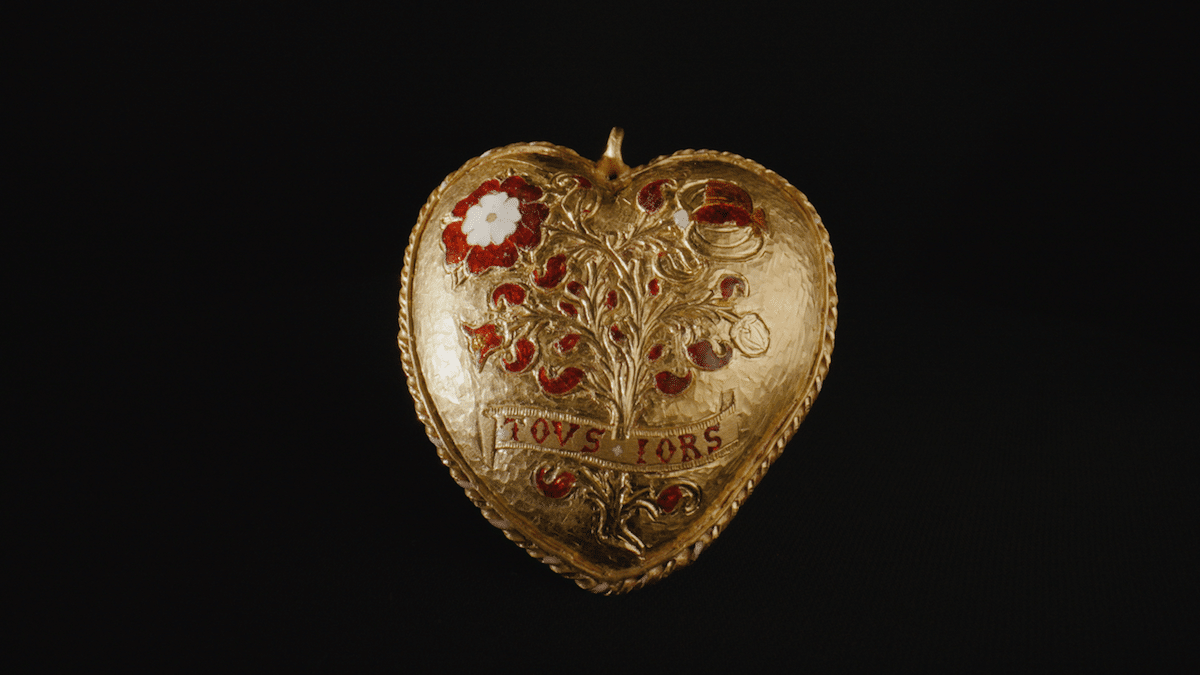
The British Museum has secured the £3.5 million required to buy a Tudor period heart-shaped pendant in time for Valentine’s Day. The jewel was discovered by a metal detector last year. The 24-carat gold pendant is a rare find from the court of Henry VIII and his first wife, Katherine of Aragon. It will now enter the Museum’s permanent collection, where it is expected to remain on display. The campaign to keep the object in a public institution was launched last October, with a deadline set by the export deferral process for April 2026. That target has been met several months early.
The decisive contribution came from the National Heritage Memorial Fund, which awarded £1.75 million, accounting for half the total sum required. The grant coincides with the Fund’s 45th anniversary and reinforces its long-standing role as a lender—and funder—of last resort for objects deemed of national importance. Additional support from charitable trusts, arts bodies and individual donors completed the total, allowing the Museum to proceed with the acquisition.
What distinguished this campaign was the scale of public participation. More than 45,000 individual donations were made, together amounting to £380,000—just over ten per cent of the overall total. In a climate where museums often struggle to mobilise grassroots support for acquisitions, the response suggests that certain objects can still cut through institutional fatigue and funding scepticism.
Significant philanthropic backing also played a decisive role. The Julia Rausing Trust has contributed £500,000, while the Art Fund awarded £400,000, including support from the Rought Fund. The American Friends of the British Museum added a further £300,000, illustrating the object’s international appeal. Actor Damian Lewis (Wolf Hall) lent his support to the campaign, helping to broaden its public reach, though the success ultimately rested on a combination of institutional credibility and emotional narrative.
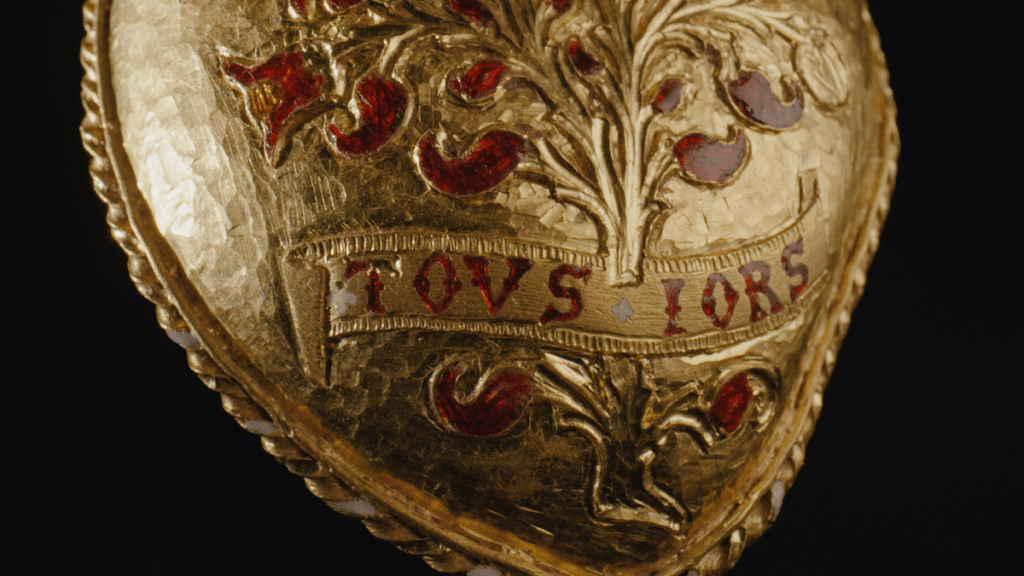
At the centre of that narrative is the pendant itself. Heart-shaped and fashioned from solid gold, the object bears the Tudor rose entwined with Katherine of Aragon’s pomegranate emblem. Beneath it runs a banner inscribed with the word “tousiors”—an archaic French rendering of “always”. The message is unambiguous, and unusually intimate for an object associated with Henry VIII, whose marital legacy is more often defined by rupture than devotion.
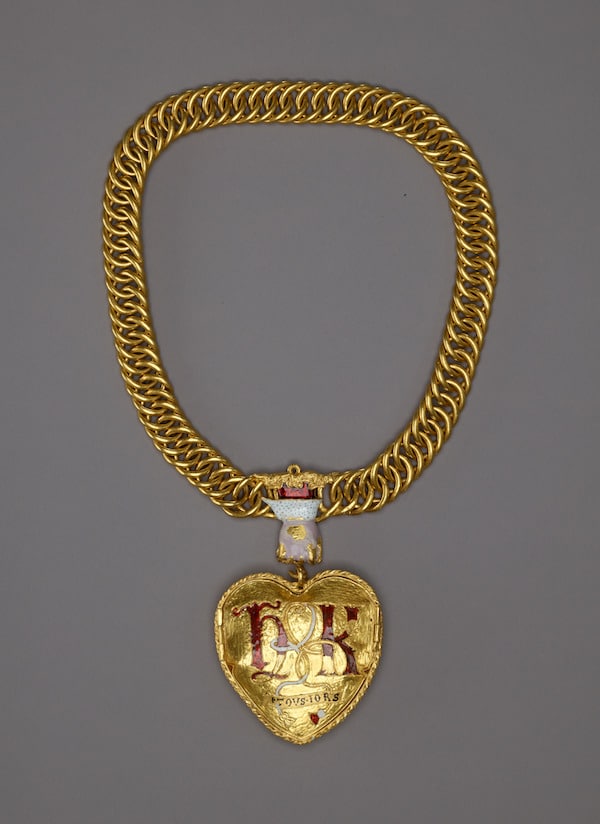
The Heart is believed to date from the early years of Henry and Katherine’s marriage, which lasted 24 years and was the longest union of the king’s life. During that period, Katherine played an active political role, acting as regent during Henry’s absences and exerting influence within the early Tudor court. Very few material objects survive that speak directly to the relationship between the two, making the pendant an exceptional witness to a formative phase of Tudor power before the dynastic and religious upheavals that followed.
The pendant was discovered in 2019 by a metal detectorist in Warwickshire and subsequently declared a treasure trove. Research undertaken by the British Museum suggests it may have been commissioned for a tournament held in October 1518, organised to mark the betrothal of Princess Mary to the French dauphin. Such events were occasions for carefully staged splendour, and Henry was known to commission elaborate “costume” jewellery from London goldsmiths, intended to be worn briefly by courtiers as part of a larger display of magnificence.
Dr Nicholas Cullinan, Director of the British Museum, described the acquisition as evidence of the continued public belief in museums as custodians of shared history. He noted that the campaign demonstrated how historical objects, when properly contextualised, can still spark imagination and collective responsibility. Plans are now being developed for a national tour, with Warwickshire—close to the site of discovery—expected to feature prominently.
For curators, the acquisition represents both an opportunity and a challenge. Dr Rachel King, Curator of Renaissance Europe and the Waddesdon Bequest, has spoken of the object’s capacity to raise unanswered questions: who wore it, on what occasion, and how it came to be buried. Those uncertainties are part of its power. Unlike royal portraits or official documents, the Heart operates in a more ambiguous register, falling somewhere between a personal token and a political symbol.
The National Heritage Memorial Fund framed its support in similarly broad terms. Simon Thurley, the Fund’s Chair, described the pendant as an unusually direct insight into the culture of Henry VIII’s court, one that connects personal relationships to the machinery of early Tudor governance. Since its founding in 1980, the Fund has supported nearly 1,500 acquisitions, and the inclusion of the Tudor Heart adds another chapter to that quietly accumulating national archive.
Art Fund Director Jenny Waldman cited the campaign as an example of what can be achieved when public generosity and private philanthropy align around a shared objective.
With the fundraising complete, the Museum will now work with the Department for Culture, Media and Sport to finalise the payment of the Treasure reward to the finder and landowner. The British Museum expects to formally accession the pendant later this year. In the meantime, it remains on display in Room 2, Collecting the World, where it has already drawn sustained attention.
To mark the acquisition, the British Museum Press will publish an accessible introduction, Object in Focus: The Tudor Heart, written by Rachel King, in May 2026.