I first met Tracey Emin in the 1990s, when she was a young artiste maudit, hanging out with the then-new YBA bad boys, but not yet a household name. It was at her tiny Waterloo shop that she was running with Sarah Lucas, and she was off her head, presumably from a good night out. Her growing fame was built on a drunken TV appearance and her notorious tent, appliqued with the names of literally everyone she had ever slept with, bought by the art guru of the time, Charles Saatchi.
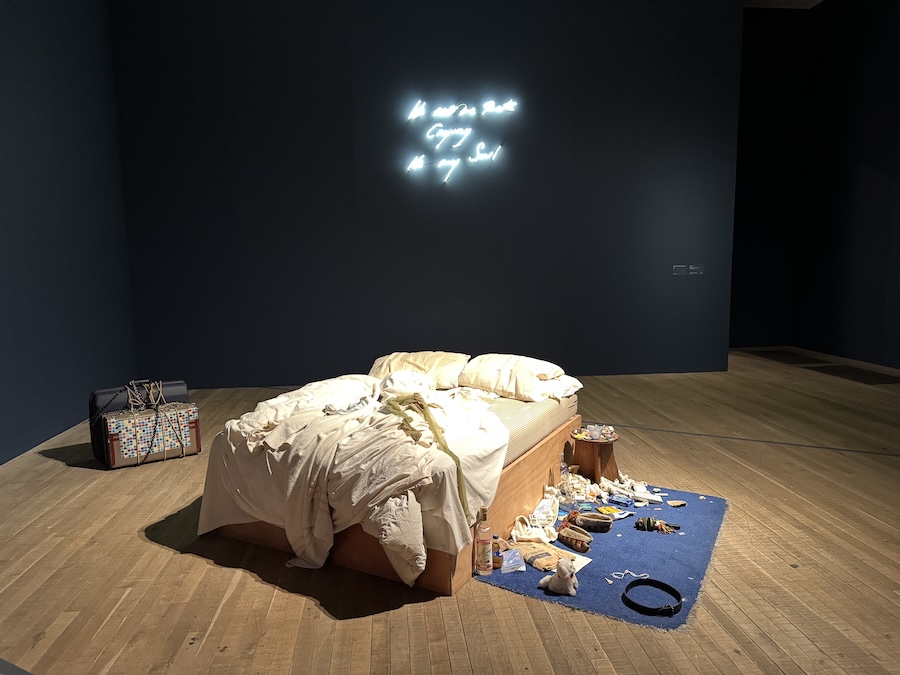
Tracey Emin, My Bed 1998
During the ensuing years, I wrote about her work several times. It always seemed solipsistic and narcissistic to follow Warhol’s example of merging life with art. Autobiography was her subject. Her focus always herself: her traumatic childhood in Margate, the teenage sex, and her abortion. A photo of her sitting with splayed legs rubbing money up against her vulva, and her unmade bed, inspired by four days spent in a depressive collapse, drinking only alcohol, made her notorious. The popular press loved the fact that My Bed, with its used tissues, grubby sheets, condoms, and abandoned tubes of lube, was shortlisted for the 1999 Turner Prize. There were cries of ‘anyone could do that,’ to which she retorted, “Well, they didn’t, did they?” Conceptually, the piece was up there with Marcel Duchamp’s urinal (she does, after all, have an MA from the Royal College of Art), though it was rather more self-obsessed. At the time, notoriety and épater les bourgeois (the posh French phrase for trendsetting artists getting up the public’s noses) seemed the focus of her art rather than a desire for any universal connection. It suited the mood of those go-getting, Blairite times, and she became very rich.
Then, in July 2020, her world was turned upside down. A biopsy revealed that she had an aggressive form of squamous cell bladder cancer. Surgeons were forced to remove her bladder, uterus, ovaries, fallopian tubes, urethra, lymph nodes and parts of her vagina and colon, leading to dependency on a urostomy bag. After the loss of her mother, Pam, in 2016, along with a failed legal bid to expand her Spitalfields studios, she felt that the ‘city was crushing her’ and had moved back to her childhood home, Margate. From now on, she would live under some of the “loveliest skies in Europe” that had inspired Turner.
No one could wish such a devastating illness on anyone. It has obviously been hugely challenging for a still young woman, and she has risen to that challenge with bravery and fortitude. Many would have collapsed under such a burden of ill health, but to appropriate Shakespeare’s words from Macbeth, nothing in her life became her like such devastating illness. It has changed her work, given her a new gravitas and focus. What was superficial and self-absorbed has become poignantly universal. This was first evident in her show The Loneliness of the Soul with ‘her friend in art,’ Edvard Munch at the RA. Just recovering from cancer, her vulnerability and psychological pain were evident for all to see, used as the engine for her expressionist paintings. There was a new emotional integrity. The move back to Margate also inspired a reaching out, the philanthropic opening of TKE Studios, which provides affordable workspace for young artists, and an 18-month residency for painters. She was creating a new legacy.
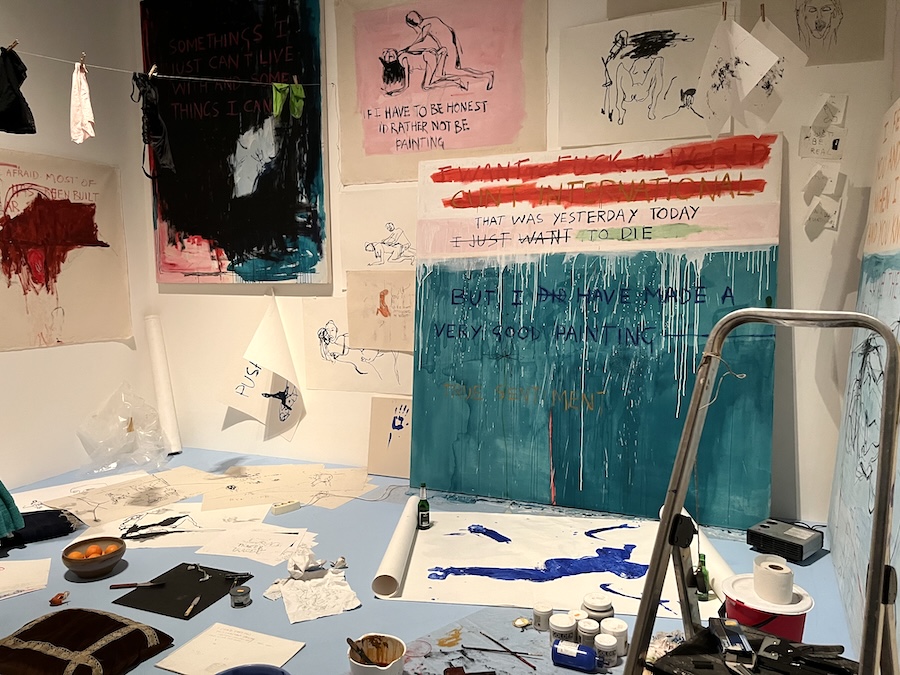
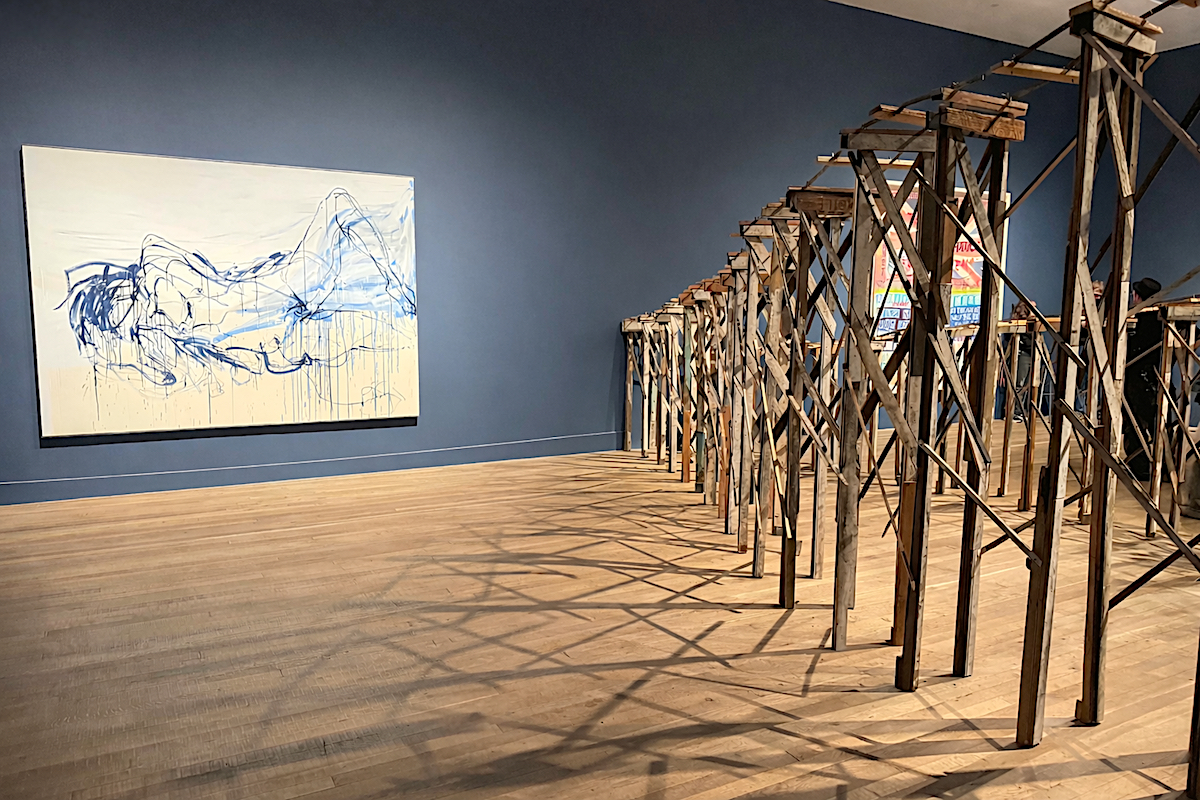
Tracey Emin, recreation of studio in Stockholm
Now, there is a major retrospective, A Second Life, at Tate Modern, spanning 40 years of art practice. The themes remain her personalised trauma and pain. There is the reference to youthful sexual assault in her neon piece I Could have Loved my Innocence 2007 and the embroidered calico, Is This a Joke 2009. A candid video has her talking to camera outside the Elizabeth Garret Anderson hospital where she had an abortion that went wrong. But the show has been tightly curated. There is a delicate balance between the more youthful narcissism and the later paintings influenced by Munch, Egon Schiele, and the drawings of Joseph Beuys that touch more deeply on the human condition. Her later work is no longer driven simply by ego but illustrates a much deeper existential disquiet. For six years after her abortion, she gave up painting. Exorcism of the Last Painting I Ever Made 1996 documents a time when, for three weeks, she shut herself in a Stockholm gallery in an attempt to reconcile with her relationship with paint, which has become ever more significant post her illness.
A row of small bronze sculptures and Ascension 2024 explore her relationship with her body after the major surgery for bladder cancer. The medium suits her expressionistic style, allowing her to explore what it is like to live and inhabit space in a damaged body. Remarkably assured, they have something of the visceral power of Rodin.
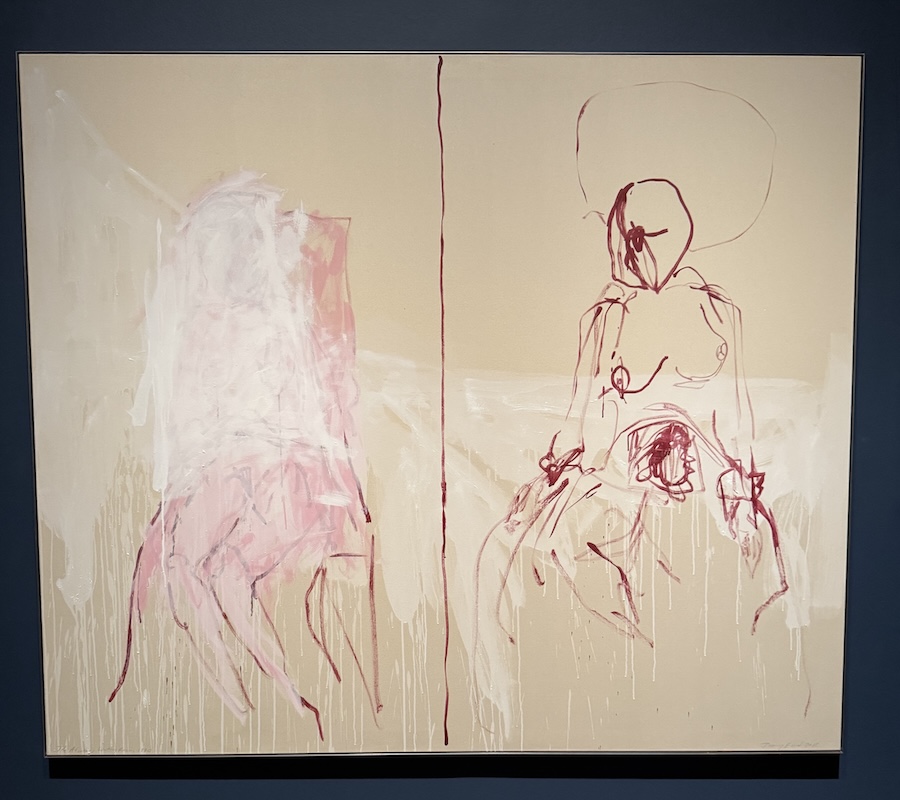
Tracey Emin, The Abortion Waiting Room 1990, 2018
Tracey was one of the first female artists to harness her day-to-day life story: the racism of her childhood when she was perceived as ‘other’ with her dark Turkish Cypriot complexion, the compulsive sex, the alcohol fuelled days and nights. In doing so, she captured something of the ‘90s zeitgeist. But to walk, now, into the final gallery at Tate Modern is to witness the extraordinary journey that both she and her art have been on. Painting has literally given her a second life. She has said that without it, she is nothing, that there would be no point to her life, that contains neither children nor parents. The paintings are rough, visceral, expressionist, even transcendental as they feel their way, tentatively, into deeper spiritual territory. Full of human doubt, they ask questions about what it means to be moving towards death (as we all are). Containing both dark and light, they are an outpouring of what it means to survive, to be alive. Here is an artist at the height of her powers, holding nothing back. Against the odds, she has chosen to live. Her whole existence is justified by making art. As Descartes might have said: I paint, therefore I am. From the days of being known as ‘mad Tracey from Margate’, she has been made a Dame and evolved into a mature artist, one to be reckoned with.
Tracey Emin: A Second Life, Tate Modern, 27 February – 31 August 2026
Visit Here
Sue Hubbard is an award-winning poet, novelist, and independent art critic www.suehubbard.com. She has published five collections of poetry and four novels, the latest, Flatlands from Pushkin Press and Mercure de France.