I travelled to Cape Town during the week of the Investec Cape Town Art Fair for a focused curatorial research trip. Beyond the fair itself, I met artists, visited studios and galleries, and spent time in key institutions to better understand the city’s art ecology from within.
Before the fair’s opening, I visited the Norval Foundation. Its contemporary architecture and sculpture garden—featuring works by Yinka Shonibare, William Kentridge, and others—frame a wide-ranging programme. Inside, Portia Zvavahera’s exhibition Tanda rima (“Chase away the darkness”) centred on dream imagery and themes of spirituality, motherhood, vulnerability, and care. In conversation, she described painting as a means of working through emotional difficulty. The layered surfaces and saturated colour operate as protective structures; the works are intimate yet open, inviting viewers into a shared emotional space.
A major survey of Brett Murray, curated by Karel Nel, brought together more than eighty sculptures spanning his career. Murray frequently deploys animal imagery as a proxy for political actors and systems of power in South Africa. While often formally playful, the works sustain a pointed critique, balancing accessibility with conceptual precision.
The fair gathered 126 exhibitors from 34 cities, with artists representing 44 countries, and opened to a vibrant audience of collectors and professionals from across South Africa and abroad, including Britain and Canada. Despite its scale, many presentations were tightly curated and maintained a focused clarity.
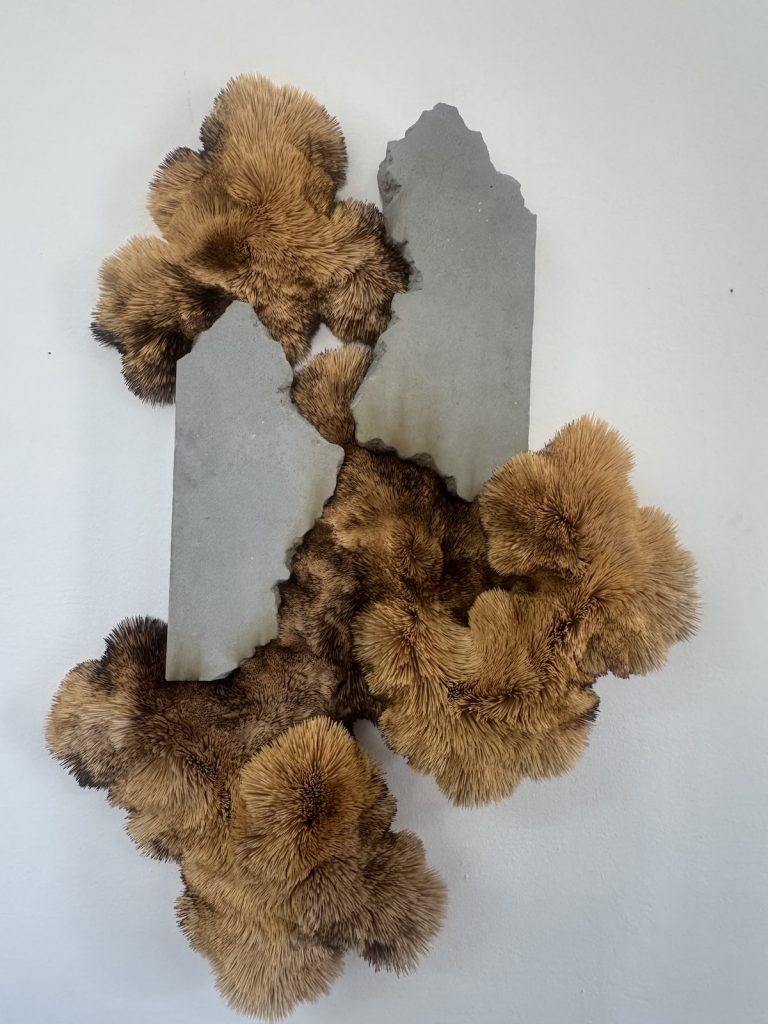
Chris Soal studio visit
Blank Projects stood out with works by Asemahle Ntlonti (b. 1993), whose textured compositions incorporate everyday materials. Addressing lived experience and the ongoing effects of violence and loss in Black communities, the works carry a quiet material intensity without overt narration.
At Suburbia Contemporary, Amy Rusch received the Materiality Prize. She works with salvaged plastics and inherited threads, using sewing as a form of drawing. Her abstract textile works resemble shifting landscapes or maps. When I spoke with her, she described her practice as “sculpting the wind,” a phrase that beautifully captures the sense of movement in her work. As a sailor, she thinks a lot about navigation and air currents, and that sensitivity translates into pieces that feel structured yet fluid. They are thoughtful reflections on memory, material, and transformation.
Afronova Gallery presented Sibusiso Bheka, recipient of the inaugural ORMS International Photography Prize. His photographs of daily life in Thokoza demonstrate dignity and attentiveness, resisting reductive narratives of hardship.
Beyond the fair, galleries mounted substantial exhibitions. At Goodman Gallery, Dynamic Equilibrium surveyed Atta Kwami’s practice, situating his abstraction within West African architectural, textile, and mural traditions through bold colour and rhythmic structure. At Stevenson, Penny Siopis’s Love in a Turning World employed glue, ink, and found materials to embrace contingency. The layered surfaces explored love and grief as intertwined states, with vulnerability positioned as a form of strength.
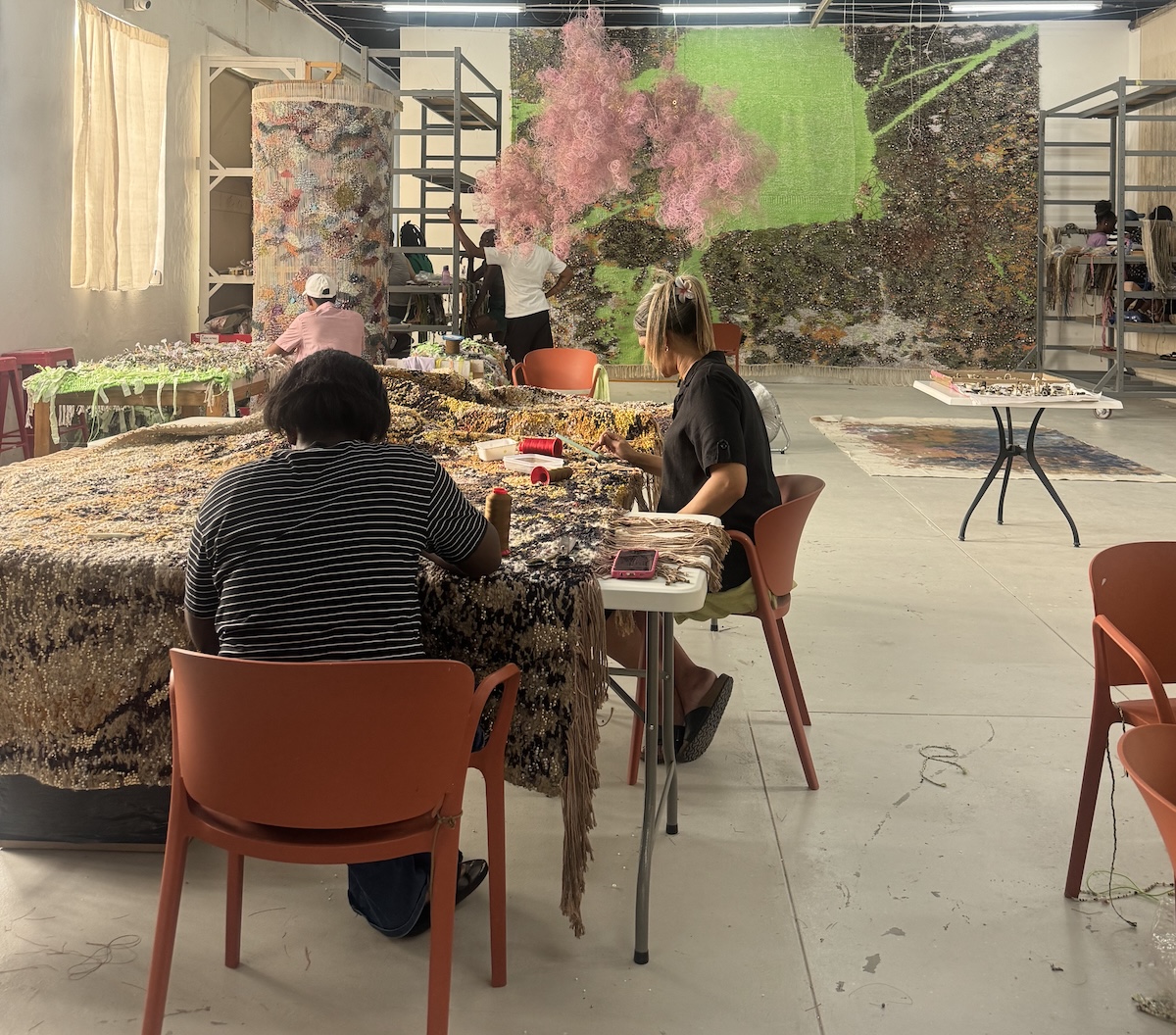
Studio visits deepened the week. Chris Soal transforms industrial and quotidian materials into precisely constructed sculptures that reconsider the spatial and environmental implications of objects. In Igshaan Adams’s studio, (see lead image), a collaborative process—en route to an exhibition at the Guggenheim Museum Bilbao—translated performative gestures into large-scale woven and beaded works. Drawing on mapping, lived experience, Islamic prayer traditions, and South African craft histories, the practice is structurally communal. Lungiswa Gqunta’s installations and sculptures employ glass bottles, petrol, rope, and razor wire to address colonial violence, land, and systemic injustice. Wezile Harmans uses photography and film to stage portraits that interrogate Black identity and masculinity, asserting presence and self-representation.
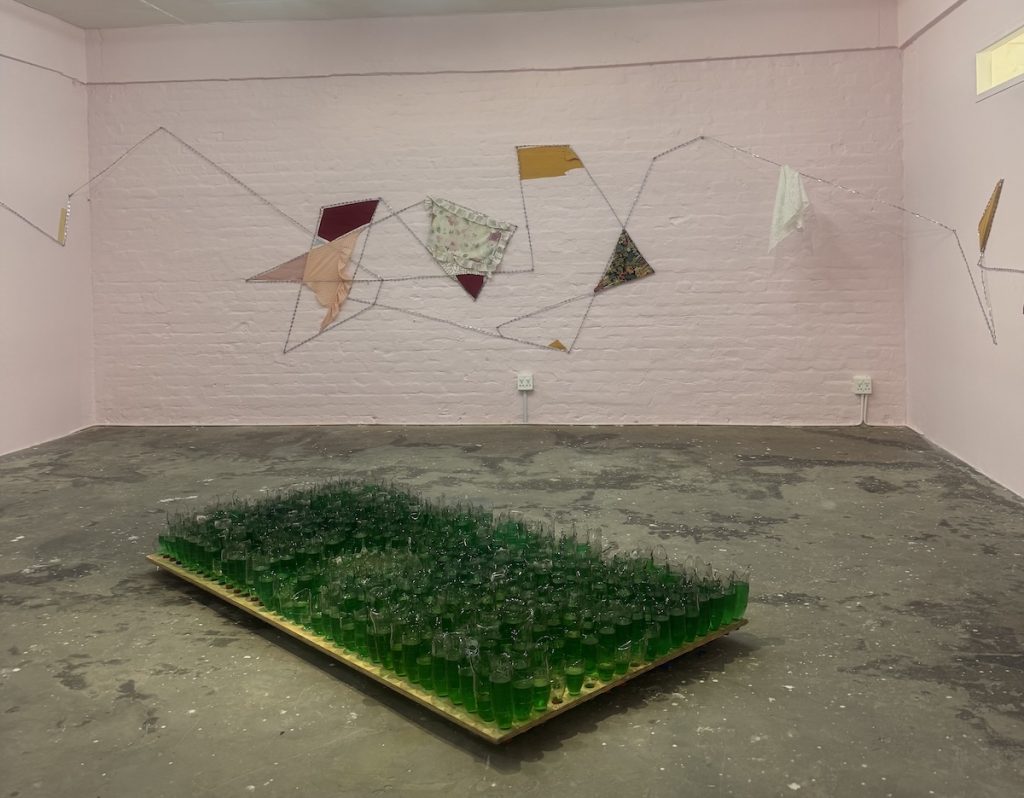
Lungiswa Gqunta studio visit
A significant discovery was Buqaqawuli Nobakada, winner of the Tomorrows/Today (TILGA) Prize. Her paintings on lace—delicate yet resolute—celebrate Black womanhood, mobilising a traditionally domestic material to articulate strength, vulnerability, and ancestral continuity.
At Zeitz MOCAA, housed in a converted grain silo at the V&A Waterfront, Rita Mawuena Benissan’s atrium commission, The Procession (2025), suspended a tapestry inspired by Ghanaian royal processions, activating the vertical space through colour and ceremonial symbolism. At A4 Arts Foundation, Deep Water, curated by Josh Ginsburg, examined immersion and uncertainty across media; Nicholas Hlobo’s installation stood out for its theatrical and emotional charge.
The week concluded with a visit to the private collection of Paola and Guido Giachetti. Installed in their villa, the collection comprises over 1,500 works (acquired since the mid-1980s) from their various homes. Alongside figures such as Kentridge, Sheila Hicks, Antony Gormley, Jason Martin, and a commissioned work by Gerhard Marx, the collection reflects sustained support for African artists.
Across museums, galleries, and studios, Cape Town’s art scene demonstrates how contemporary South African artists confront the country’s recent histories—colonialism, apartheid, and structural violence—while refusing to be confined by them. Lived experience is transformed into formally rigorous work that asserts dignity, complexity, and future-oriented perspectives, with resilience embedded in material, process, and community. In this context, it is particularly regrettable that South Africa will not present a national pavilion at the upcoming Venice Biennale, a missed opportunity to showcase one of the most critically engaged and globally relevant artistic scenes today. For me, the visit marked the beginning of a deeper engagement with contemporary African art, with Johannesburg as the next point of research.
Investec Cape Town Art Fair 20-22 February 2026
Visit Here