
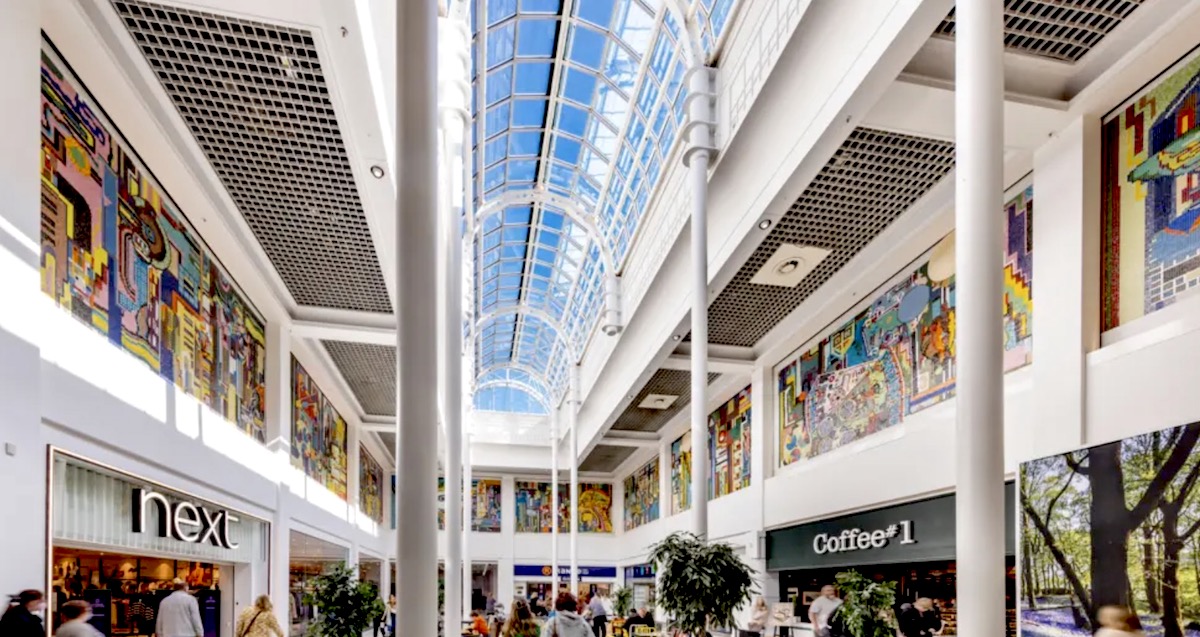
The Secretary of State for Culture, Media and Sport has given a series of mosaic murals by the Scottish Artist Sir Eduardo Paolozzi Grade II listed status. The artworks are installed in an unassuming 1980s-built shopping centre in Redditch.
The mural was unveiled in 1983 at Milward Square inside the Kingfisher Shopping Centre. Twelve mosaic panels, commissioned through a brief that asked Paolozzi to respond to Redditch’s needle industry, the town’s defining manufacturing heritage. What he produced was characteristically dense and layered: industrial imagery colliding with pop culture, contemporary media, technology, and the recognisable visual motifs that run through his wider practice. Funding came from the Redditch Development Corporation, the Needles Industry Group, and the Arts Council of Great Britain. It was, in other words, a serious public commission that deserved to be treated as one.
Historic England, which recommended the listing, cited the “exceptional quality, craftsmanship and survival” of the panels. That word survival matters. Public art in shopping centres has a poor track record of surviving redevelopments, rebrands, and the general indifference of retail management. These panels have been carefully conserved in recent years, and they’re still there, still intact, still being seen daily by people who may or may not know what they’re looking at.
Paolozzi died in 2005. His reputation as a founding figure of the British pop art movement and as one of the most inventive sculptors of the postwar period has only grown since. His Tottenham Court Road mosaics are his most seen public works, encountered daily by thousands of Tube passengers who don’t always register them consciously but would notice immediately if they disappeared. Redditch is less prominent than London, but the artworks are no less serious as a commission.
The C20 Society, which campaigns to protect modern architecture and design and has been pushing for this listing, welcomed the decision, offering additional context worth noting. These are the first of Paolozzi’s murals to receive national listed status. The Kingfisher Centre also becomes only the second postwar shopping centre to be wholly or partially listed in England, after the Milton Keynes Shopping Building. That’s a narrow field, but it signals that heritage bodies are beginning slowly, imperfectly to reckon with the cultural value of postwar commercial spaces and the art made for them.
A spokeswoman for the Kingfisher centre said the mosaics were “a much-loved feature of Milward Square”, forming an important part of both the centre’s identity and the town’s heritage. They are working with the borough council to ensure long-term preservation.
Grade II listing means the structure is now subject to tighter controls on any proposed changes, which is precisely the protection this kind of work needs. Public art is vulnerable in ways that gallery art isn’t. It exists in spaces governed by commercial logic, and commercial logic doesn’t always make room for a twelve-panel Paolozzi mosaic when the lease comes up for renewal. Now, at least, it has to.