
Georg Baselitz, who has died at the age of 88, was one of those artists whose significance resists easy summarisation. He was labelled a Neo-Expressionist and spent much of his career quietly undermining that designation. He was compared to the German painters of the early twentieth century and spent just as much energy looking forward as back. He was, in the end, a figure entirely his own: difficult, uncompromising, frequently provocative, and, in his final decades, revealed as one of the most profound artistic voices his generation produced.
He was born Hans-Georg Bruno Kern on 23 January 1938 in Deutschbaselitz, a village in Saxony, whose name he would later adopt. The choice was made in 1961 and was, characteristically, both personal and pointed: a gesture of loyalty to origins that his country’s division had placed on the wrong side of a border. He had grown up in Nazi Germany, come of age in socialist East Germany, and been shaped by the full weight of that compressed historical experience. His teachers were schoolteachers. His earliest artistic education came from the wildlife photographers and plein-air painters who worked in the natural landscape of the Upper Lausitz. The birds and terrain of that region would resurface throughout his mature work, transformed almost beyond recognition.
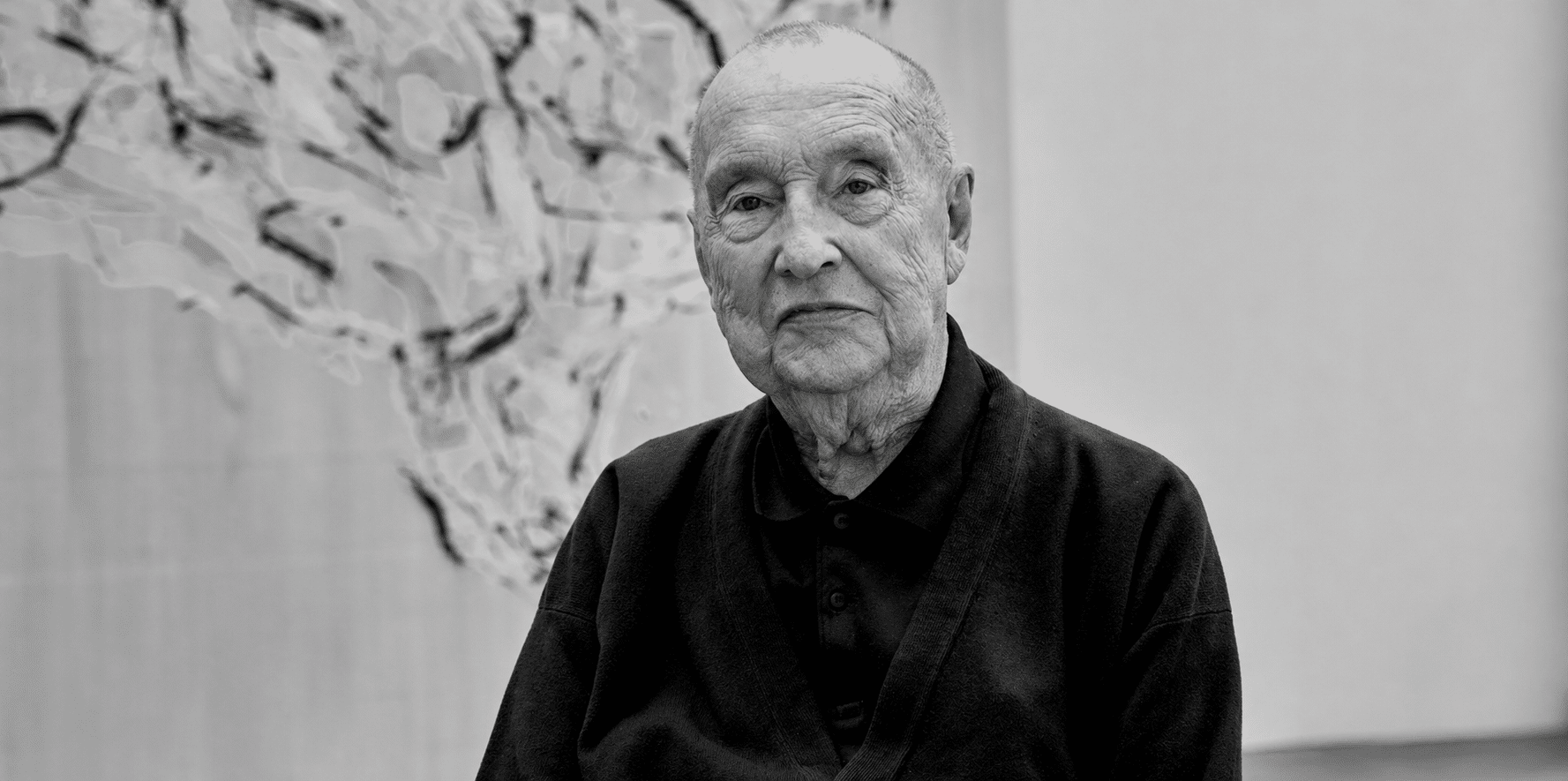
Georg Baselitz, Controversial German Neo-Expressionist Painter, Dies at 88. Photo courtesy Thaddaeus Ropac gallery
His formal art education was troubled from the start. Rejected by the Dresden Art Academy, he enrolled at the Weißensee Academy in East Berlin, where he was suspended for what the institution described as sociopolitical immaturity. This charge tells you more about the institution than about the student. He left East Germany in 1957, moving to West Berlin and entering the Hochschule für Bildende Künste. The West offered no smoother passage. His first solo exhibition in West Berlin in 1963 was closed by police, two paintings were confiscated on grounds of obscenity, and he was fined. The show had lasted a matter of weeks. Within two years, he was in Florence on a scholarship, beginning the Heldenbilder series. These Heroes paintings would eventually be recognised as among the defining works of postwar German art.
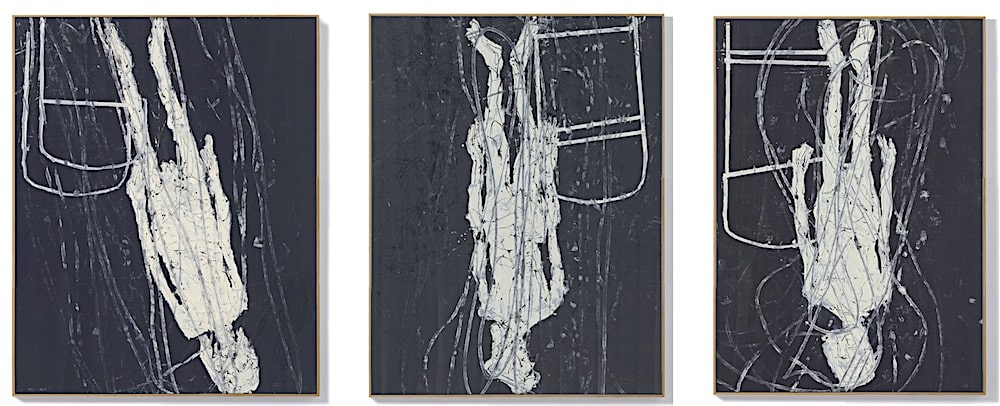
The inversion came later, in 1969, and it changed everything. Baselitz began painting his canvases upside down and exhibiting them that way, a decision that sounds simple but, in practice, has extraordinarily complex implications. The technique was not a gimmick.
The series of inverted eagles that followed in the early 1970s was among the most resonant images in German postwar art, the national emblem of both the Third Reich and the Federal Republic tumbling earthward in blotchy, finger-painted descent. Gerhard Schröder, who served as German Chancellor from 1998 to 2005, hung one of these paintings prominently behind his desk in the chancellery, ensuring its appearance in official portraits. It was a characteristically complicated act of appropriation, and Baselitz let it stand.
His 1980 appearance at the Venice Biennale generated its own controversy. The wooden sculpture he exhibited, attacked with an axe and a chainsaw and depicting a seated figure whose gesture recalled a Nazi salute, caused immediate and sustained uproar. Baselitz maintained that the gesture was one of deference rather than a fascist salute, inspired by an artefact of the Lobi people of Burkina Faso, and that the association was in the eye of the beholder, conditioned to see exactly that. The argument was never fully resolved, which in retrospect seems appropriate for an artist whose entire practice was built on the productive discomfort of uncertain interpretation.
Beyond painting, he worked in graphic art and sculpture throughout his career, and his opinions on the art world and its mechanisms were delivered with a bluntness that periodically overshadowed the work. His remarks about female artists, made in 2013 interviews and repeated in 2022, were widely and justifiably condemned. He later withdrew some of those statements and expressed admiration for Tracey Emin and Artemisia Gentileschi, a partial recantation that acknowledged the damage without quite repairing it. His dismissals of East German painters who had continued working in the realist tradition were equally unsparing, and the withdrawal of his own works from documenta in 1977, in protest at their inclusion, was an act of pugnacious certainty entirely consistent with his character, if not necessarily with his finest judgment.
What the critical focus on his controversies has consistently obscured is the extraordinary quality of his late work. Beginning with the Avignon series in 2015, conceived in conscious dialogue with Picasso’s own late period, Baselitz spent the final decade of his career in a sustained reconsideration of everything he had made before. The eagles, the bare everyman forms, the severed limbs and fractured motifs of earlier decades all reappear, but transformed, settled into a confidence and formal authority that made the earlier work look, in retrospect, like preparation. His final series, Eroi d’Oro, presented alongside the current Venice Biennale, places his lifelong subjects on gold grounds, recalling Byzantine devotional painting while remaining entirely contemporary in its emotional register.
The ultimate subject of this final work is Elke. Baselitz met Elke Kretzschmar, a graphic design student, shortly after arriving in West Berlin. They married in 1962, after hitchhiking through Europe together in the early years of shared poverty, working odd jobs, painting bars, living on refugee grants and whatever else came to hand. She does not appear prominently in his early work. She becomes the central subject only as the career reaches its fullest expression, the portraits of her and of them together accumulating in his final years with the force of a life’s reckoning. Inverted, floating in gold, honest and unflinching and profoundly human, these last paintings are among the most moving works made by any European artist of his generation.
His views on women artists were, by any measure, indefensible. In a 2013 interview with Der Spiegel, he stated flatly that women don’t paint very well, a remark that drew immediate and widespread condemnation. Rather than retreating from the position, he restated it nine years later in conversation with the Guardian, arguing that the art market, which he treated as a reliable index of quality, confirmed his view, and citing the predominance of women in academy painting classes as evidence that their relative scarcity at the top of the market reflected something other than structural disadvantage. The circularity of that reasoning, using a market shaped by decades of institutional sexism as proof of natural hierarchy, appeared lost on him entirely.
He subsequently withdrew elements of what he had said and offered his admiration for Tracey Emin and Artemisia Gentileschi as a form of qualification. It was a gesture that acknowledged the criticism without genuinely engaging with it. Whether it amounted to a retraction is a matter of interpretation. What is not in question is that the remarks caused real harm, lending the authority of a major artist’s name to attitudes that had already done considerable damage to women’s careers and reputations across the field. That Baselitz was capable of seeing greatness in individual women artists while simultaneously dismissing the broader category is a contradiction his admirers have had to sit with and will continue to do so.
The Thaddaeus Ropac gallery, which represented Baselitz for many years, confirmed his death on Thursday. He is survived by his wife, Elke, and by a body of work that will take decades to assess fully.