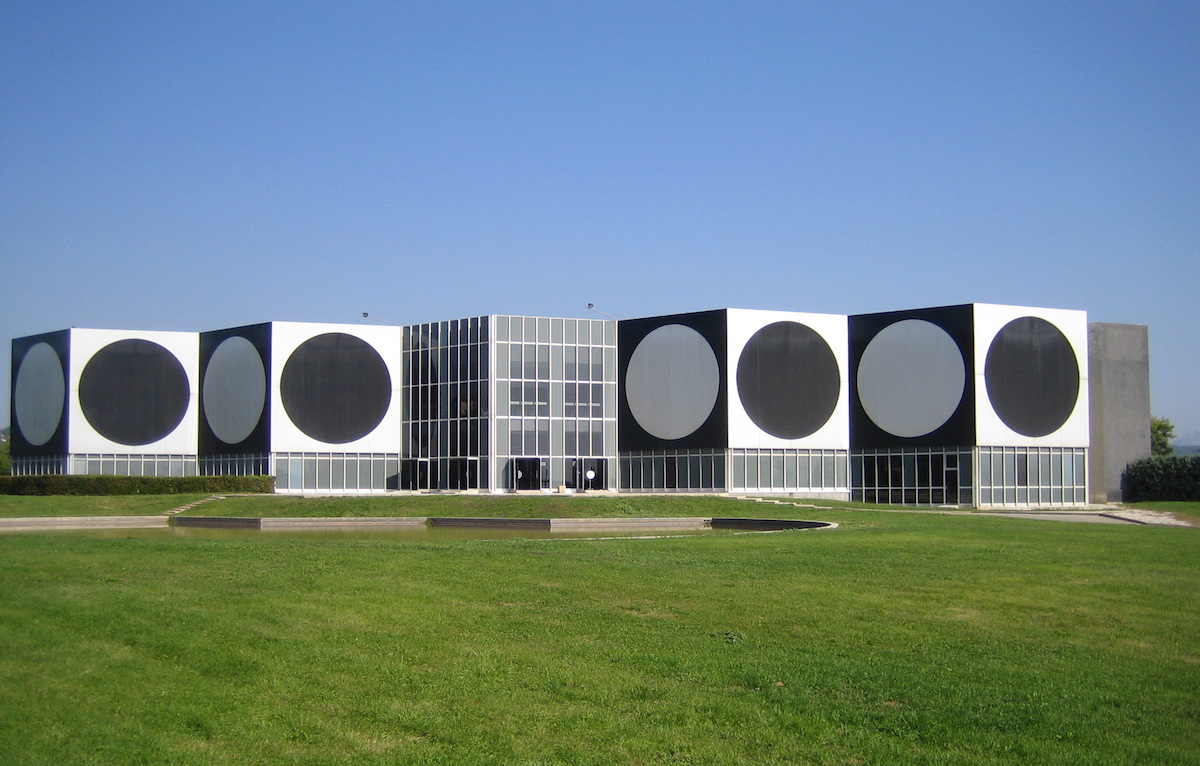
The Victor Vasarely Foundation in Aix-en-Provence has struggled for years to maintain the Op Art landmark. This year, the building turns fifty, and the anniversary finds it in a complicated state: partially restored, financially stretched, and calmly determined to survive.
From the road into Aix-en-Provence, the building is impossible to miss. That concertinaed façade circles within squares, black and white, harshly geometric, announcing itself on the hillside with confidence. Which is more or less what it was.
The foundation was established by Victor Vasarely in 1966, with construction of the building beginning in 1973 and its inauguration, broadcast on national television, in February 1976. It was conceived as a centre for his belief in “art for all”, democratic, collective, scaled to match the ambition of the idea. Forty-two monumental works, each up to eight by six metres, are housed across seven double-height cells. One of the first artist-founded foundations in Europe. A building that was, for a moment, celebrated internationally.
What followed was a slow decimation. Local political disputes, inheritance complications, and the slow withdrawal of state funding left the building deteriorating quietly for years. When Vasarely fell ill in the 1980s, his sons couldn’t take on the building, and it passed into the care of a local law school director. After Vasarely died in 1997, legal disputes over works held by the foundation became entangled with a still-ongoing conflict involving the second wife of one of his sons. The building that had been inaugurated on national television was leaking through its roof.
It wasn’t until Pierre Vasarely, the artist’s grandson, became chief executive in 2009 that the situation began to stabilise. What he found was not encouraging. “Nothing had been maintained,” he says. “There was no heating, no air-conditioning. The roof leaked.” Before anyone could touch the art, the building itself needed saving first. External cladding, fourteen pyramidal skylights, climate control systems — all of it required before conservators could get near the monumental wall pieces.
The historic monument listing in 2013 unlocked government support, and an €12 million restoration budget followed, with 85% funded by various levels of government and the foundation covering the remaining 15%. That covered the building. The art is a slower, more expensive project. Of the forty-two monumental works and two sculptures, roughly half have now been restored. Each one costs between €100,000 and €120,000. Twenty remain. The foundation is a private non-profit, accustomed, as Pierre puts it, to getting by on its own strength, but the maths of large-scale conservation don’t bend to goodwill alone.
A year ago, the foundation auctioned works to raise funds, a decision that reflects how tight things had become. State funding, administrator Caroline Vasarely explained at the time, had largely dried up since 2019. “The longer we wait, the more difficult it will become to remedy the damage.” That much is true of any building of this complexity left without adequate resources.
2026, the foundation is hoping, changes the picture. The 120th anniversary of Victor Vasarely’s birth coincides with the building’s own fiftieth, and a major exhibition of his work runs from 12 June to 1 November. Visitor numbers, which reached 102,000 before the pandemic, haven’t yet returned to that level, but there’s a reasonable case for optimism. The recent opening of Cézanne’s family home nearby as a heritage centre should draw additional visitors to the area and, in Pierre’s view, reposition the foundation within a broader cultural itinerary. His grandfather would have appreciated the connection. When the building’s cornerstone was laid in 1973, Vasarely buried a message inside it. It read: “From Cézanne to Vasarely: we will be worthy.”
Whether 2026 delivers on that ambition remains to be seen. But the building is still standing, the art is being restored panel by panel, and the family is still fighting for it. After everything the foundation has been through, that counts for something.
Victor Vasarely
Victor Vasarely: The Artist Who Tricks Your Eyes
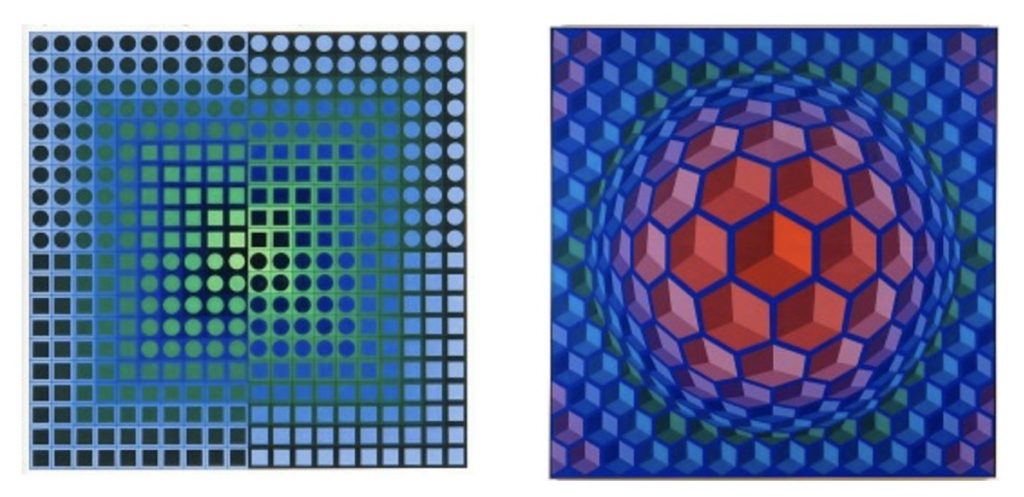
There’s a moment in every Vasarely you encounter when the surface refuses to stay still. Shapes bulge, grids warp. Flat canvas insists it has depth. That optical restlessness didn’t arrive fully formed; it was the product of decades of thinking, working, and living across borders and disciplines before it found its defining language.
Victor Vasarely was born in Pécs, Hungary, in 1906. He studied medicine in Budapest, which he abandoned after two years. The scientific temperament stayed. The commitment to method, to objectivity, to understanding how things actually work rather than how they feel, ran through everything that followed.
In 1929, he enrolled at the Muhely in Budapest, the school Alexander Bortnyik had modelled directly on the Bauhaus in Dessau. Gropius, Kandinsky, Klee, and Albers were the reference points, and their influence proved lasting. It was here that Vasarely first encountered abstract art and constructivism, producing his early Etude bleue and Etude verte, and beginning to articulate something that would preoccupy him for the rest of his career: the idea that art should be less individualistic, more collective, adapted to the modern industrial world rather than retreating from it.
Hungary in the early thirties was becoming inhospitable to avant-garde thinking. Pressure from the government pushed numerous artists toward association with progressive political movements, and like several of his contemporaries, Vasarely left. He arrived in Paris in 1930 and took work as a designer, first at the Havas advertising agency, then at the printer Draeger’s, and later at Dewambez. Commercial work. But he approached it as a plastic artist and mined it accordingly.
This graphic period, running from roughly 1929 to 1946, was when the foundations were laid. Lines that don’t define shapes but emerge from deformed grids. Juxtaposed contrasts that create their own spatial tension. Zèbres from 1938, L’Échiquier from 1935, Fille-fleur from 1934 — two-dimensional works that already had one foot in the optical experiments to come. He described this period later as establishing “the basic repertoire of my abstract kinetic period.” He knew, retrospectively at least, exactly what he had been doing.
Between 1935 and 1947, he went sideways, by his own account. He called it a period of “false routes” — drawn toward cubism and surrealism, making figurative work, still lifes, portraits and landscapes. Autoportrait from 1941, L’Aveugle from 1946. Not bad work, but not quite his work. Even here, though, there’s a drift toward simplification and schematisation that points forward.
From the 1960s onward, the fully realised Vasarely emerges. His Hommage à l’Hexagone series, running from 1964 to 1976, plays with cell structures and relief — surfaces that read as hollow, then prominent, then hollow again — ambiguity multiplied by coloured lines that create what he called a “trompe l’oeil perpetuum mobile.” The eye cannot resolve it. That’s the point.
In 1965, he was included in The Responsive Eye at MoMA in New York, the exhibition that effectively named and legitimised Optical Art as a movement. The premise was movement suggested rather than actual, a new contract between artwork and viewer that demanded active participation rather than passive reception. The press did what the press does and christened Vasarely the inventor of Op Art. The label stuck, not entirely fairly to the others involved, but not entirely wrongly either.
He was, and remains, something genuinely unusual — an artist whose commitment to collective, democratic, socially accessible art. Someone who backed that commitment with a visual language so precise and so disorienting that it still stops people cold in gallery doorways, fifty years on, wondering what their eyes are doing.
Top Photo courtesy Victor Vasarely Foundation