
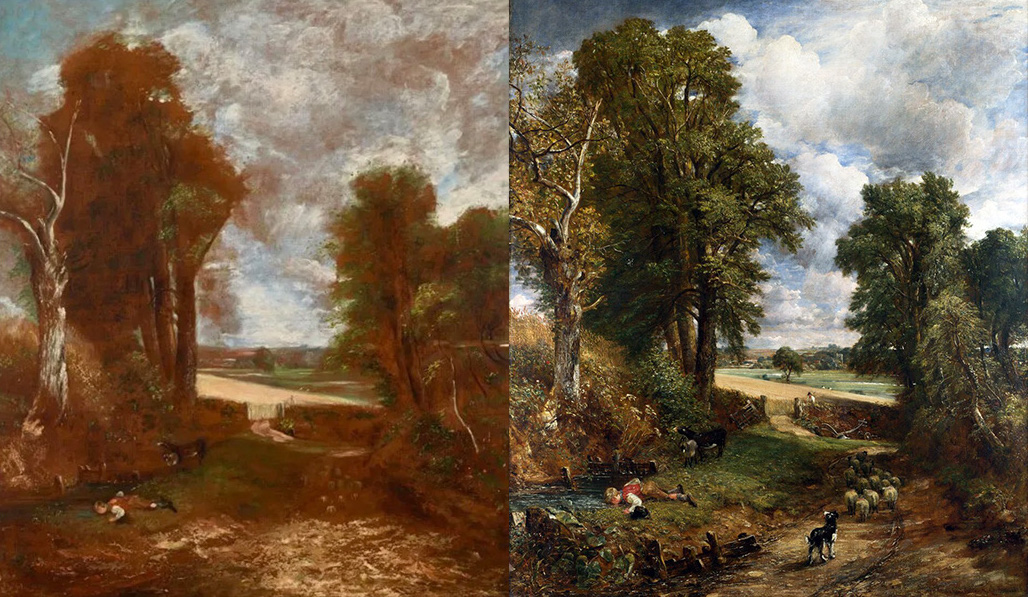
A large-scale oil study for John Constable’s The Cornfield, the largest known to exist, has been languishing in a small historical museum in Jefferson, Texas, for decades. Unrecognised, miscatalogued as one of scores of known copies, gathering the particular kind of obscurity that only a rural American institution can provide. It will now lead Heritage Auctions’ European Art sale in Dallas on 5 June.
The Jefferson Historical Society and Museum acquired the work in the late 1960s from Newhouse Galleries, then based in New York, as a gesture of support for the fledgling institution. For the best part of fifty years, it was considered a copy of one of approximately 85 known versions of the scene set in Fen Lane, Suffolk. It took Marianne Berardi, co-director of European art at Heritage Auctions, visiting in 2017 to facilitate a separate sale, to suspect otherwise. The painting perplexed her. In 2023, the Historical Society funded a proper investigation.
Constable specialists Anne Lyles and conservator Sarah Cove were brought in. What followed was a full technical examination, including cleaning tests, pigment analysis, infrared reflectography and the results were unambiguous—complete consistency with Constable’s materials and working methods. A sensitive restoration followed, and then further study. The conclusions are significant.
At 55 by 48 inches, this is the largest known study for The Cornfield. The existing scholarly narrative had a gap. The assumption, repeated by previous historians, was that Constable moved directly from small preliminary works to the finished painting. This leap always seemed difficult to account for, given how resolved the final canvas is. That assumption is now wrong. “Previous commentators have talked at length about how Constable leapt from the small, preliminary works for The Cornfield directly to the finished painting,” Cove noted. “Since the rediscovery of the full-size sketch, we now know that it is incorrect.”
More than that, Cove observed that Constable laid out the sketch in a single sitting and then returned to rework it at least once later. You can see him thinking. “We see his thought processes actually taking place,” she said. That’s precisely what full-scale studies were for in his practice, not decorative exercises but working documents, the equivalent of reference photographs for an artist whose visual memory was, by his own admission, unreliable.
The dating is educated guesswork. Lyles places the initial work around 1820, based on collected data, including cove notes, similarities in handling with The Leaping Horse from 1825, suggesting that Constable may have returned to this canvas in early 1826 while reworking it after it came back from the Royal Academy. The chronology is plausible but not settled. These things rarely are.
As for how it ended up at Newhouse in the first place, the most likely route is through the Foster and Co. studio sale held the year after Constable died in 1837, the sale that first made his studies available to the public, most of whom had never seen them and few of whom particularly wanted them at the time. The Foster ledger lists “The Corn Field; a study from nature, for the picture in the National Gallery.” Whether that entry refers to this canvas is one of the questions that will keep scholars occupied for a while.
John Constable’s The Cornfield at the National Gallery, London, is often seen as his greatest painting. Having been completed in 1826, it depicts a Suffolk lane in high summer, the light thick and golden, a boy face-down at a pool drinking while his flock wanders, and a dog keeps a sceptical eye on proceedings. The lane is Fen Lane, a route Constable walked every day as a schoolboy, which conveys the feeling of a specific time and place. The church tower visible in the distance doesn’t exist. He put it in because the horizon needed it. The red poppies, the precisely observed botanical detail in the foreground, he called “eye-salve,” added quite deliberately to make the painting more appealing to buyers who wanted beauty tidied up and made comfortable. He knew his market. He was trying to sell a painting.
It didn’t work. Not in his lifetime. The Cornfield was exhibited five times and came back to the studio five times. One of his most polished, most considered works, and yet it was unsaleable. Constable died in 1837, still in possession of it. Posthumously, a group of admirers pooled their money, bought the painting from his estate, and donated it to the National Gallery. The first Constable to enter the national collection arrived as an act of collective appreciation rather than a commercial transaction. Something about that feels fitting, given how little the market valued it while he was alive.
The irony runs deeper when you consider what The Cornfield represents historically. This is the moment, or one of them, when landscape painting stopped being scenery and became the subject. Before Constable and Turner, landscape was backdrop, the setting in which historical figures and mythological dramas played out. After them, the field, the sky, the particular quality of light on a Suffolk afternoon, these were the points. The Cornfield sits at that hinge—the towering elms, the haze over the wheat, the almost physical sensation of heat. Constable wasn’t painting a place so much as painting his relationship to it. Something close to devotional, if that’s not too strong a word.
The eye-salve, incidentally, is worth a proper look. The botanical detail in the foreground is specific enough that scholars have identified individual species. Constable knew exactly what was growing along that lane. The “sellable” details turn out to be among the most rigorously observed things in the painting.
The study is on view at Heritage Auctions in London from 27 March to 2 April, before travelling to Dallas for the sale on 5 June.