

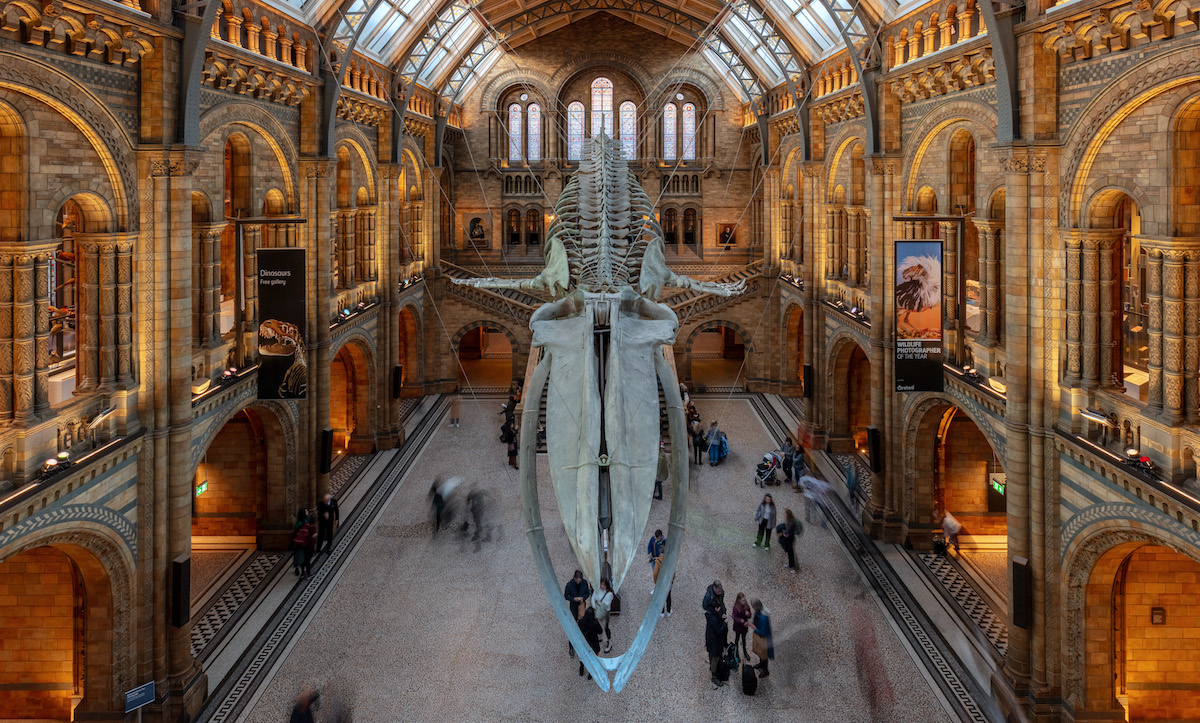
The Natural History Museum has topped the UK’s visitor attractions chart for the first time, drawing more than 7.1 million people through its doors in 2025, a 13% increase on the previous year and the highest number ever recorded by any museum or gallery in a single year. The South Kensington institution takes the number one spot from the British Museum, which had held it for the previous two years.
Over four million people saw a National Gallery painting in person in 2025 – wherever they were on display. 4,213,845 visits were made in person in 2025 to the National Gallery, London, and to its exhibitions, displays and other creative programmes on tour. 4,147,544 visits were made to the National Gallery’s Trafalgar Square site in London during 2025 (that is an increase of 29% on the 2024 figure of 3,203,451) Following its Bicentenary in 2024 the Gallery benefited from the opening of the newly transformed Sainsbury Wing – restoring the 30% visitor capacity that had been lost during its temporary closure for renovation – and the opening of CC Land: The Wonder of Art, the biggest-ever rehang of the Gallery’s collection (both from 10 May 2025).
The figures come from the Association of Leading Visitor Attractions, whose annual survey covers 409 sites across the UK. Total visits across all ALVA sites reached 165 million in 2025, up 2% on the previous year but still below the 170 million recorded in 2019, before the pandemic reshaped how and whether people moved around. Recovery, then, but not quite full recovery.
The top five reads as a fairly predictable celebration of London’s institutional dominance: the Natural History Museum, the British Museum, Windsor Great Park, Tate Modern and the National Gallery. What’s more interesting is what the numbers say about why people are showing up and what’s driving the increases.
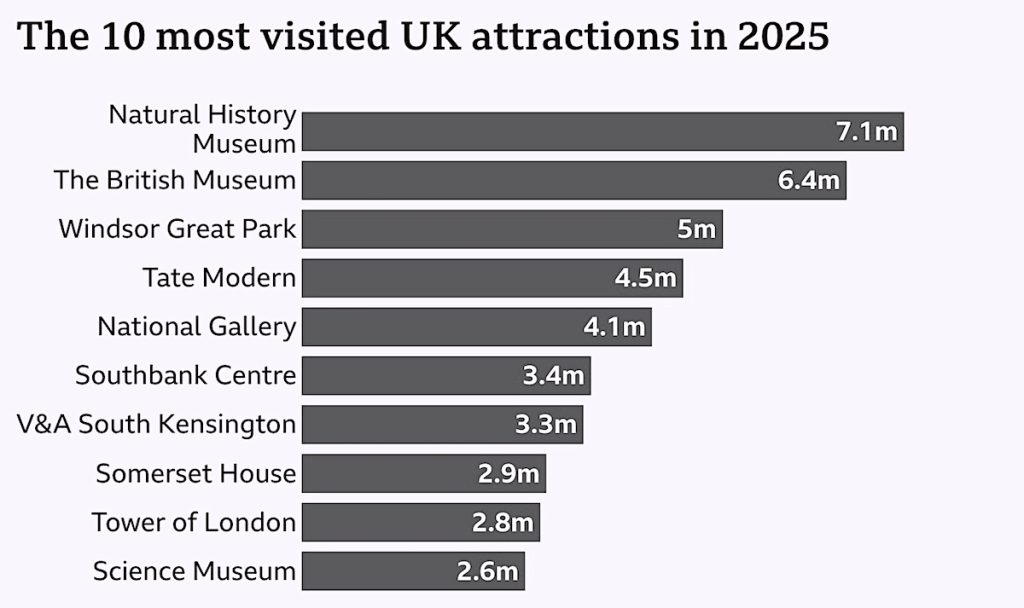
At the Natural History Museum, director Dr Doug Gurr described the team as “thrilled”, which is the word directors use in these situations, but the scale of the number genuinely justifies it. 7.1 million visitors is not a marginal improvement. It represents a sustained, significant increase in public appetite for what the museum offers, at a moment when household budgets are under real pressure. That people are choosing to spend their leisure time and their leisure money here, in these numbers, says something.
Bernard Donoghue, ALVA’s director, put it plainly. “In a time of unpredictable futures, uncertain economics, global insecurities and an ongoing cost-of-living crisis, the UK public is more tactical than ever in deciding how they spend their leisure pounds and their leisure hours.” Visitor attractions, he argued, are what people give up last. The data bear that out, even with overall visits still below pre-COVID levels, demand for the right experience at the right institution remains robust.
The British Museum will be watching its own chart position with interest. It drops to second this year but has an unusually strong card to play in 2026: the Bayeux Tapestry arrives from Normandy in September, the first time it will have left France since it was made, and the queues are likely to be extraordinary. If any single exhibition can dramatically move the annual numbers, it’s that one.
Elsewhere in the top twenty, the Royal Albert Hall, Westminster Abbey, the Barbican and the National Portrait Gallery all attracted more than 1.5 million visitors. The Houses of Parliament saw a 47% increase, reaching 823,000, a striking jump, presumably reflecting a particular public appetite for institutions right now, not all of it entirely comfortable. The Royal Academy had its strongest Summer Exhibition since before the pandemic, with visitor numbers up 20% to 740,000.
The reopening of the Sainsbury Wing at the National Gallery drove notable increases in attendance there, demonstrating again what the sector has always known: capital investment and significant exhibitions move the needle more reliably than almost anything else. At the country-house end of the spectrum, Halloween and Christmas programming drove increases at Chatsworth, Kenwood House and Blenheim Palace, which is a different kind of cultural offering but one that clearly works.
New entries included the V&A East Storehouse, which ranked 107th after drawing 416,000 visitors in less than seven months of operation — exceeding its first-year targets and suggesting the Stratford outpost has found its audience faster than even its most optimistic supporters anticipated.
Outside London, Scotland recorded a 2.6% increase across its typical attractions, with Edinburgh Castle among the venues that drew more than 2 million visitors. Wales was up a more modest 0.9%. Among English regions outside the capital, the North West saw the strongest year-on-year growth at 11.3%, followed by the East Midlands at 7.5%.
The broader picture is one of a sector that has largely recovered its confidence and audience, even if overall visitor numbers haven’t quite returned to their pre-2020 levels. The Natural History Museum’s record is genuinely impressive and reflects something real — a public that, despite everything, keeps coming back to these buildings, these collections, these experiences. Whether it’s a family in front of a blue whale skeleton or a queue stretching down Exhibition Road for a blockbuster show, the appetite is clearly there.
Several significant openings and loans are lined up for 2026, and the sector is cautiously optimistic that visitor numbers will reflect that. The British Museum’s loan of the Bayeux Tapestry alone could be transformative. Add the full opening of V&A East, the new London Museum and the Museum of Youth Culture, and there’s a reasonable case that this year outperforms the last.