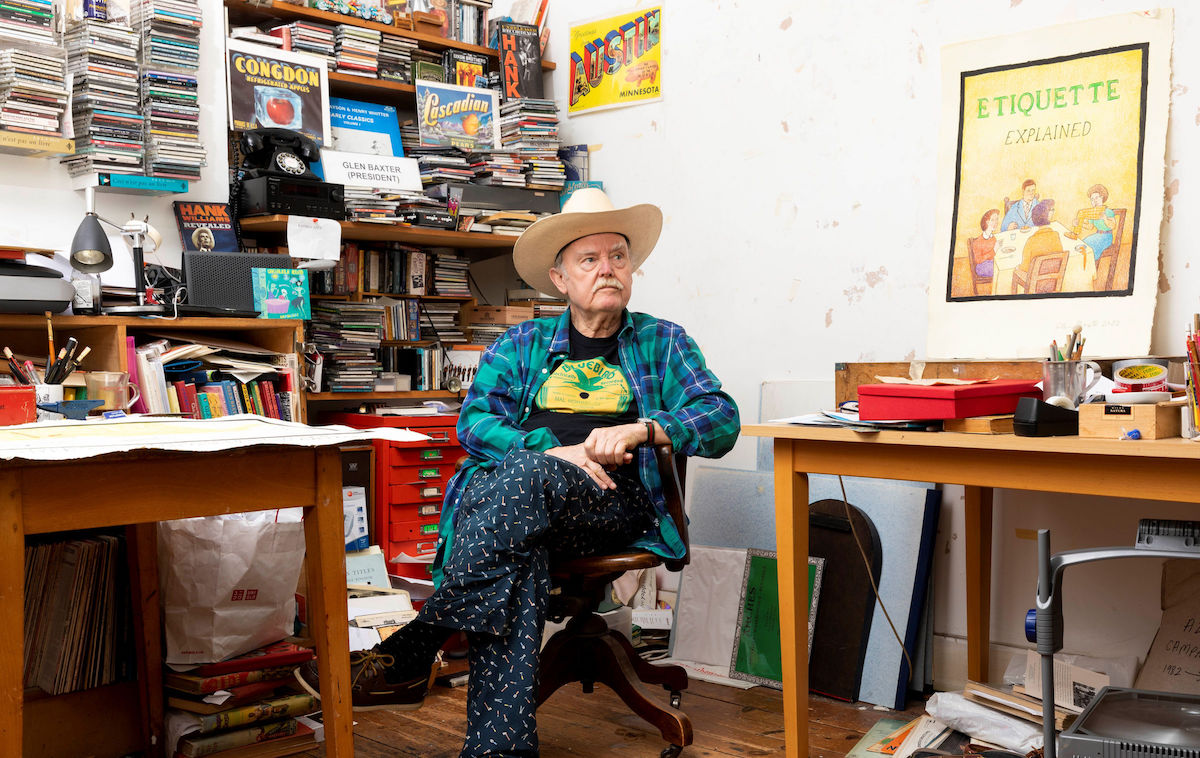
Glen Baxter, the Leeds-born artist whose deadpan ink drawings made absurdism look easy and pretension look ridiculous, has died. He was one of those rare figures who managed to make serious art out of the refusal to be serious, and in doing so built a body of work that influenced everyone from Edward Gorey to Salman Rushdie, while remaining cheerfully impossible to categorise.
Born in 1944, Baxter grew up shuttling between the cinema and the public library, filling his head with Marx Brothers films and Biggles adventure books. The latter, written by the self-styled Captain W.E. Johns, captivated him less for its plots than for its vocabulary. Johns had a habit of writing for children in language no child would naturally use: his characters never “said” anything, they “opined” or “blurted.” The fact that Johns had also invented his own military rank struck the young Baxter as magnificently fraudulent. Both of these qualities would eventually find their way directly into his art.
Glen Baxter
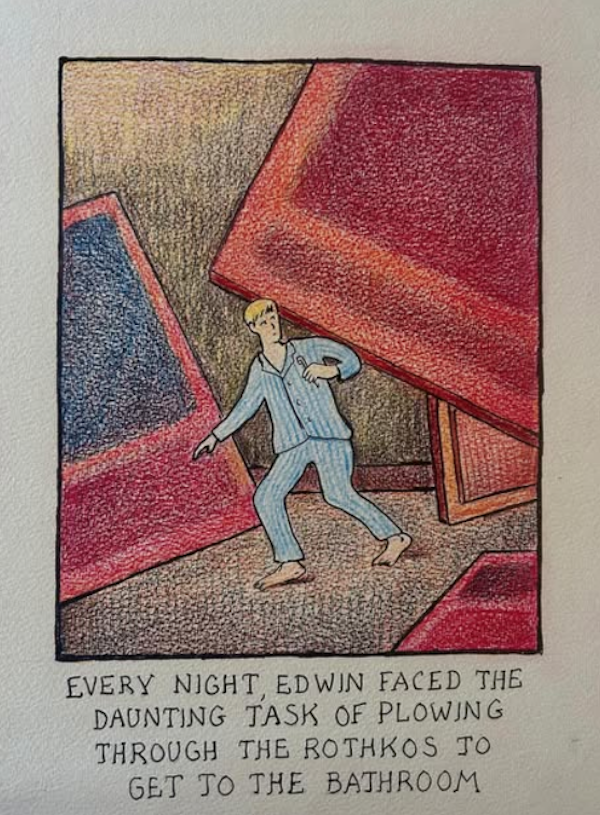
He arrived at Leeds College of Art in 1960 to find it dominated by students painting large abstract canvases in the manner of Rothko or de Kooning. As a lifelong devotee of the Marx Brothers, he found their seriousness faintly absurd. When tutors told him to stop making figurative drawings and stop being silly, he responded in the only way that made sense to him: he carried on. Taking his lead from André Breton, Alfred Jarry and Harpo Marx in roughly equal measure, he developed a position that treated the art world’s solemnity as its own best punchline.
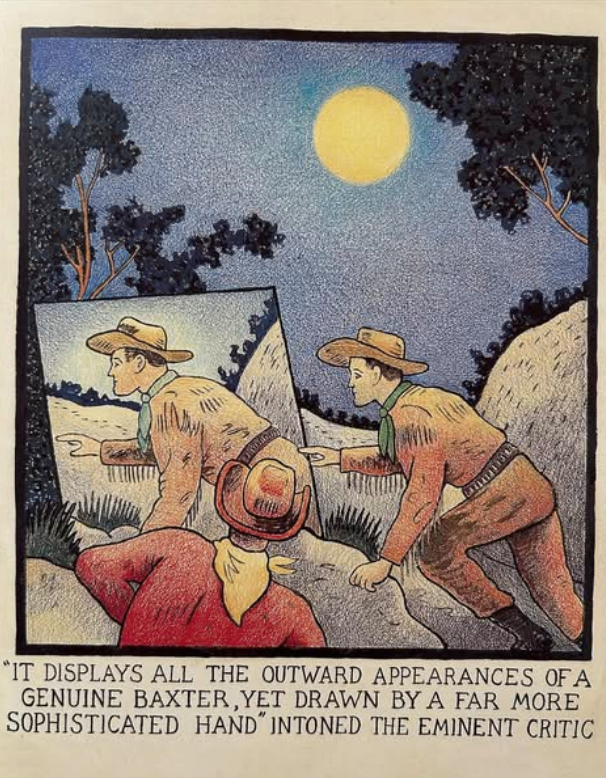
His mature work took the form of a deceptively simple template: a crisp ink drawing, often hand-coloured in crayon, paired with a caption that bore no logical relationship to what was depicted above it. Cowboys debated the merits of abstract painting in the Wild West. Gentlemen in tweed discussed matters of cultural importance in increasingly improbable settings. The language, lifted wholesale from the overwrought register of boys’ adventure fiction, collided with the imagery to produce something that functioned as both art criticism and comedy, without quite being either. John Ashbery traced Baxter’s lineage back through Lewis Carroll, Raymond Roussel and the Comte de Lautréamont. Baxter himself tended to smile and change the subject.
After graduating, he moved to Leytonstone, largely because it was Alfred Hitchcock’s birthplace, and took a job teaching football and pottery at a local school. In his spare time, he haunted Better Books on the Charing Cross Road, the independent bookshop that served as a gathering point for London’s counterculture in the late 1960s. There he fell in with The People Show, an alternative theatre group, and performed as Inspector Baxter at the Edinburgh Festival in 1968. It was also around this time that his poetry attracted the attention of Larry Fagin in New York, who published him in Adventures in Poetry and eventually invited him to read at The Poetry Project at St Mark’s Church in the East Village. New York in the early 1970s, Baxter later said, felt like putting your finger into an electric socket.
He stayed in Greenwich Village, performed in ‘full tweed’ at St Mark’s to considerable effect, and came away permanently altered. The poets he encountered there, for whom words were everything and money was largely irrelevant, shaped his understanding of what language could do when stripped of its ordinary function and reassembled without instructions. When he returned to London, his poems had begun to contract, becoming denser and more imagelike, until they resembled captions more than verses. A Dutch publisher, Jaco Groot of De Harmonie in Amsterdam, spotted his work in a poetry magazine and tracked him down. The result was Baxter’s first book, Atlas, published in 1979 in black and white because colour was too expensive.
Glen Baxter
Read More
His exhibition at the ICA that same year, installed in the corridor between the bar and the toilets, attracted rave notices in the Times and the Guardian, bringing him to the attention of a wider audience. From there, his career expanded steadily. He contributed to The New Yorker, Vanity Fair, Vogue, and Elle, sent drawings to editors by fax with evident delight, published numerous books, and exhibited across New York, Paris, London, Tokyo, San Francisco, and Sydney. In 1999, the French government commissioned him to design a tapestry. His work entered the collections of the Tate and the Victoria and Albert Museum. He held a part-time lectureship in fine art at Goldsmiths from 1974 to 1986.
Throughout all of this, his drawing style barely changed. The cowboys kept appearing. The vocabulary of Biggles persisted. Characters continued to blurt rather than speak. He remained genuinely uninterested in being thought of as a comedian, insisting he was an artist whose subject matter happened to be funny. The distinction mattered to him. What he was actually doing, as the poet Ashbery understood, was asking serious questions about aesthetic value, cultural authority, and the social structures that underpin taste, using humour as the most efficient instrument available for the purpose.
He is survived by his wife Carole, whom he met while teaching in Islington in 1970 and who encouraged him throughout his career. He once nearly knocked a journalist over with two bin bags outside his house in Camberwell and accused her of not ringing the doorbell. When she rang it again to prove she had, he seemed satisfied. It was, in its way, a perfectly Baxterian encounter.
Top Photo Courtesy Flowers Gallery all rights reserved