
Two paintings by Claude Monet that have been held in private collections for more than a hundred years are to appear at auction in Paris this April, offering collectors a rare opportunity to bid on works that have been effectively invisible to the art world for generations.
The first, Les Îles de Port-Villez, painted in 1883, will be offered at Sotheby’s Modern and Contemporary Sale on 16 April with an estimate of €3 million to €5 million. (
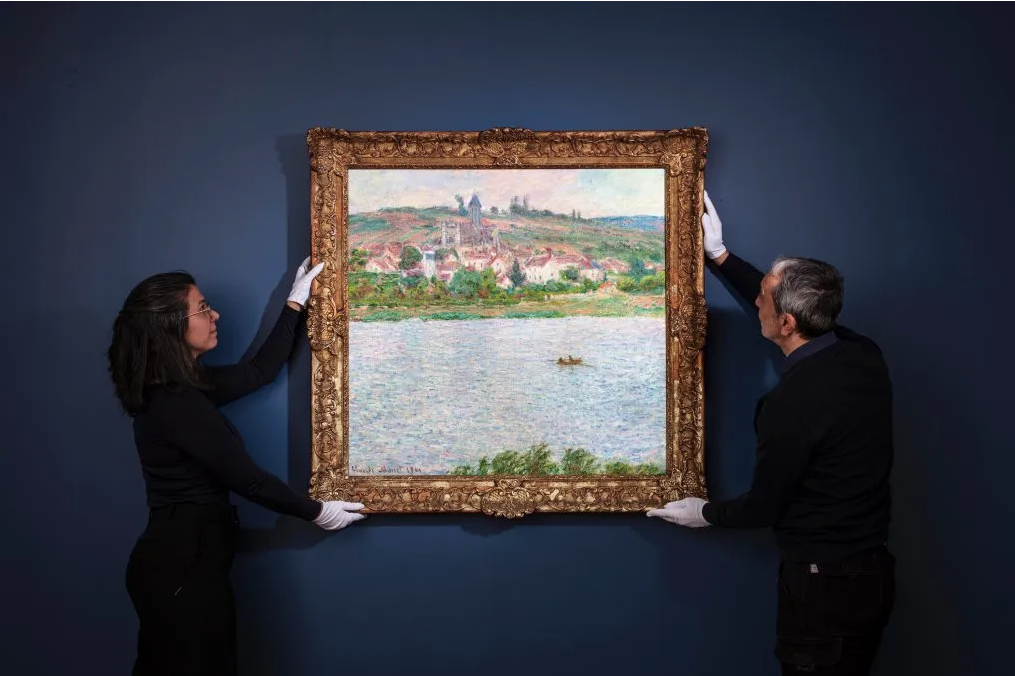
Update: Claude Monet, Les Îles de Port-Villez (c. 1883). Achieved on April 16 at Sotheby’s Paris after being sequestered in a private collection for the past 115 years. The lot smashed its presale estimate of €3 million to €5 million ($3.5 million to $5.8 million), bringing in €6.5 million ($7.6 million).) The second, Vétheuil, Effet du Matin, dating to around 1901 and carrying an estimate of €6 million to €8 million, emerged after news of the first consignment circulated through French collecting networks in January, prompting its owners to bring it forward.
“Thomas Bompard, co-head of modern and contemporary art at Sotheby’s Paris, describes them as the most valuable Monet paintings to appear at auction in France since 2001.”
Les Îles de Port-Villez was painted in the same year Monet moved to Giverny, the village on the Seine where he would live and work for the final four decades of his life. The painting depicts the densely wooded islands that sat in the river directly across from his new home, a subject he returned to on roughly half a dozen occasions during this period. The work was made from a specially adapted studio boat that Monet used to move freely on the water, choosing his own vantage points rather than painting from the bank. The result is a composition built on energetic, generous brushwork, the billowing mass of the island and its reflection rendered in greens and blues, while the sky above is treated almost as an afterthought.
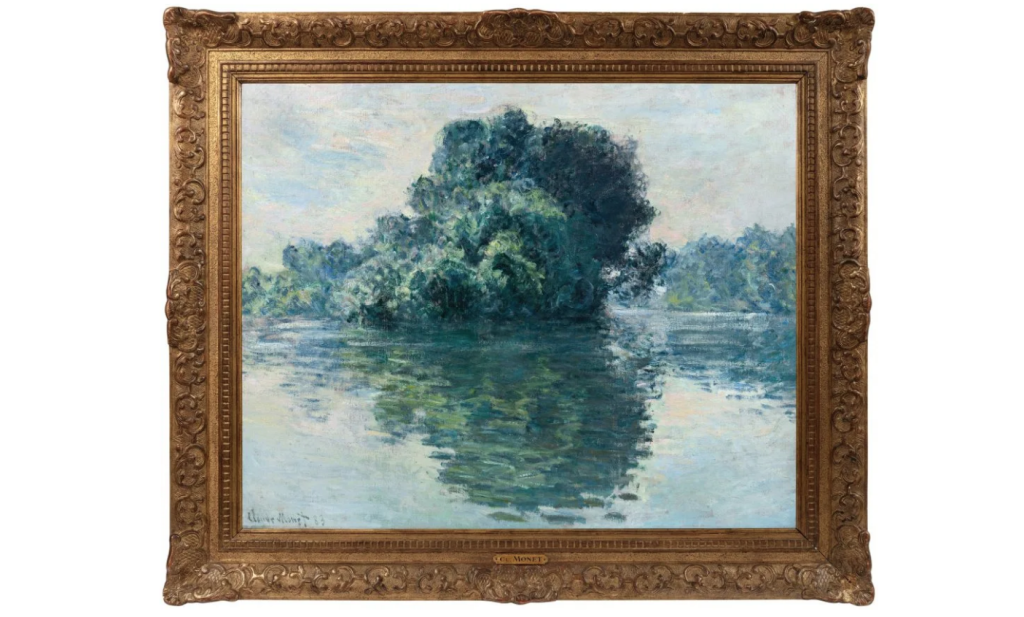
Claude Monet, Les Îles de Port-Villez (c. 1883). Photo courtesy Sotheby’s Paris.
Until now, the painting has been known only through a black-and-white photograph taken in the 1950s. Its last confirmed public appearance was on the walls of Paul Durand-Ruel’s gallery on Fifth Avenue in New York in the early twentieth century. Durand-Ruel was among Monet’s earliest and most committed supporters, an advocate who lent the painter 20,000 francs to purchase his house at Giverny in 1890. After that, the gallery that showed the picture passed into private hands and remained there.
Bompard sees the Port-Villez paintings as a pivotal moment in Monet’s development. “Monet is like an explorer arriving in a new world and using his boat to be as free as possible,” he said. “He’s saying: ‘I am going to choose the part of the landscape that I want to paint, not the part that nature or some Impressionist code chooses.’ He really becomes the master of his aesthetic.” In terms of colour, technique and the intensity of observation, Bompard regards this period as anticipating Monet’s later obsession with the water lily paintings that would occupy the last years of his life.
Vétheuil, Effet du Matin tells a very different story about the same stretch of river, painted eighteen years later from a position some distance downstream. By 1901, Monet’s circumstances had changed considerably. He was famous, financially secure, and no longer dependent on a studio boat. He had acquired a Panhard and Levassor motor car, then among the fastest vehicles available, which allowed him to travel further and work across a wider area. That summer, he rented a house at Lavacourt, on the opposite bank from the village of Vétheuil, and found a high vantage point above the Seine, painting the river scene throughout the warm months.
The approach is quite different from the directness of the Port-Villez work. At Lavacourt, Monet worked on multiple canvases simultaneously, returning to each as the light shifted in quality. Vétheuil, Effet du Matin, is the second in a series of fifteen paintings made from the same position. The compositions from this period are more expansive than those of the 1880s, taking in broader sweeps of sky, farmland, and water, with enough detail that a boatman’s oars and the village gardens are legible within the atmospheric whole. Bompard describes it as having “the right balance between an atmospheric feeling and details,” a painting far enough into the series to be settled in its purpose but not yet pushed toward the looser, more abstracted quality of the later works.
Most of Monet’s Port-Villez paintings from the 1880s are held in museum collections and rarely come to market, which makes the April appearance of Les Îles de Port-Villez particularly unusual. As Bompard put it, “For a collector to be able to bid on a great Monet which is in perfect condition and has not been seen for a century, it almost doesn’t exist anymore.”
The auction record for a Monet remains the $111 million paid for the haystack painting Meules at Sotheby’s New York in 2019.