Due to ongoing restrictions imposed by the Lee Miller Archives, image reproduction, including news reporting and art criticism, can only be viewed HERE
A scrapbook assembled by a man named Roland Haupt, photographic assistant to Lee Miller and Cecil Beaton during the Second World War, has been discovered after languishing in a drawer for over 80 years. Previously unseen prints of some of the most significant photographs of the twentieth century, alongside images nobody knew existed at all. The Bodleian Libraries at the University of Oxford have now acquired it from the art dealer Michael Hoppen.
Haupt started the album in 1943. He was, by any measure, one of the most trusted figures in the orbit of both photographers, the person to whom Miller would send her exposed film from the front, via army courier, for processing and printing in his small darkroom in London, before forwarding the results to Vogue. The required trust is considerable. Anyone who has worked in a darkroom knows the anxiety of that moment when the lights come on, and you see whether the film has survived processing intact. Miller was shooting on 120-format, which is notably less forgiving than 35mm. She was sending rolls from Normandy, from Germany, from the concentration camps. Haupt processed them, printed them, and sent them on. He also, it now emerges, kept some of the earliest prints for himself.
The result is what dealer Michael Hoppen has described as “an empirical time capsule” of the war’s final years. That phrase is precise. This isn’t a curated archive or a retrospective selection. It’s a daybook, haphazard, personal, populated with the kind of accumulation that a working assistant makes when they’re at the centre of history and they know it. Newspaper cuttings of the day showing Miller and Beaton’s images in print. Mixed portraits. Theatre sets. And interspersed among all of it are some of the most significant photographs of the period.
The album begins with Haupt’s own introduction, brief and quietly moving: “This is the story of my favourite photographer, Lee Miller — Vogue war correspondent who followed the American army from the beaches of Normandy, five days after D-Day, up to the final entry into Berlin and after that she continued her journey visiting countries that had been occupied, having many exciting experiences here are a few of the beautiful pictures she sent back.”
There is an unpublished photograph of Miller in Hitler’s bathtub taken by her partner, David Scherman, who, in turn, photographed her in the same bath. Miller’s son has described it as his mother’s way of “sticking two fingers up at Hitler,” which is one way of putting it. The image has become one of the most reproduced photographs of the war. This previously unpublished version adds another layer.
Around it in the album are photographs that are harder to look at. Hitler’s bedroom, with the bed unmade, Miller had slept in it. His living room and desk. Ordinary objects in ordinary rooms, which produce, as the album’s notes observe, “a chilling and unsettling realisation when one realises whose home we are looking at.” Miller herself wrote about the experience of moving through Hitler’s house: “Hitler had never really been alive for me until today. He’d been an evil-machine-monster all these years, until I bathed, ate and slept in his house. He became less fabulous and therefore more terrible.” That last phrase, less fabulous and therefore more terrible, is the kind of observation that takes a moment to settle, and then won’t leave you.
The album contains photographs from Dachau and Buchenwald. Firing squads. Scenes of grief around the camps. An image of two young SS guards, captured, beaten and tied in the back of a van, staring directly into Miller’s lens. Her writing about those guards was brief and offhand; she described it as difficult to put into words. She wrote instead about justice and vengeance, and about how to go on living in the world with full knowledge of what people do to each other.
What makes this album particularly noteworthy, beyond the historical weight of its contents, is its juxtaposition. Fashion photographs by Miller showing models resting during a shoot sit alongside war photographs, and the album’s description notes that they are easily mistaken for images of bodies at first glance. This is not accidental. It reflects Miller’s own understanding of what photography could do, the way the same formal language can carry fashion and atrocity, beauty and horror, without resolving the tension between them.
Cecil Beaton’s contribution to the album tells a different story. He was stationed in North Africa, and his photographs from that period show a more restrained, compositionally measured approach to abstract studies of war’s detritus in the desert landscape, which he described as surreal. There is no European horror here. Beaton was recording something different: endurance, physical extremity, the strange beauty of a landscape being destroyed. His pictures from North Africa are among his least-known yet best works
Scattered through the later pages are portraits of the world those photographers moved through: Picasso, Marlene Dietrich, Fred Astaire, Noël Coward, Mervyn Peake, Bob Hope, Margaret Bourke-White. A world connected by art, politics, theatre and the particular intimacy of people living through history together.
There is also, startlingly, an extraordinary print of a semi-naked Miller with a plaster cast of her torso, possibly made by her husband, Roland Penrose, upended over her head. Penrose had photographed the casting process, in keeping with their shared engagement with the Surrealist movement in Paris before the war. That this image sits in the same volume as the Dachau photographs says something about the range of the life Miller was living.
Hoppen is right that knowing Miller trusted Haupt with her film, “knowing what she had in the can”, changes how you read the relationship. He was not a peripheral figure. He was the person through whom some of the most important images of the century were passed on to the world. That he kept these prints, assembled this album, and that it survived intact in private hands for eighty years is the kind of story that makes you glad someone, somewhere, couldn’t bring themselves to throw things away.
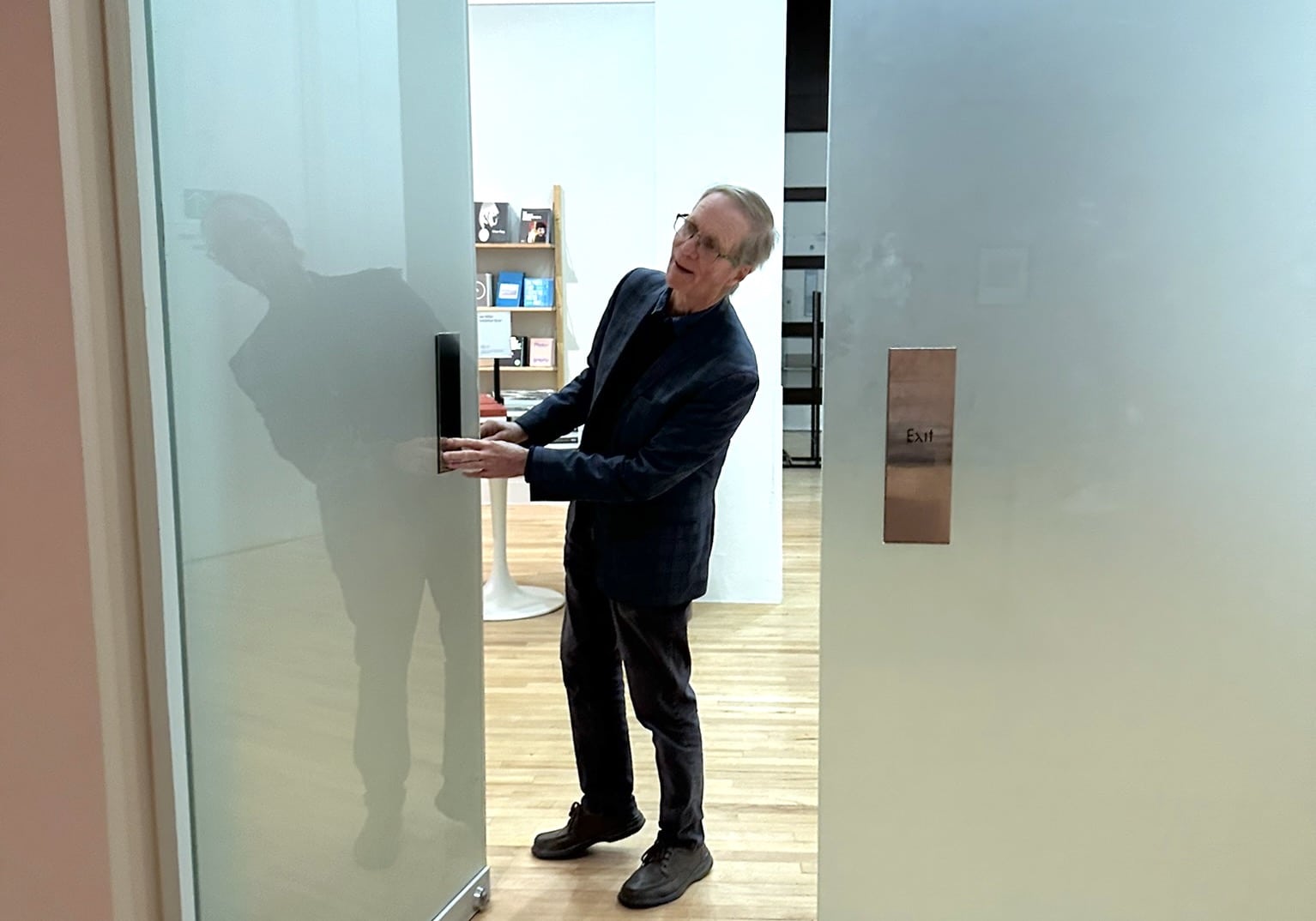
Top Photo: Antony Penrose © Artlyst 2026
The Bodleian Libraries’ acquisition ensures this rare time capsule will remain in the public domain.