
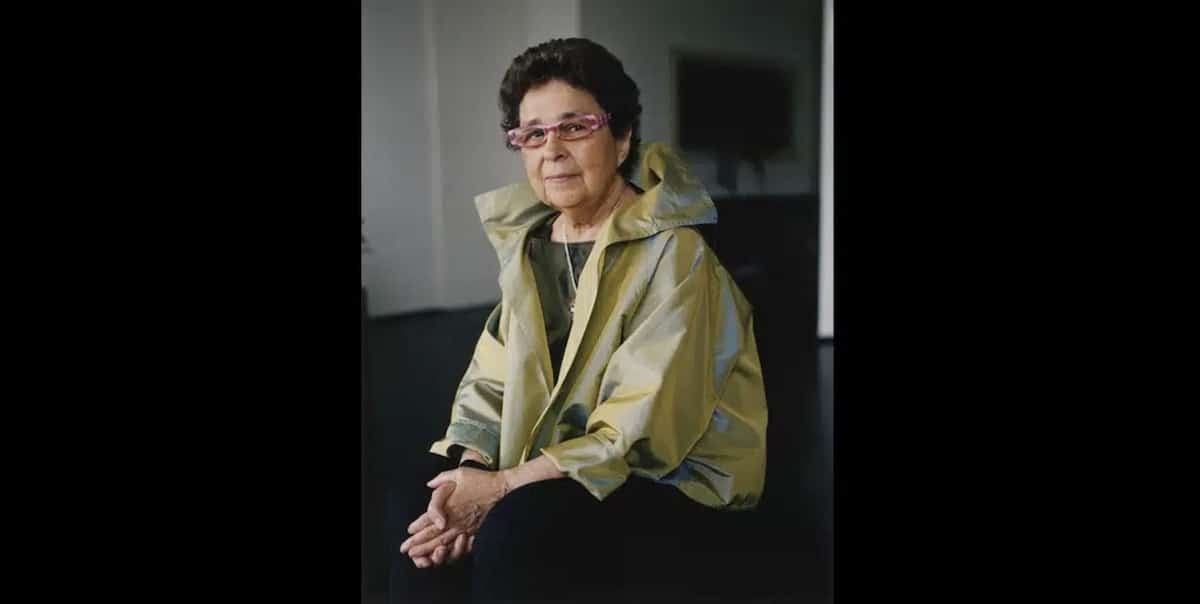
Marian Goodman, who died in Los Angeles in January at 97, had spent half a century building one of the most respected galleries in the world, representing artists whose careers she saw before anyone else did, in markets that hadn’t yet formed around them. Now Christie’s has announced that her personal collection will come to auction in New York next month, in a series of sales titled “Breaking Ground: The Private Collection of Marian Goodman,” estimated in total at around $65 million. A guarantee is in place.
The centrepiece is Gerhard Richter. Several works by the German painter will lead Christie’s 21st-century evening sale on 20 May, forming a single-owner sequence of seven canvases spanning 1982 to 2009, with estimates ranging from $30,000 to $50 million. Goodman began representing Richter in 1985, when his market in the United States was undeveloped despite the critical and commercial recognition he had already achieved in Germany. It was considered a risky move at the time. Over the four decades that followed, she held on to key works from each major phase of his practice. Christie’s describes this, in its statement, as “an act of love and admiration.” That framing is sentimental but not inaccurate. These were not investment positions. They were paintings she wanted to live with.
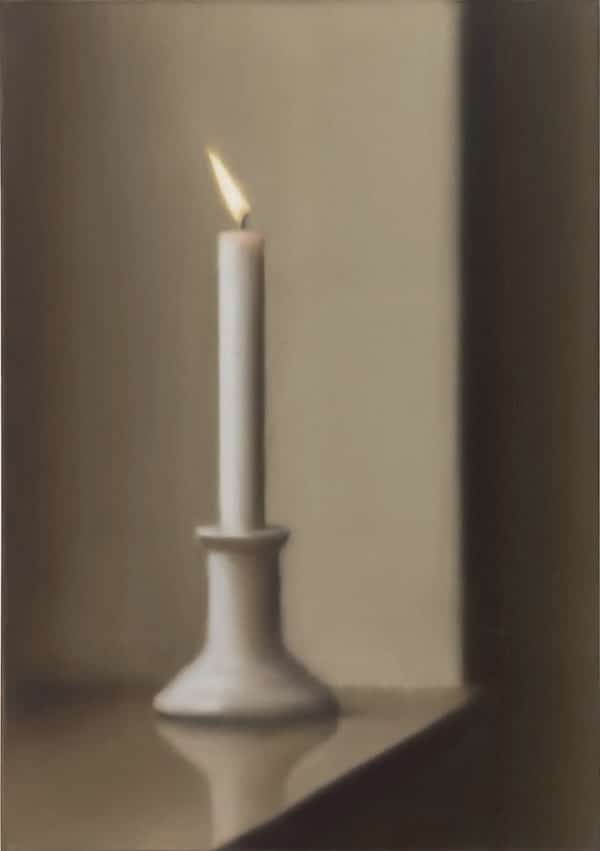
Gerhard Richter, Kerze (Candle), 1982) Image courtesy Christie’s
The star lot is a candle painting from 1982, estimated at $35 million to $50 million. Richter’s candles are arguably his most recognisable motif outside the squeegee abstractions — intimate, technically extraordinary, loaded with the particular atmosphere of things observed with absolute precision and transformed into something stranger than photography. Another canvas from the same series served as the cover image for Sonic Youth’s Daydream Nation in 1988, which did more to expand Richter’s cultural penetration in certain circles than any amount of critical apparatus. The current auction record for the artist stands at $46.3 million, set at Sotheby’s London in February 2015 for an abstract painting from 1986. The candle estimate puts it within range of that record, and given the provenance and the moment, the bidding could go further.
The evening sale on 20 May is only part of the picture. A single-owner day sale on 21 May will offer lower-priced works from the collection. An online sale runs from 8 to 22 May, featuring works from Goodman’s earlier Multiples platform — editions and prints by John Baldessari, Andy Warhol, Dan Flavin and Richard Artschwager, priced between $800 and $35,000. This is where the collection becomes accessible to a different kind of buyer, reflecting something true about who Goodman was and what she valued. The multiples programme was never a sideline. It was a commitment to the idea that important art should reach people who couldn’t afford the paintings.
Marian Goodman’s story is one of the more remarkable in the history of the contemporary art market. She was a lifelong New Yorker who enrolled at Columbia University in 1963 as the only woman in her graduate art history programme. Her gallery opened on West 57th Street in 1977 with a solo show of Marcel Broodthaers, the Belgian poet and artist whose work occupied a peculiar, difficult position between conceptualism and institutional critique, and whose market at the time was essentially nonexistent. The choice announced exactly the kind of dealer she intended to be.
Over the following decades, Goodman built a roster of important postwar and contemporary art: Richter, Annette Messager, William Kentridge, John Baldessari, Chantal Akerman, Nan Goldin, and Steve McQueen. She expanded to Paris in 1995, establishing a space in the Marais that became a serious institution in its own right. A London location operated between 2014 and 2022. Los Angeles followed in 2023, and the gallery moved from Midtown to Tribeca the following year. At 97, she was still involved.
Her daughter Amy Goodman, speaking about her mother’s eye for talent, described it as a sixth sense. “She could meet somebody and see ahead; she could see their career. She had real intuition. I called the gallery my mom’s garden.” The horticultural metaphor is apt. Goodman didn’t acquire artists so much as tend to them, sometimes for decades before the market caught up with her judgment.
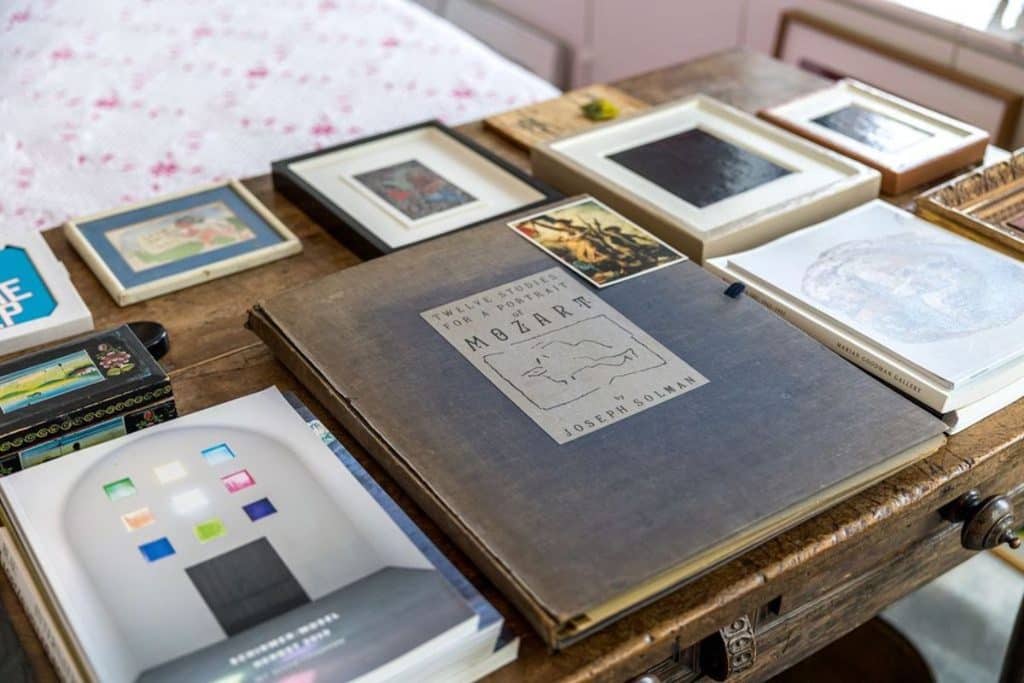
A selection of books and other items of interest Photo: Christie’s
Christie’s will send highlights from the collection on a pre-sale tour through Paris, London and Los Angeles before a full exhibition at its Rockefeller Centre headquarters ahead of the May auctions. The global circuit reflects both the stature of the collection and the international nature of the market that Goodman helped to shape over fifty years.
The Richter candle estimate of $50 million is the number everyone will watch. But the more telling figure might be the $800 starting price on the online sale. Both ends of that range say something about what kind of dealer Marian Goodman was, and what kind of collection she left behind.