Francisco de Zurbarán’s ‘Saint Francis in Meditation’ was a highlight among many other wonderful works in the National Gallery’s Saint Francis exhibition, held in 2023. This image is an attention grabber for its intensity in both composition and content. St Francis is the sole focus, powerfully highlighted against a dark background through chiaroscuro contrasts that earned Zurbarán the nickname “Spain’s Caravaggio”. In frayed, patched, dull robes, Francis kneels, his eyes, set in shadow by his hood, raised radiantly heavenward while he tightly clasps a skull to his chest. Realism and mysticism are compellingly combined in a spellbinding image that screams mortality and devotion.
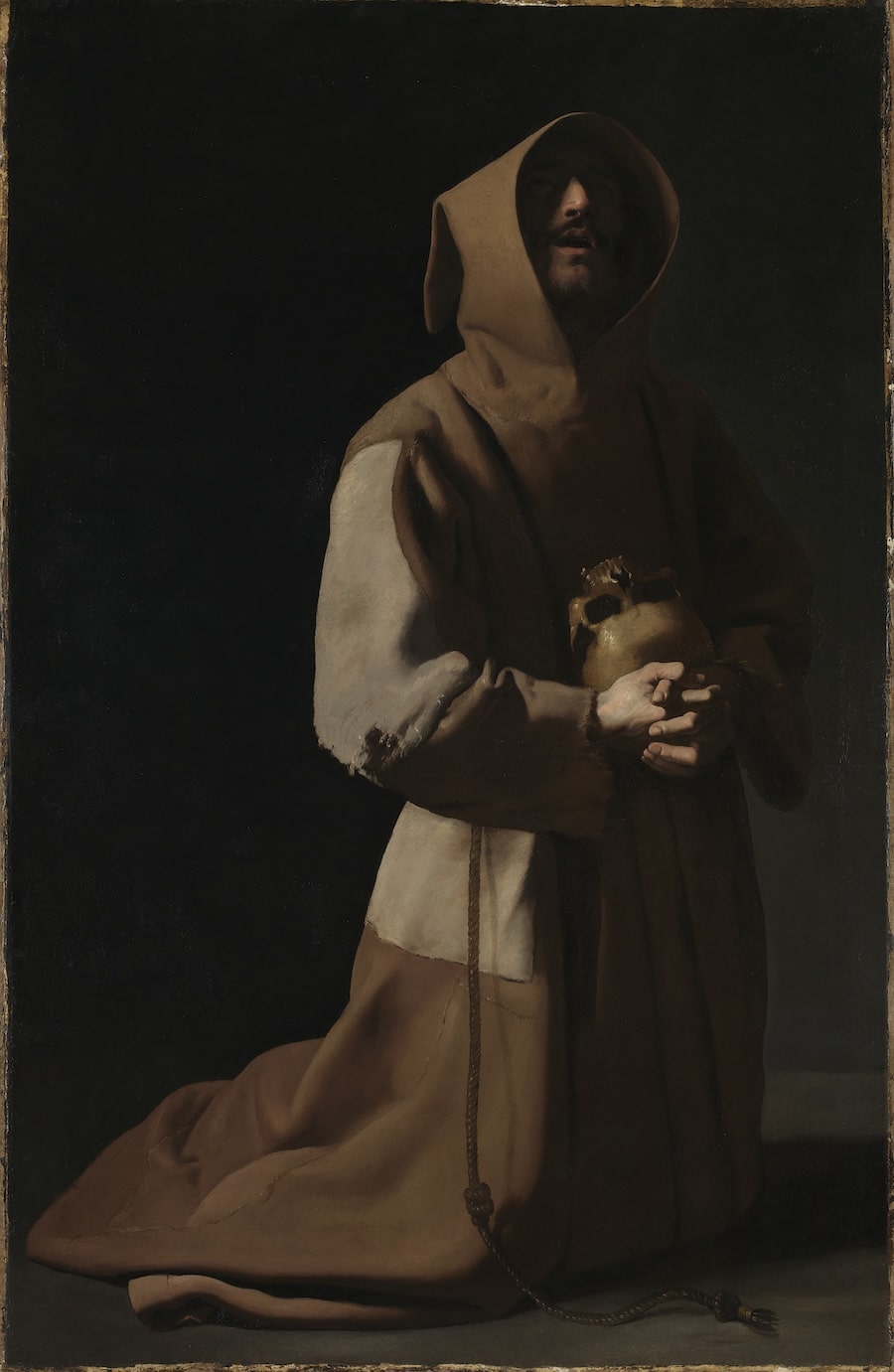
Francisco de Zurbarán, Saint Francis in Meditation, 1635-9, © The National Gallery, London
This concentrated minimalism in composition, combined with a searing attention to content, is what has come to be seen as the essence of Zurbarán’s sight and insight, whether in his depictions of saints, Christ’s crucifixion, or his still-lifes. In the latter, each element of the still-life occupies its own space and is thrilling in itself whilst also sitting alongside, on a level, its compatriot objects and existing in relation to them. The achievement of this exhibition, however, is that it breaks out of that single, stereotypical focus on a single element of Zurbarán’s work to show the true breadth of his oeuvre and, in so doing, highlights his innovative practice.
He spent most of his life in Seville, then one of the richest cities in Europe, whose maritime links to the Americas made it a hub of global trade. His paintings for the city’s religious orders, for private patrons, and, for a time in Madrid, even for the king of Spain served to make him, along with Diego Velázquez and Bartolomé Esteban Murillo, one of the leading painters of 17th-century Spain.
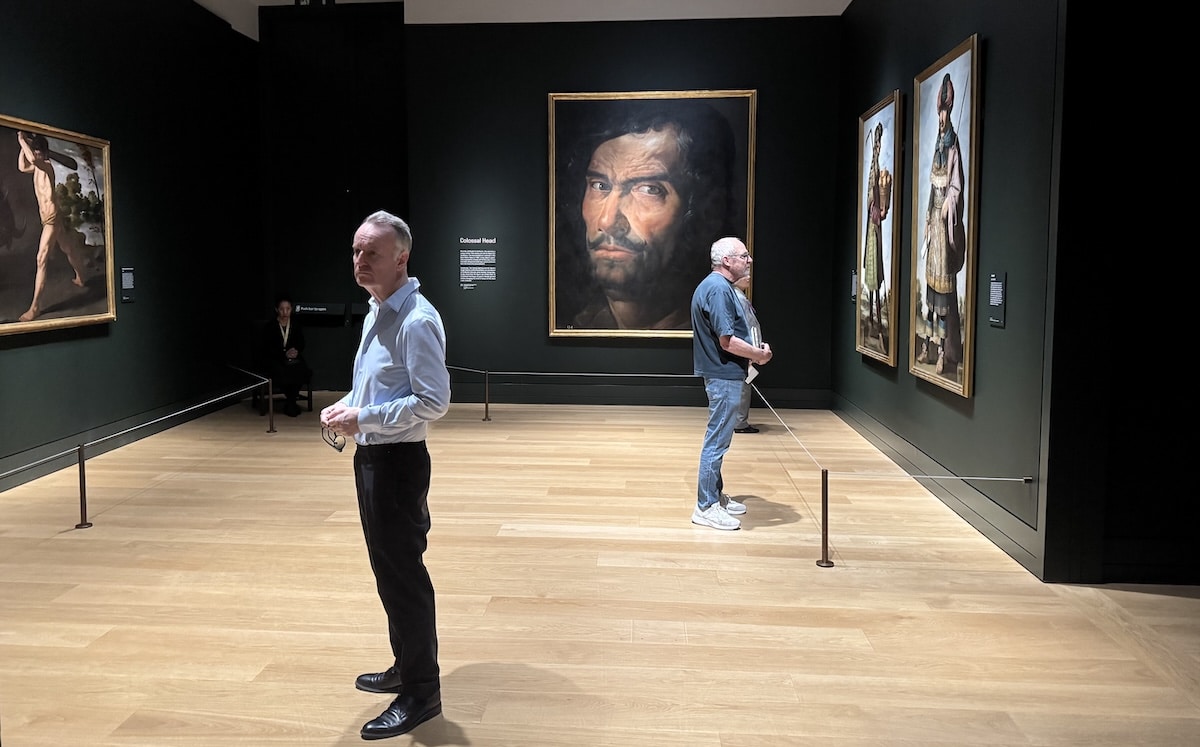
Zurbarán, Colossal Head, Recently attributed to Zurbarán, this painting is unique within 17th century art and its origins are mysterious, First documented on a staircase in the Buen Retiro Palace in 1661, it may depict a giant. At this scale, it must have been designed to strike awe, surprise and even fear into those who encountered it.
Several “firsts” are worth noting as viewers progress through the exhibition. These range from the first painting of ‘The Vision of Saint Alonso Rodriquez’ – Alonso was a 16th-century Jesuit lay brother with a focus on venerating the hearts of Christ and the Virgin Mary – to a completely new composite image of ‘Christ and the Virgin in the House at Nazareth – where the young Christ receives a premonition of his future suffering and his mother seated alongside anticipates her own future grief.
Through 15 Immaculate Conceptions painted across his career, Zurbarán contributed to the development of the very specific pictorial formula developed in 17th-century Seville to depict the idea of the Virgin Mary’s Immaculate Conception – the belief that she was conceived without sin. As this belief is an idea rather than a story or image, the imagery Zurbarán and his peers developed for their paintings is essentially an early example of conceptual art. This imagery was based on the depiction of the Virgin found in the Book of Revelation, where she is ‘clothed with the sun, the moon under her feet, wearing a crown of 12 stars’.
Two of Zurbarán’s images depicting the Virgin in this way – ‘The Immaculate Conception with Two Boys Praying’ and The Immaculate Conception with Saints Joachim and Anne’ – can be viewed in a room designed for contemplation and comparison. The two Immaculate Conceptions are displayed alongside each other on one side of the room, while two Crucifixions – ‘The Crucified Christ’ and ‘Christ on the Cross with the Virgin, Mary Magdalene and Saint John’ (one early, the other later) – are shown together on the opposite wall.
Zurbarán’s crucifixions, particularly ‘The Crucifixion’ from 1627, which is displayed in the introductory room, have a three-dimensional quality to the central figure set against a dark void that led those who saw these images in, for example, the dimly lit sacristy of San Pablo el Real, Seville, to believe ‘it to be a sculpture’. His combining of such highly sculptural figures with dramatic lighting and an intense naturalism was his key innovatory contribution to depicting the mysteries of the Christian faith.
The ‘Agnus Dei’ in the final room possesses all these qualities and combines extreme realism with symbolic depth, offering another image that is an innovation, demonstrating Zurbarán’s devotion to understanding and imaging the events at the heart of his faith.
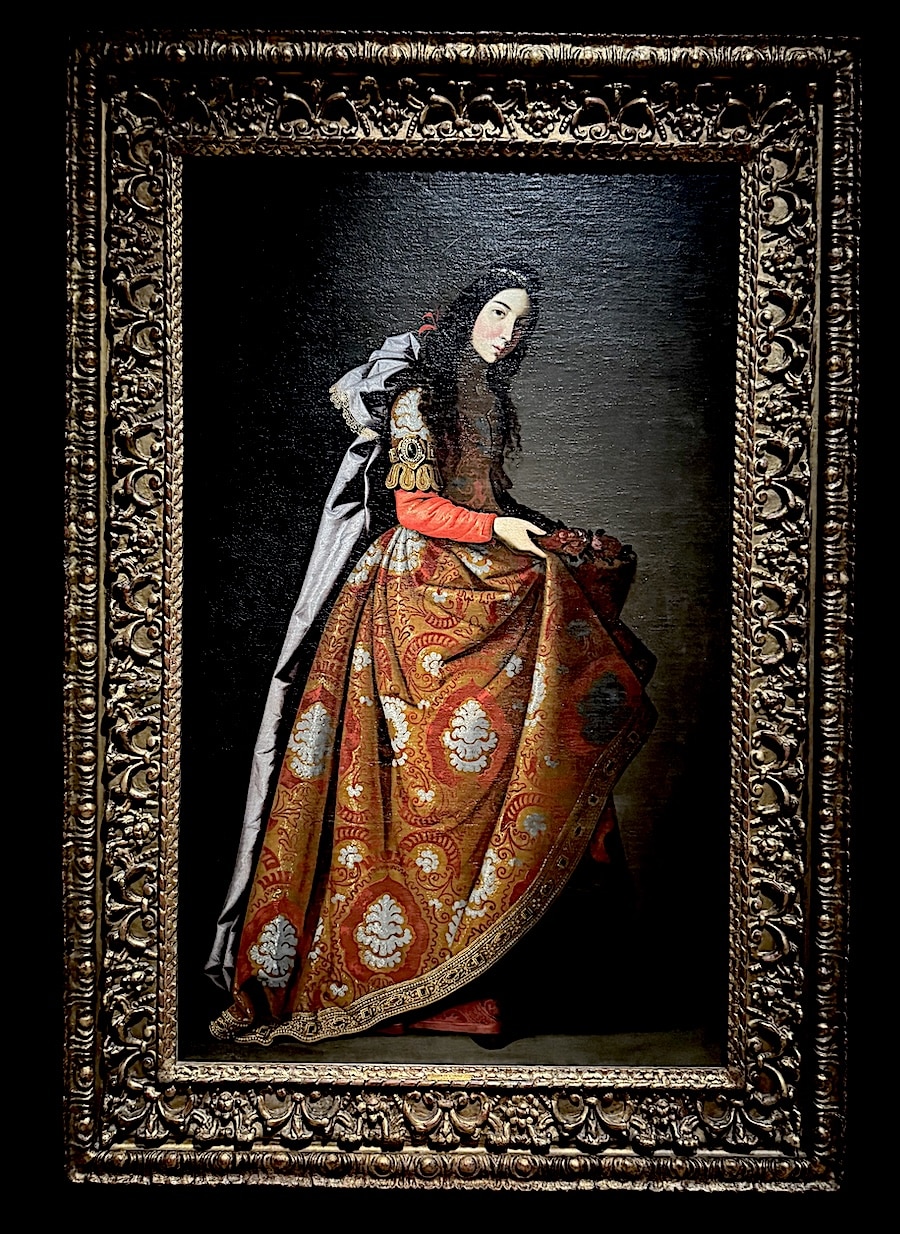
Saint Casilda by Zurbarán c 1635
His innovations, however, range further still and extend into exceptional use of colour and a depiction of sumptuous materials that was both original and so stunningly well observed that it has served as inspiration for later fashion designers, such as Cristóbal Balenciaga.
Zurbarán’s interest in fabrics may have had its roots in his merchant father’s dealings in cloth. His intimate knowledge and understanding of material, its weight and heft, its texture, folds and falls, is apparent whether he is painting the homespun wool of friars’ habits or the flowing gowns of his Virgin Saints. The latter provides another example of his own created iconography and the ‘elegance and sophistication of his approach’, as Benito Navarette Prieto writes, ‘succeeded in making this subject fashionable in both Seville and the Viceroyalties of New Spain and Peru’.
Zurbarán’s innovations are threaded throughout this exhibition, which, after its introductory room, focuses on major religious commissions, his evocation of fabrics, his iconography, commissions from outside Seville, his still-lifes and those of his son, and private commissions. The curator’s thematic choices enable Zurbarán’s range to be seen, while also providing opportunities for contemplation that might not have been as apparent in a chronologically structured show.
The final picture is a further innovation. The theme of ‘The Crucified Christ with a Painter’ has no precedent in Western art. St Luke, the patron saint of painters, stands at the foot of the Cross, palette and brushes in hand, looking attentively at Christ with emotion and devotion. Although not a self-portrait, everything we have seen in the rest of the exhibition leads us to recognise that this is the way Zurbarán himself painted, and that St Luke stands here as a cypher for the artist.
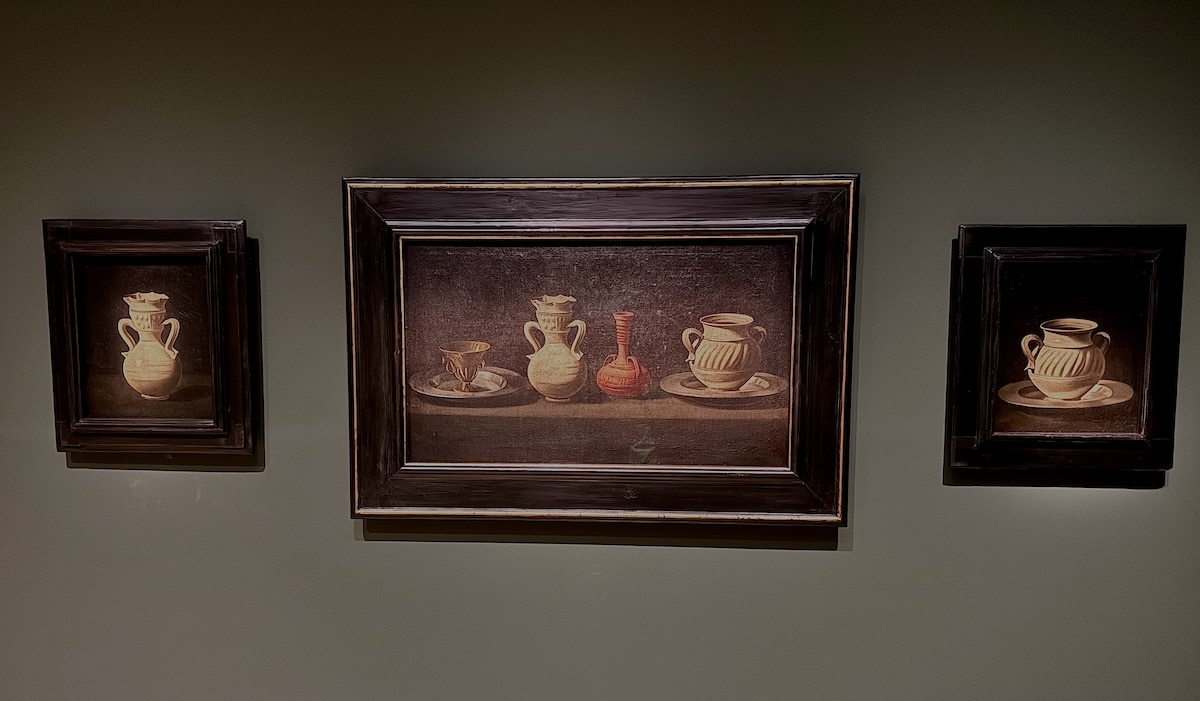
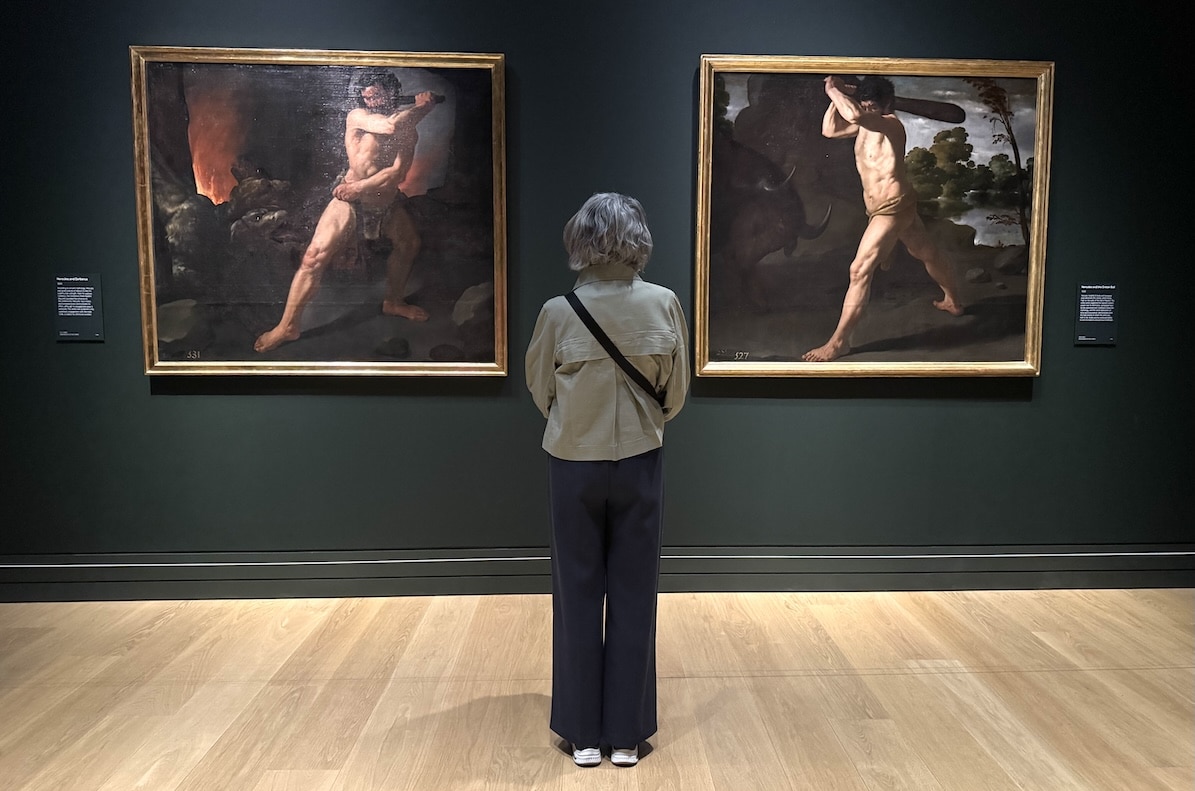
Zurbarán, National Gallery, installation view
The still lifes, with their contrast between the work of father and son, also lead to the same realisation. Zurbarán’s son, Juan, paints the exuberant, abundant materiality of loaded, luxurious baskets in contrast to the intensity of Zurbarán’s focus on the interiority and essence of each element in his still-lifes, each of which inhabits their own space. Juan is captivated by the overall sense impressions of luxurious beauty and bounty, while his father looks with attentive devotion at each object to see both essence and relation.
It is this approach to painting that infuses the range of approaches utilised by Zurbarán across a career of contrasts and innovations, each inspired and illuminated by the devotion he shows to his subjects and the spiritual realities to which they, as symbols, relate.
Zurbarán, National Gallery, 2 May – 23 August 2026
Visit Here