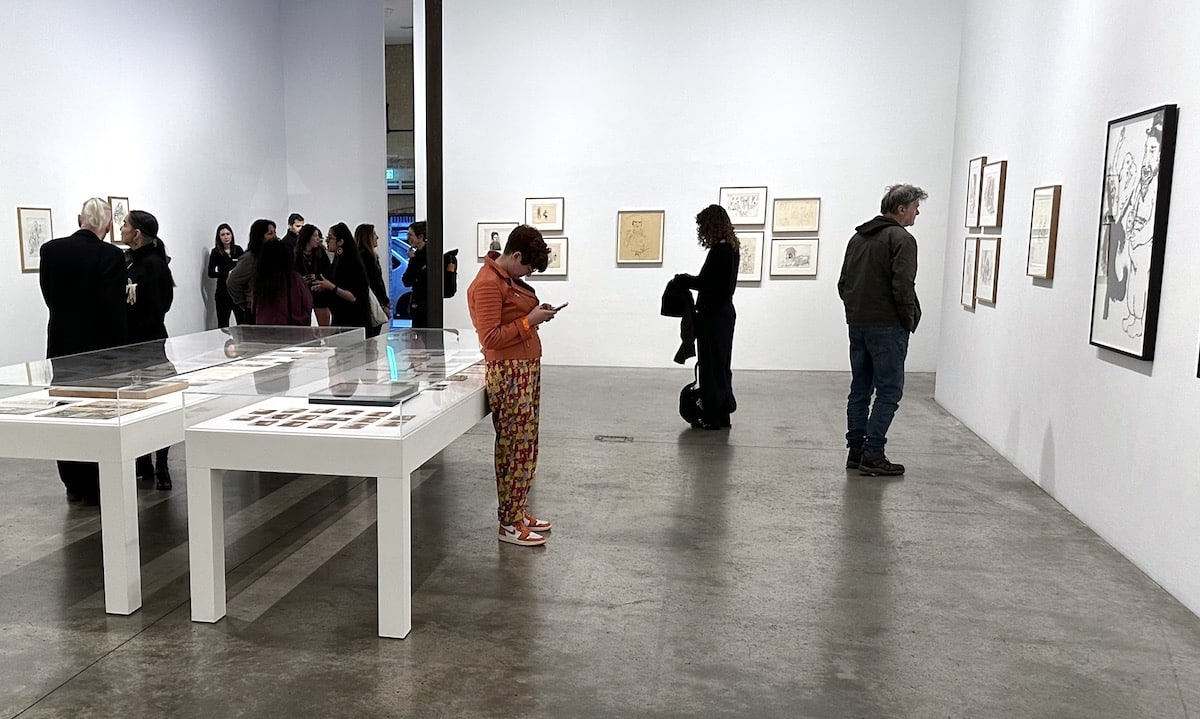
The earliest work in this Paula Rego exhibition of drawings, Story Line, at Victoria Miro London, is a study of her grandmother made when she was nine years old in 1944, proudly signed in her childish hand. In it, the old woman, her hair in a tight bun, her glasses held by a chain, sits sewing. The final drawing in the show is of her own granddaughter, made when Rego was eighty.
Drawing was central to Paula Rego’s practise. She always spoke of herself as a ‘drawrer’ (her word) rather than a painter. Born in Lisbon in 1935 to liberal parents, she grew up in an era dominated by the patriarchy of the Catholic church and the Fascism of the Portuguese dictator Salazar. It was an era when women were expected primarily to be good and obedient wives, mothers, and daughters. For a shy young girl, drawing provided an escape from what felt like an alien and unpredictable environment. She would shut herself away in her room and create fantasy worlds. Pictures, she found, could convey feelings and stories in ways that words could not. They provided a form of solace as well as a way to understand things that couldn’t be expressed directly in words. But, arriving in England at the tender age of seventeen to attend the Slade, Rego found nothing but disdain for her narrative approach. One of her tutors, the painter Victor Passmore, asked dismissively, “How can you do this?” of a painting she had done of fat men eating around a table, “This is not ‘modern art’”.
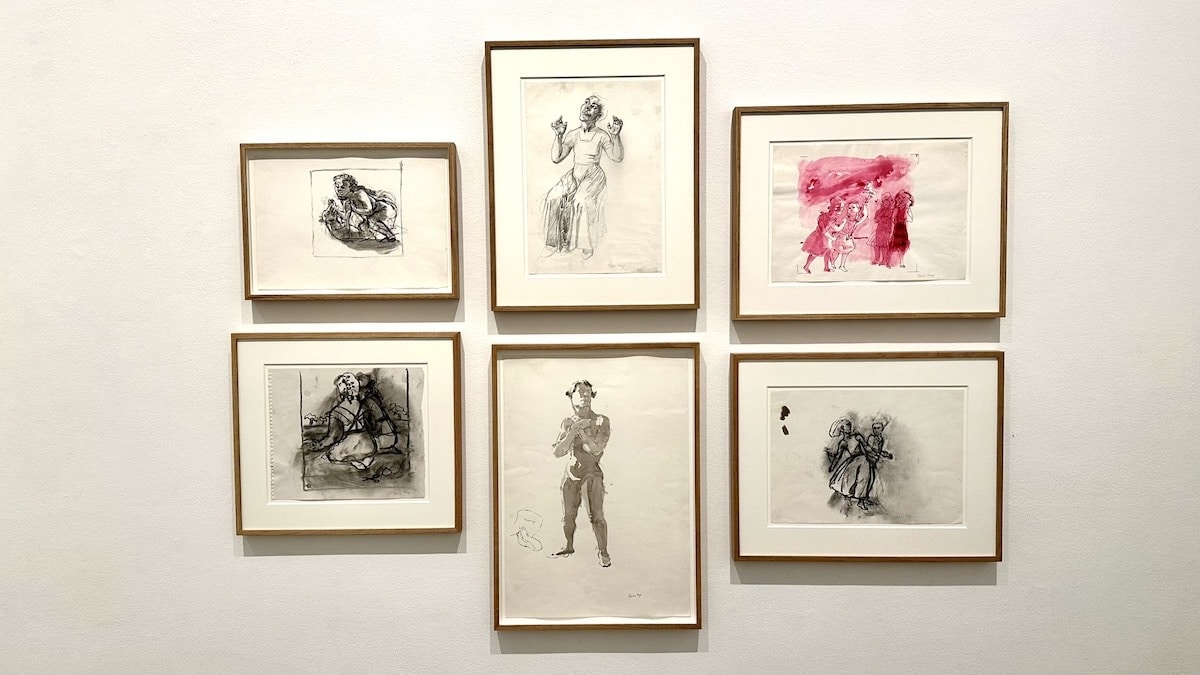
Paula Rego: Story Line, Victoria Miro
But it was not ‘modern art’ that primarily inspired Paula Rego, but the fairy tales and folk fables of her childhood told to her by aunts and grandmothers. These would provide her with the archetypal characters that inhabit her work. Art was, for her, a form of play, one that allowed her to connect to emotions buried deep within her subconscious, to express complex feelings of fear, jealousy, abandonment and lust, feelings that she would spend many years exploring in Jungian analysis.
Coming to maturity as an artist in an era when figuration was frowned on and the dominant painterly vocabulary was abstraction, she remained true to her own vision that paintings should tell a story. While the younger generation of YBAs were experimenting with sharks, beds and cigarettes, Paula Rego drew in pencil, conte and pastels. Drawing was, for her, always a voyage of discovery, a way of finding out what she thought. The figures and characters expressed as animals in her early sketchbooks would become transmuted into her Dog Woman series in the 1990s. After the death of her husband Victor Willing from multiple sclerosis, these allowed her to explore her grief and to process her complex feelings. As her son Nick Willing has said: “A Rego drawing is never just one thing, but many feelings working together to reveal the truth.”
There is a direct correlation between the line she drew and her internal world. Even when she appropriated stories as in her study for The Maids, based on the play by Jean Genet, she was primarily speaking of her own internal landscape. In a Study for The Little Murderess, 1987, a girl approaches a bath, her stocking wrapped around her knuckles as if about to strangle the recumbent figure (a nod to David’s Marat). The work underlines some of the guilt, anger, and frustration that she felt towards the men (husband and lovers) in her life.
Her most overtly political drawings were made in response to the failed referendum to legalise abortion in Portugal in 1988. Though they were also deeply personal for her, when still a teenager, she had sought a backstreet abortion after becoming pregnant by Victor Willing. Her 1998 Study for Untitled (Abortion Series) captures something of that lonely anxiety in the finely wrought pencil drawing of a despondent girl, her back to the viewer.
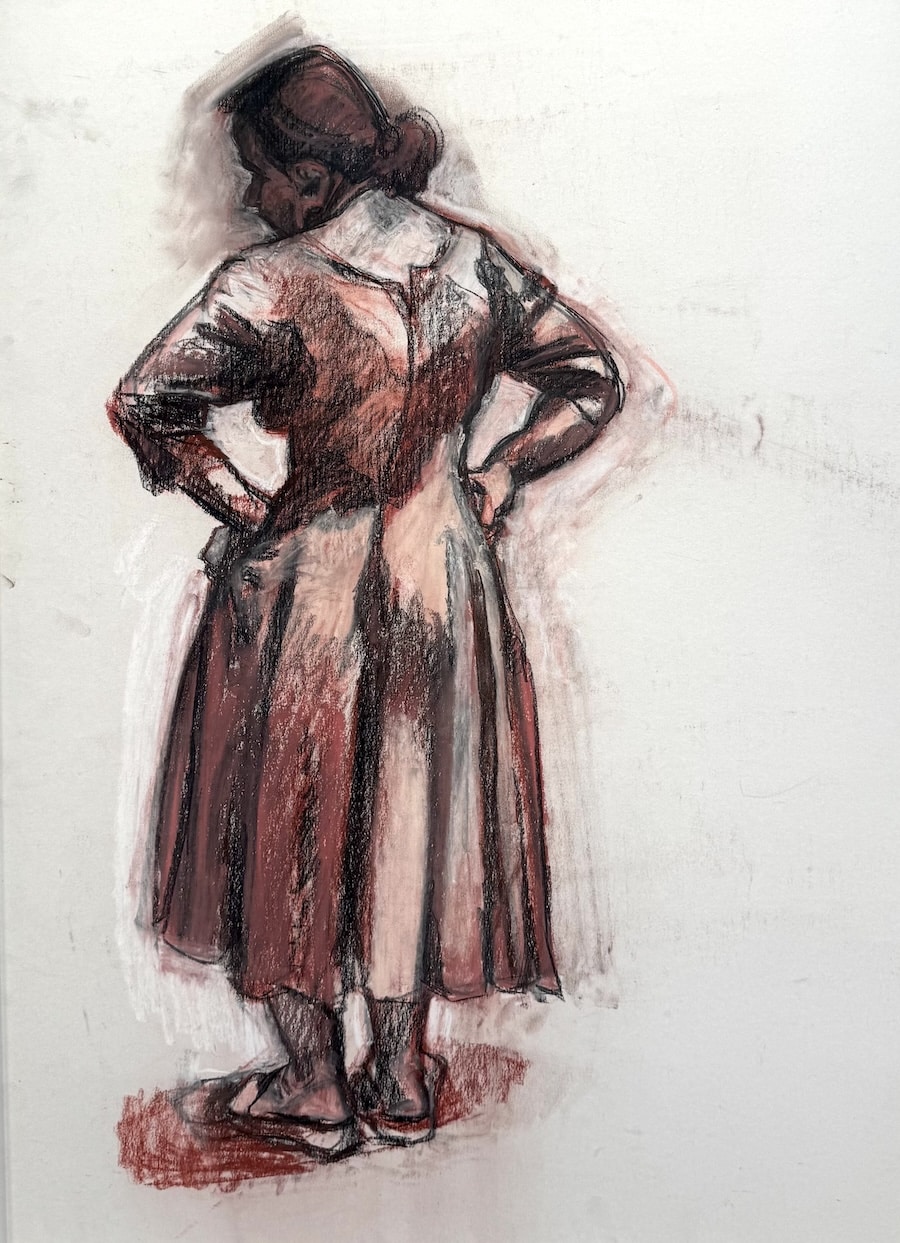
Paula Rego, Jane Eyre, 2002, pastel on paper
Among her strongest works are those of women. Rooted, sturdy and beefy-thighed, they seem to defy their apparent vulnerability. In the wonderful pastel on paper of Jane Eyre, the lone figure stands hands on her hips in a workaday red dress, nursing an air of rebellion. While her study for Germaine Greer shows the feminist icon sitting knees flopped open in a gesture of sexual defiance.
Rego mostly worked from live models, but she also used ‘dolls’ or, as the Portuguese call them, bonecos,’ which she made of papier mâché. These she could place in position, and they would stay still and be ‘obedient.’ Sometimes, as in the ink drawing War Rabbits, characters would metamorphose into animals. People and dolls were often used together, blurring the lines between reality and fantasy, creating an uncanny ambivalence. “You can,” she said, “be as horrible and violent as you want in your pictures.” Revenge was taken on a teacher she had hated in school by casting her in roles that required someone mean.
Throughout her life, Paula Rego drew her family and those who peopled her life, her cousin, the maids in her parents’ house, and her grandchildren. Through them, she told the stories of her childhood and the stories of women. Working against the prevailing mood for slickness, she brought, as this exhibition shows, an uncompromising authenticity and deep psychological insight to her work, exploring the female psyche and experience.
Paula Rego: Story Line, Victoria Miro London, 16 April – 23 May 2026
Visit Here
The exhibition is accompanied by a new book written by the artist’s son, Nick Willing.
Sue Hubbard is an award-winning poet, novelist, and freelance critic. Her fourth novel Flatlands, from Pushkin Press can be bought here: Flatlands by Sue Hubbard | 9781911590743 | Pushkin Press. Her latest poetry collection God’of Gwen Artist: poems on the life of Gwen John, Serena Press (see here)