
On the long driveway up to Houghton Hall, I glimpse Sean Scully’s monumental grid of Corten steel through the trees, a Claudio Parmiggiani resembling a narwhal tusk rises vertically beside the Church, and Richard Long’s circle of tree stumps with their roots turned skywards, the eponymous white deer strutting amongst them. A handful of past reminders from annual exhibitions, which began in 2015, certain works remaining and forming an ever-growing collection for the Houghton Arts Foundation. Lord Cholmondeley tells me that since starting this programme, Houghton’s visitorship has doubled. It’s one of an ever-growing number of estates and historic houses pivoting towards displaying temporary exhibitions and collecting contemporary art to attract new audiences. This year, works by Lynn Chadwick are scattered across the extensive grounds as well as inside the Hall itself.
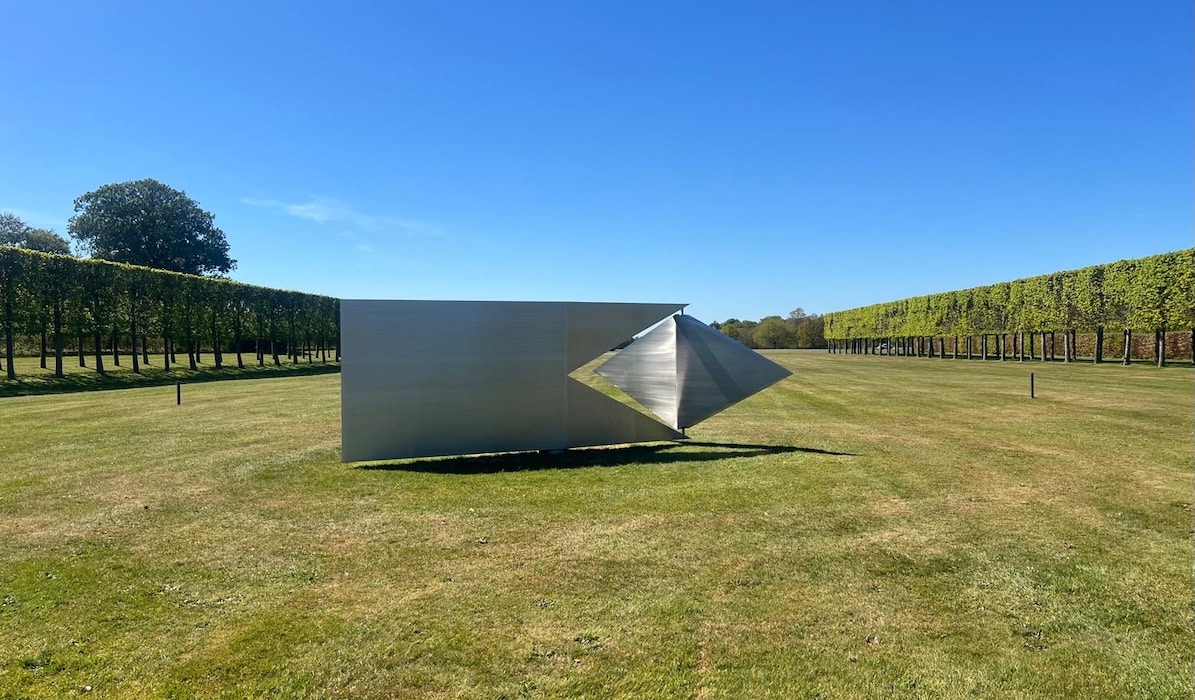
Lynn Chadwick, Ace of Diamonds
Lynn Chadwick (1914-2003) began his career as an architectural draughtsman, later fabricating mobile constructions for trade fairs. His work was included in the Festival of Britain in 1951, and he became a full-time sculptor. In 1956, he showed in the British Pavilion at the Venice Biennale and won the International Prize for Sculpture, not only beating Giacometti but also remaining the youngest artist ever to receive the award. Seventy years on from that success, his role in post-war British sculpture is being celebrated at Houghton Hall.
A small exhibition in the south wing gallery provides an introduction to Chadwick and his working process. Archival photographs and drawings illustrate how he constructed works using a metal frame or armature, which was then filled to form a core, added to and then scraped away, creating a roughly finished surface often revealing the bare bones of the piece like an endoskeleton showing through taut skin. Also on display here are maquettes for some of the Beast series seen elsewhere throughout the park and inside the Hall, and a very Calder-like mobile from 1952.
Across the park, a variety of works are on display. Jubilee IV (1985) is made up of two majestic bronze figures, their robes wafting behind them as they stride and sashay their way out of the stable block towards the park, like a pair of gossiping extras from Conclave. The male figure’s face is represented abstractly by a square, the female’s a triangle – a motif employed repeatedly by Chadwick. Large Barley Fork (1975) in the stable block courtyard resembles an amorphous combine harvester emerging from its shed, bearing its fierce gnashing teeth. This is the first time this particular work has been realised and shown in public.
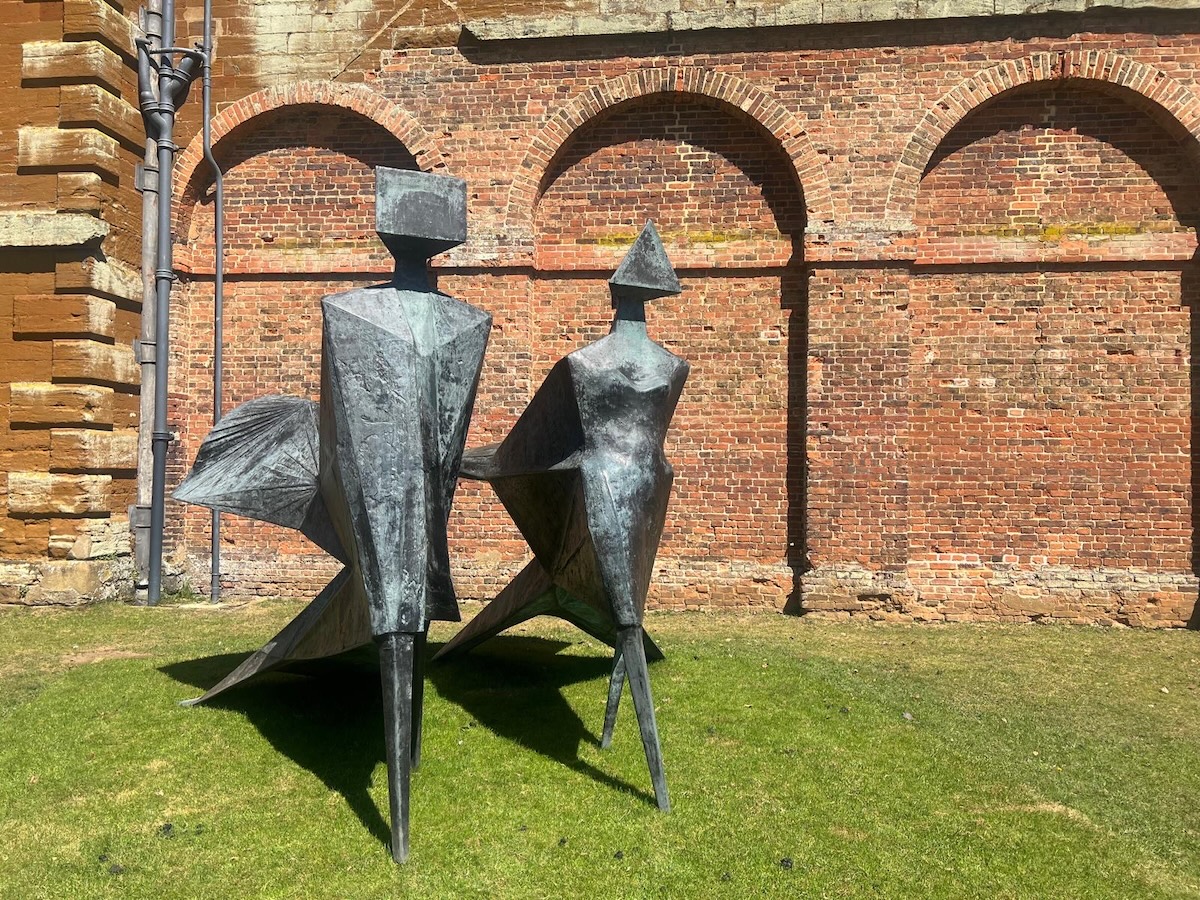
Lynn Chadwick, Jubilee IV
Outside St Martin’s church in the park, a work entitled Square (1968) confronts the approaching spectator with their own reflection in the flat, polished mirror-like surfaces on the body and face of this figure. He reminds me of Sidney Nolan’s Ned Kelly, his body and head reduced to black squares. Inside, Proctor II (1964) is a much simpler geometric abstract form, barely attempting to represent a figure.
It’s interesting to see how Chadwick’s works integrate across the park alongside other structures and features – with the Hall itself and other architectural structures, with other artists’ sculptures such as Richard Long’s Full Moon Circle at the end of the west lawn close to the ha-ha. Here stand three figures, The Watchers (1960), guarding the fake neo-Palladian temple masquerading as a water tower behind them, like ancient warriors. They face off to the seated Little Girl I, II and III (1987) across the lawn. In the magical secret garden beside the Hall are three works, one entitled Moon of Alabama (1957) referencing Brecht and Weill, but for me The Doors zithers through my head. This work was originally called Sputnik 3, and you can see why – the nebulous form balanced delicately on three legs.
Entering the Hall through the lower arcade, Cloaked Figure IX (1978) bustles through the undercroft like a penitent nun, or a character from The Handmaid’s Tale. Upstairs, Beast IX (1956) guards the grate like a firedog howling at the moon. Orator (1956) rests aptly on the desk in Walpole’s study, Houghton being the home of Britain’s first prime minister. And in the centre of the grand Stone Hall stand the Three Elektras (1969), each balanced on three legs, and ‘bright’ because of their polished black reflective breastplates. They dominate the room as if staring down the three flailing male figures in a wall niche, a version of Laocoön and his sons.
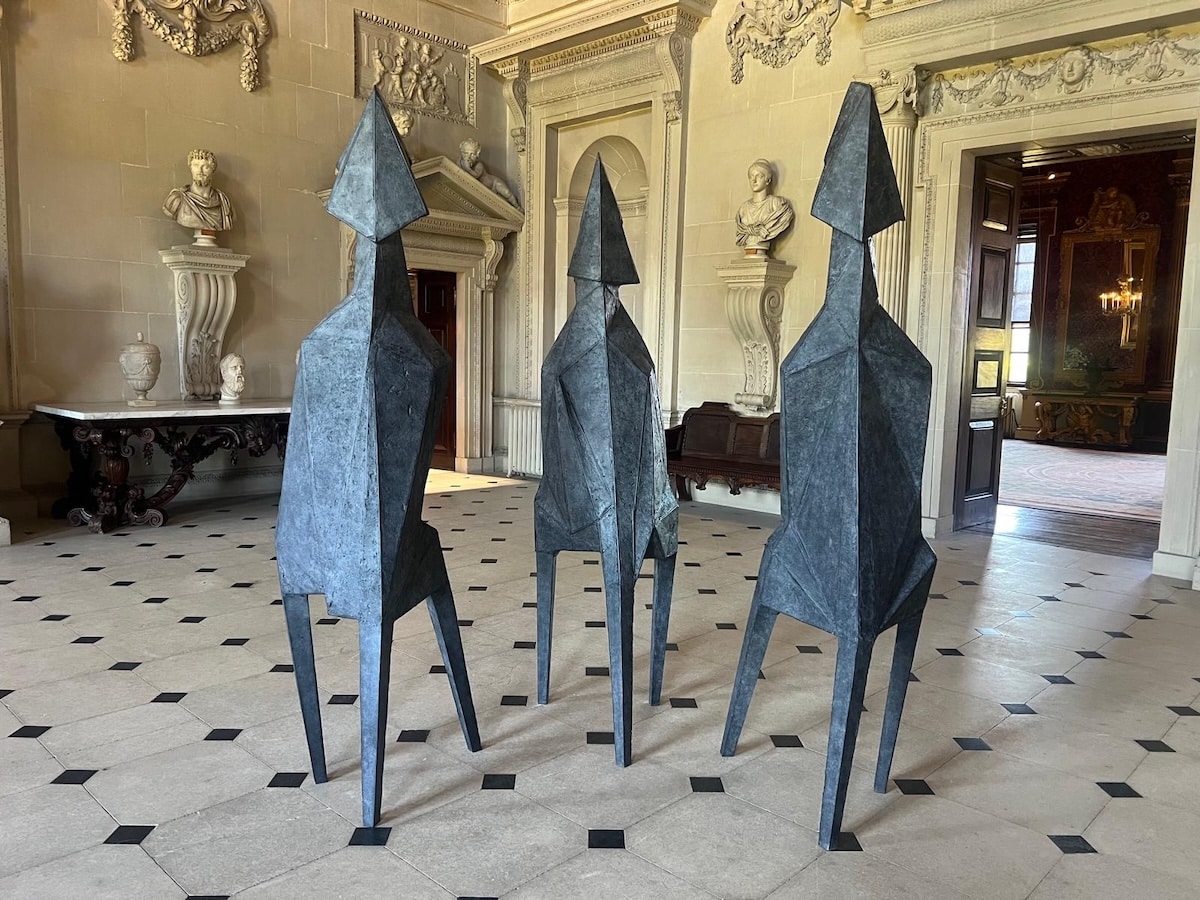
Lynn Chadwick, Three Elektras
Five sentient beasts are scattered throughout the west lawn area; one particularly lupine example is the rearing Howling Beast I (1990), hidden at the central apex of the parterre maze, and Beast Alerted I (1990) on the lawn nearby. Chadwick used a technique developed later in his career for these works, cladding the structural frameworks with stainless steel. These multifaceted beasts reflect the sun and shine, unlike the textured cast bronzes, like anthropomorphic air conditioner ducts on New York rooftops.
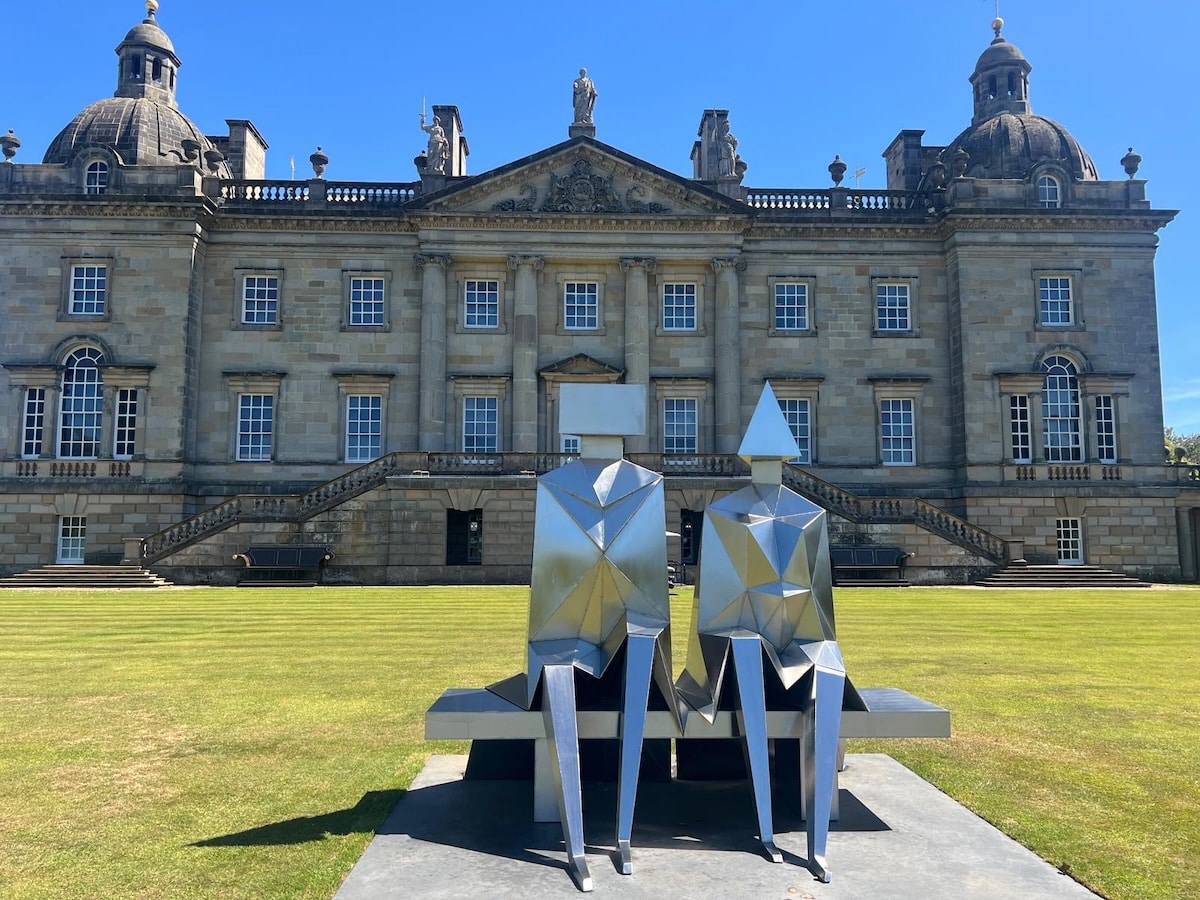
Other works using a similar technique include the prominent Sitting Couple on Bench (1990), front and centre of the Hall on the west lawn, as if they are the Lord and Lady surveying their demesne. The last work of Chadwick’s career, the kinetic Ace of Diamonds III (1986-1996), harks back to that small early mobile seen in the gallery but here on a monumental scale – the base gyrating slowly while the giant diamond lozenge nicked in its side turns and turns in the other direction. On this glorious late April day, this piece danced in the strong winds as if in celebration.
Lynn Chadwick at Houghton Hall, Norfolk Saturday, 2 May – Sunday, 4 October 2026
Visit Here