
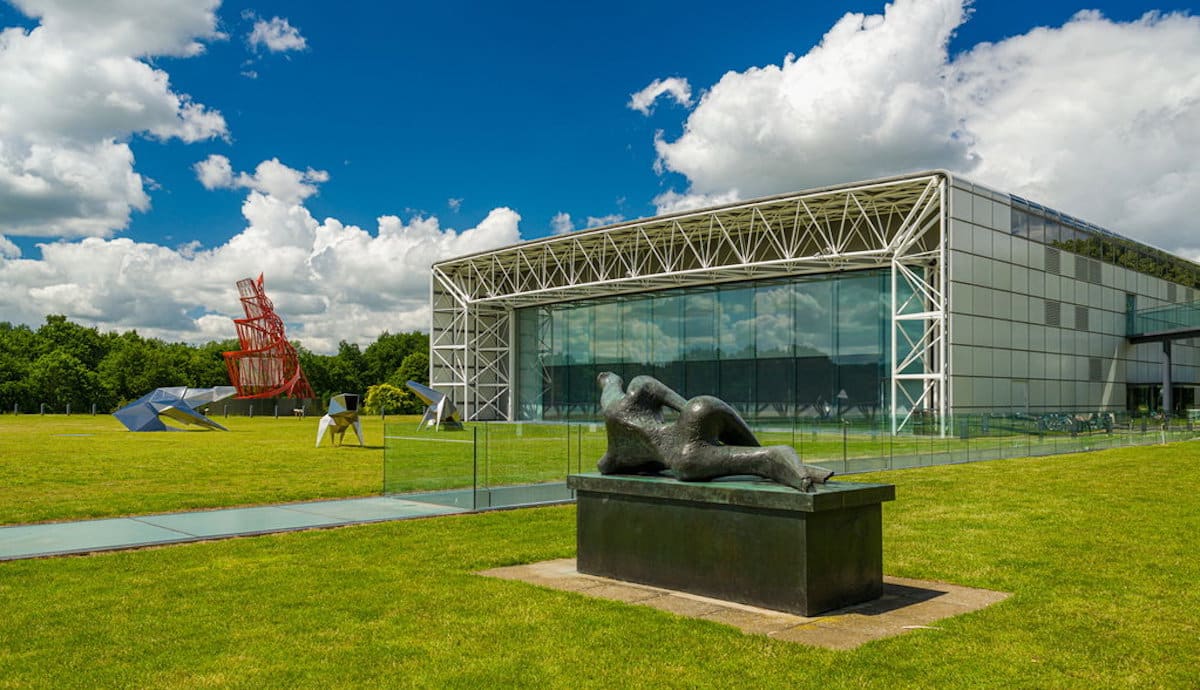
One of the most architecturally significant museum buildings in Britain has received a transformative funding injection. The Sainsbury Centre at the University of East Anglia in Norwich has received £91.2 million from Lord David Sainsbury through the Gatsby Foundation, his charitable organisation, a donation its executive director, Jago Cooper, has described as securing the venue’s future. The Gift is among the largest single donations to a regional cultural institution in recent British history, and it arrives at a moment when the Sainsbury Centre is preparing to celebrate the fiftieth anniversary of its founding commission.
The funding will be directed toward a substantial programme of upgrades and improvements, including the renewal of entrances, lifts, signage, and flooring; the extension of the south cafe terrace; and the integration of advanced solar technology into Foster’s iconic roof. An architectural firm appointed in 2024 has been undertaking a study to determine which elements of the site require upgrading or replacement. The sustainability dimension of the project is significant: the Grade II-listed building, constructed in an era when environmental performance was not a design priority, will be substantially improved in energy efficiency as part of the renovation, with green updates incorporated into the fabric of Foster’s structure without compromising its architectural integrity.
Lord Sainsbury’s gift connects the donation to family history as much as institutional ambition. “My father always regarded his commissioning of Norman Foster to produce the Sainsbury Centre as one of the best things he ever did,” he said, “and it gives me great pleasure to provide the funding to enhance its future.” Cooper has framed the renewal in complementary terms, describing Foster’s vision for the most radical art museum in the world as being revitalised for the next generation of visitors. The language of both statements is notable for its confidence: this is not a rescue operation but an investment in something already considered exceptional.
The building that is being revitalised is, exceptional. When Norman Foster, working alongside Wendy Cheesman, received the commission in 1974, he was not yet the globally recognised figure he would become. The Sainsbury Centre, which opened in 1978, was instrumental in making him one. The structure is a massive 135-metre-long universal space encased in a steel lattice and glazed at both ends, its entire service infrastructure hidden within the double-layered skin of the walls and roof. The resulting interior is completely unobstructed, flexible and flooded with diffused light, a space that refuses the conventional hierarchy between display and circulation that most museum buildings take for granted.
Foster drew on his experience with aircraft hangars, whose functional need for large uninterrupted spans produced a structural logic that he transposed into a cultural setting. The project marked a pivotal moment in the history of High-Tech architecture, the point at which a language developed for industrial applications crossed decisively into the cultural sector. The Centre was granted Grade II listed status in 2012, formal recognition of a significance that architecture critics had long acknowledged.
The collection itself is genuinely unusual, spanning cultures and centuries in ways that traditional art-historical taxonomy tends to discourage. It sits alongside the University’s academic life, as its donors intended, and is used by students, researchers, and the general public. The Centre welcomed more than 1.16 million visitors according to recent figures from the Association of Leading Visitor Attractions. This number reflects both the building’s draw and the continued relevance of its curatorial approach.
The University’s vice-chancellor, Professor David Maguire, described the donation as emphasising the Centre’s national and international artistic and cultural significance, a much-admired treasure in the heart of the Norwich campus. That description is accurate and perhaps slightly understated. The Sainsbury Centre is not simply significant regionally. It is one of the handful of buildings in Britain that genuinely changed what a museum could be, and the investment now being made in its future suggests that its next fifty years will be as consequential as its first.
Top Photo: Andy Crouch © Sainsbury Centre