
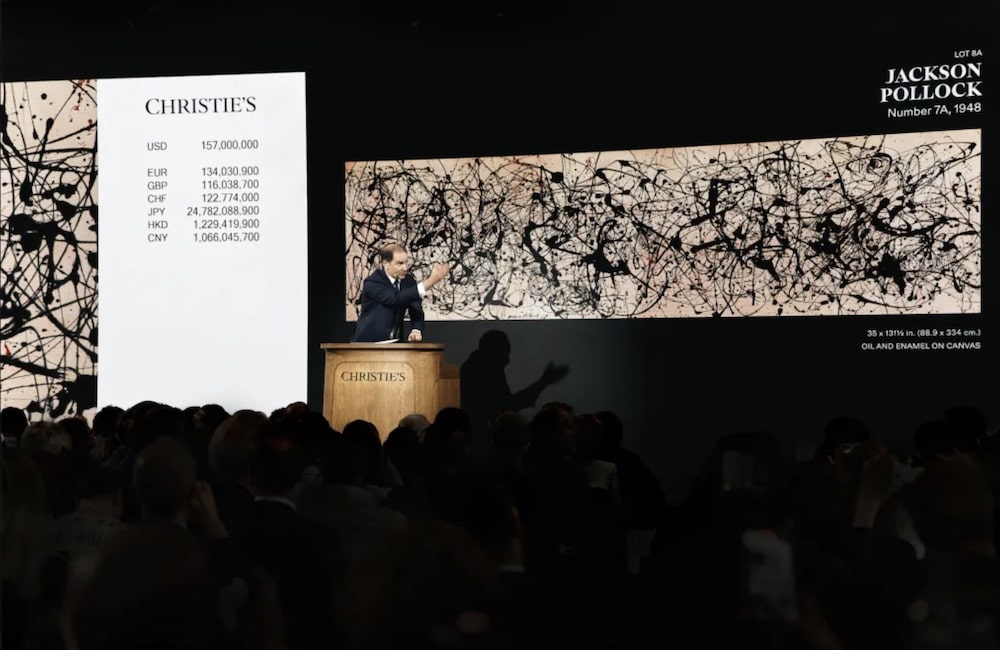
The numbers from New York’s spring auction week are in, and the headline figures are extraordinary. Christie’s delivered a double-header that totalled $1.1 billion on its opening night, anchored by Jackson Pollock’s Number 7A, 1948, hammering at $181.2 million to a room that broke into applause. Sotheby’s followed with $303.9 million in modern art. Phillips achieved $115.2 million, more than double its 2025 equivalent. Taken together, the week confirmed something the market has been cautiously suggesting since the London evening sales in March: that liquidity has returned, at least at the very top.
The qualification matters enormously, and the more experienced voices in the room were quick to provide it. “The reality of what I’d call the real middle market, maybe $100,000 to $1 million, is that things are still a bit sticky,” Candace Worth of Worth Art Advisory observed on Tuesday. “There’s definitely more energy than there was a year ago, and more things are selling, but advisers and gallerists will still tell you it’s not easy. Buyers are taking longer to make decisions.” The auction market, she added, needs to be understood as one strand among many, alongside gallery sales, private transactions, advisory businesses, younger galleries and smaller fairs, all of which are moving at their own pace and with their own dynamics.
Christie’s Wednesday evening sale, which combined works from the private collection of the late dealer Marian Goodman with a single-owner auction of Minimalist works from the Philadelphia home of Henry S. McNeil Jr, illustrated the two-speed market with particular clarity. The 42-lot sale achieved a hammer total of $132 million, or $162.6 million with fees, just over the low end of its presale estimate, with a sell-through rate of 95 per cent. Measured against Christie’s equivalent sale twelve months earlier, the 21st century evening sale component was 42 per cent higher and marked the house’s strongest result in that category in five years.
The McNeil collection opened proceedings with 12 Minimalist works, including the night’s most contested lot. Donald Judd’s untitled plexiglass and copper stack sculpture hammered at $10.6 million, or $12.8 million with fees, after a three-way, four-minute exchange, setting a new auction record for a Judd stack. The surprise of the collection, however, came at its close. Richard Artschwager’s Two-Part Invention from 1967, two modular wooden pieces estimated at $60,000 to $80,000, attracted four bidders and hammered at $500,000, more than six times its high estimate. Carl Andre’s 66 Copper-Carbon Corner, the first cubic sculpture by the artist to appear at auction, also outperformed its estimate, reaching $880,000 against a $500,000 ceiling. The contrast with five guaranteed lots by Minimalist figures, including Sol LeWitt, Dan Flavin and Richard Tuttle, all of which hammered down at or below their estimates and were almost certainly sold to their guarantors, told its own story about where genuine collector appetite currently lies within the movement.
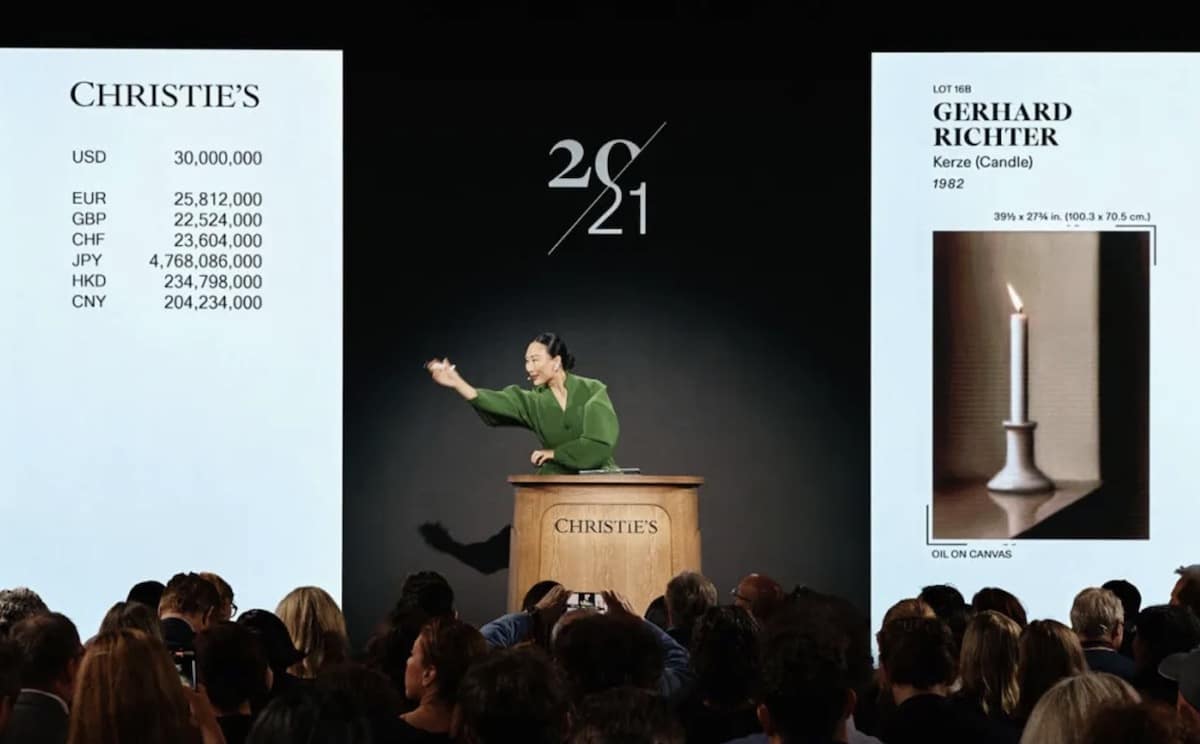
The Goodman Richters generated the most presale anticipation and the most nuanced post-sale discussion. With six of the eight works guaranteed by third parties, the group contained no disasters but produced few surprises. The star lot, Kerze (Candle) from 1982, was estimated at $35 million to $50 million, poised to challenge Richter’s secondary-market record of $46.3 million. It hammered quickly below its low estimate at $30 million, or $35.1 million with fees, to a phone bidder. The result places it as the fourth-highest price achieved by the artist at auction, which is a significant outcome by most standards, but the context of its estimate made the room read it as a shortfall. Two works exceeded their high estimates by substantial margins, including the oil-on-photograph 10. Dez. 99 [Firenze], which made $190,000 against a $70,000 high estimate, but the broader signal from the Richter group confirmed what advisors have been saying quietly for some time. Demand for the German painter’s work outside the most coveted trophy pieces is subdued, and the middle of his market is where the hesitation is most pronounced. Bidding from China and the Middle East was notably strong, the latter described by advisor Lorinda Ash as surprising given the current political climate.
The evening’s later lots produced the kind of energy depletion that tends to characterise the end of an intense auction week. Rudolf Stingel, Richard Prince and Mark Bradford all hammered below the estimate. Eric Fischl’s The Pizza Eater from 1982 hammered at $250,000 to its guarantor, half its low estimate. A Jeff Koons pornographic silkscreen from 1990 also hammered at half price, drawing the auctioneer’s quip that prompted what the room’s remaining occupants could muster in the way of laughter.
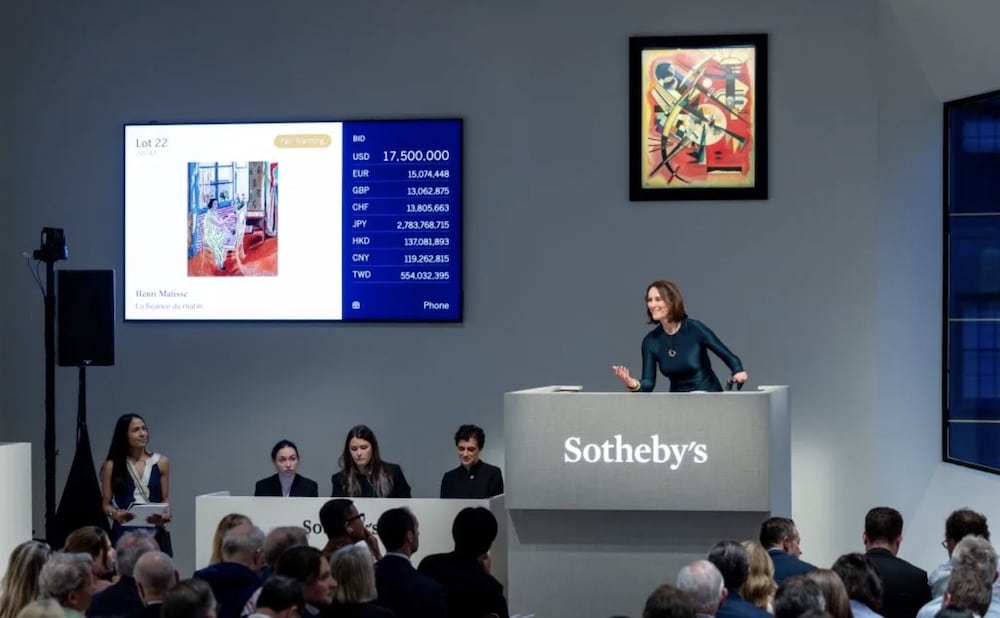
Photo Courtesy Sotheby’s
At Sotheby’s on Tuesday, the mood was steadier if less dramatic. The sale totalled $303.9 million against a high estimate of $320.2 million, with a sell-through rate of 97.6 per cent. Henri Matisse’s La Chaise Lorraine from around 1919, from the Barbier-Mueller Collection, topped the sale at $48.4 million after ten minutes of bidding against an estimate of $25 million, the evening’s most genuinely competitive moment. Picasso’s Arlequin (Buste) brought $42.6 million in restrained two-bidder bidding. A Van Gogh drawing, La Moisson en Provence, consigned anonymously from California, sold for $29.4 million within estimate. René Magritte’s Femme-bouteille from 1955, painted on an actual bottle and part of the collection of the late health lawyer Sybil Shainwald, set a record for the work, selling for $974,000. Julian Dawes, Sotheby’s head of Impressionist and modern art, noted an encouraging pattern of new collectors in their fifties and sixties entering at the $5 million to $20 million level, drawn particularly to Surrealism and to modernist stalwarts. “You’d be surprised how many people are entering at that level,” he observed. “They are not celebrities. They are not nepo babies. They are just people who are becoming billionaires and centimillionaires.”
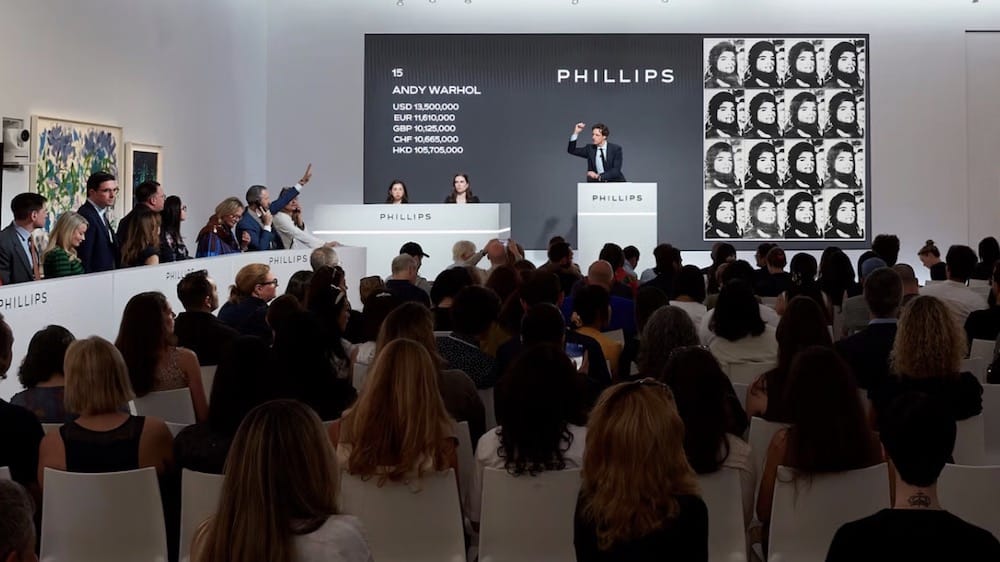
Photo Courtesy Phillips
Phillips closed the week with its strongest sale since 2022, achieving $115.2 million against a presale estimate of $84.2 million. Andy Warhol’s Four Coloured Marilyns (Reversal Series) from 1979 to 1986 set a new record for the series at $5.63 million, a sharp increase from the $3.5 million paid for a comparable work in 2017. A Joan Mitchell painting sold within its estimate at $6.8 million with fees, while a Helen Frankenthaler from the same collection sold for more than double its high estimate at $2.1 million with fees after a salesroom bidding duel. Jackson Pollock’s Untitled, from around 1948, which had failed to sell at Phillips in November 2024 after its guarantor declined to pay, returned with a reduced estimate and sold for $9.1 million, including fees. Andy Warhol’s Sixteen Jackies from 1964 led the sale but fell short of its estimate, hammering at $13.5 million.
The market’s more sober. Analysts have been articulating this message for some time. Extreme wealth concentrated in a small number of buyers can produce extraordinary headline numbers that don’t reflect the health of the market as a whole.
The Pollock at $181.2 million and the Matisse at $48.4 million are real transactions with real implications for the artists’ markets. But the sticky middle, the guarantors absorbing works that drew no competitive bidding, the canvases by established names hammering below estimate in the final hour, tells a different story. Both stories are true at the same time, and understanding the market requires holding them together rather than allowing one to eclipse the other.