Roni Horn is a conceptual artist to her core. Her work is often enigmatic, loved by the cognoscenti who understand the rules of its making and misunderstood by many of those who don’t.
‘Refusing to fit in the mould of social expectation forced me to find a way through that was truer and more respectful of myself,’ she has said. This sounds heartfelt from a gay woman now in her seventh decade, who grew up in the suburbs of New York at a time when alternative lifestyles were less viable than now. The androgyny of her name, she claims, had a deep influence, allowing for disparate aspects of her artistic personality to develop. As a result, she has never seen herself as just one thing. Even so, she knew from an early age that she wanted to be an artist, though she wasn’t sure how to go about it, studying sculpture because it allowed her to do ‘anything,’ and graduating in 1978. Afterwards, she opted to work outside the mainstream. She took numerous motorbike trips around Iceland, at one point going to live in a remote Icelandic lighthouse without even books for company. It was full-on immersion, a way of giving the ‘now’ her full attention. She has never been interested in explaining her work, but hopes there will be those curious enough to come along for the ride.
Mutability and change are what interest her. While in Iceland, she made a piece called Library of Water; huge glass columns were filled with meltwater from different glaciers. The word ‘library’ alerts us to her preoccupation. For, as in a Borges short story, a library is a place for the preservation of memories and knowledge. Often arcane knowledge that is in danger of being lost. The implication, here, is that Horn was ‘preserving’ information of these glacial waters for future generations because of the ubiquitous effects of global warming. In 2009, she had a major show at Tate Modern. In this, she further emphasised the themes of fluidity through the use of pure pigment, glass, copper and even gold.
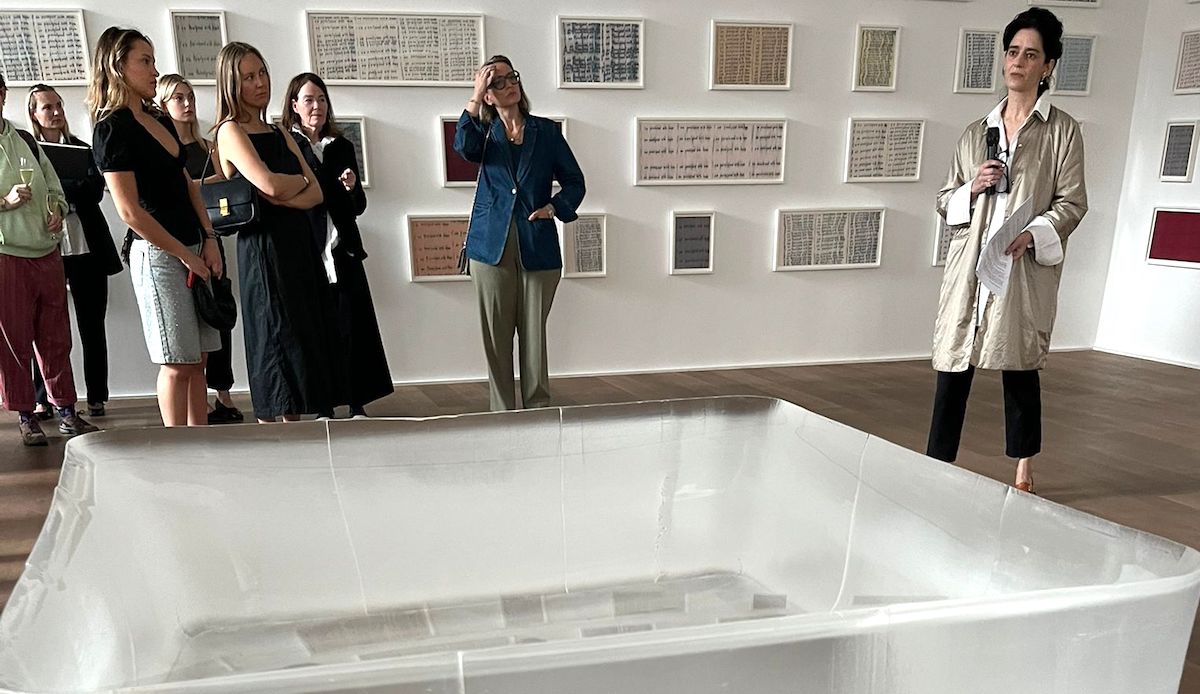
Roni Horn at Hauser & Wirth, installation shot
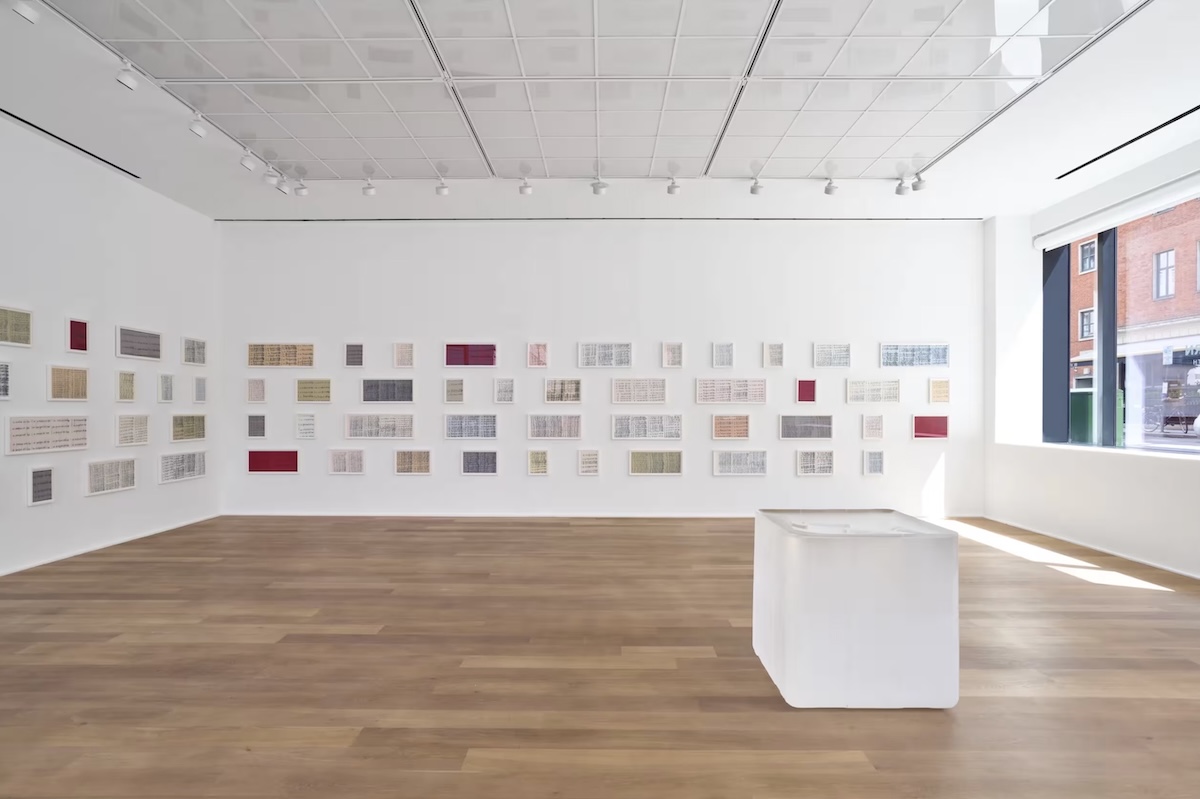
Now, Hauser & Wirth have filled the whole of one of their Savile Row galleries with her show Seizure of Hope. The exhibition is a conceptual act that makes a feature of repetition and the handwritten word. One phrase recurs like a mantra or a recording repeated on a loop. Taken from a performance by the stand-up comedian Maria Barnford, it was first used by Horn in her 2021 work LOG. ‘I am paralysed with hope’ was what Horn said, a ‘poignant connection to our time with regards to politics and the environment and now, of course, in relation to the pandemic.’
The 406 works on paper in this show are her very personal response to the world around her. Part stream of consciousness, part mantra, the repeated lines are reminiscent of those children have to copy out in school detention. The sentence ‘I am paralysed with hope’ is repeated again and again, then drawn over with wax crayon. At times, the writing is legible; elsewhere, it is blurred or smudged as if from water damage. The sentences spill, pour and bleed across the page. Executed on different coloured papers – oranges, duns and deep red – sometimes in flowing script, elsewhere in a tight crabbed hand, there is an obsessive quality about them. Not only do they suggest different personalities, but there’s the sense that if the phrase is repeated enough times, like an incantation or a spell, it will somehow take on magical properties that will make it true. It might, though, be argued that the constant repetition has the opposite effect, numbing the viewer so that with familiarity the phrase becomes not denser but thinner, sapped of all meaning.
Sitting in the centre of the gallery is a transparent glass cube, Untitled (“what happens to the hole when the cheese is gone?”) 2022. It’s not obvious what it’s doing there; it resembles a large ice cube. As the sun filters through the plate-glass windows of the gallery, it is lit up and then cast in shadow, reminding us of the constant change and mutability of the weather and the natural world. That identity, like water, is shifting, fluid, unstable rather than static or fixed. Surrounded by the forty-five slightly different works, all using the same phrase, is rather like being in a hall of distorting mirrors. Each repetition could be considered a bead on a rosary, a meditation mantra, or even a statement of optimism in the human spirit. Or, conversely, it might be seen as a point of stasis, a cry of desperation warning us that hope is finite and immutable. This exhibition does not give up its meanings easily, but one suspects that Roni Horn would be all right with that.
Roni Horn: Seizure of Hope, Hauser & Wirth, London, 21 May – 1 August 2026
Visit Here
Lead image: Installation view, ‘Roni Horn. Seizure of Hope,’ Hauser & Wirth London, 2026 © Roni HornPhoto: Alex Delfanne
Sue Hubbard is an award-winning poet, novelist and freelance critic. Her fourth novel Flatlands, from Pushkin Press can be bought here. Her latest poetry collection God’s Little Artist: poems on the life of Gwen John availabe here