
On the 28th of August 1843, the painter Richard Dadd stabbed his father to death in Cobham Park, near Rochester in Kent, believing him to be the devil in disguise. A recent tour of the Eastern Mediterranean, popular among educated and artistic young men who wanted to explore the ‘exotic’ away from the parochialism of England, had had a profound effect on his imagination, but during the demanding itinerary Dadd began to experience delusions.
On his return to England, he believed that the instruction to kill came from his true father, the Egyptian God, Osiris. Immediately after the murder, he fled to France, where he intended to go on a killing spree but was arrested after trying to cut the throat of a fellow traveller with whom he was sharing a coach. After ten months incarcerated in a French asylum, he was extradited to England and sent to the State Criminal Lunatic Asylum attached to Bethlem Hospital, suffering paranoid delusions. Unpredictable and often violent, he was then transferred to the newly opened Broadmoor Asylum in Berkshire, where, later, he died of consumption.
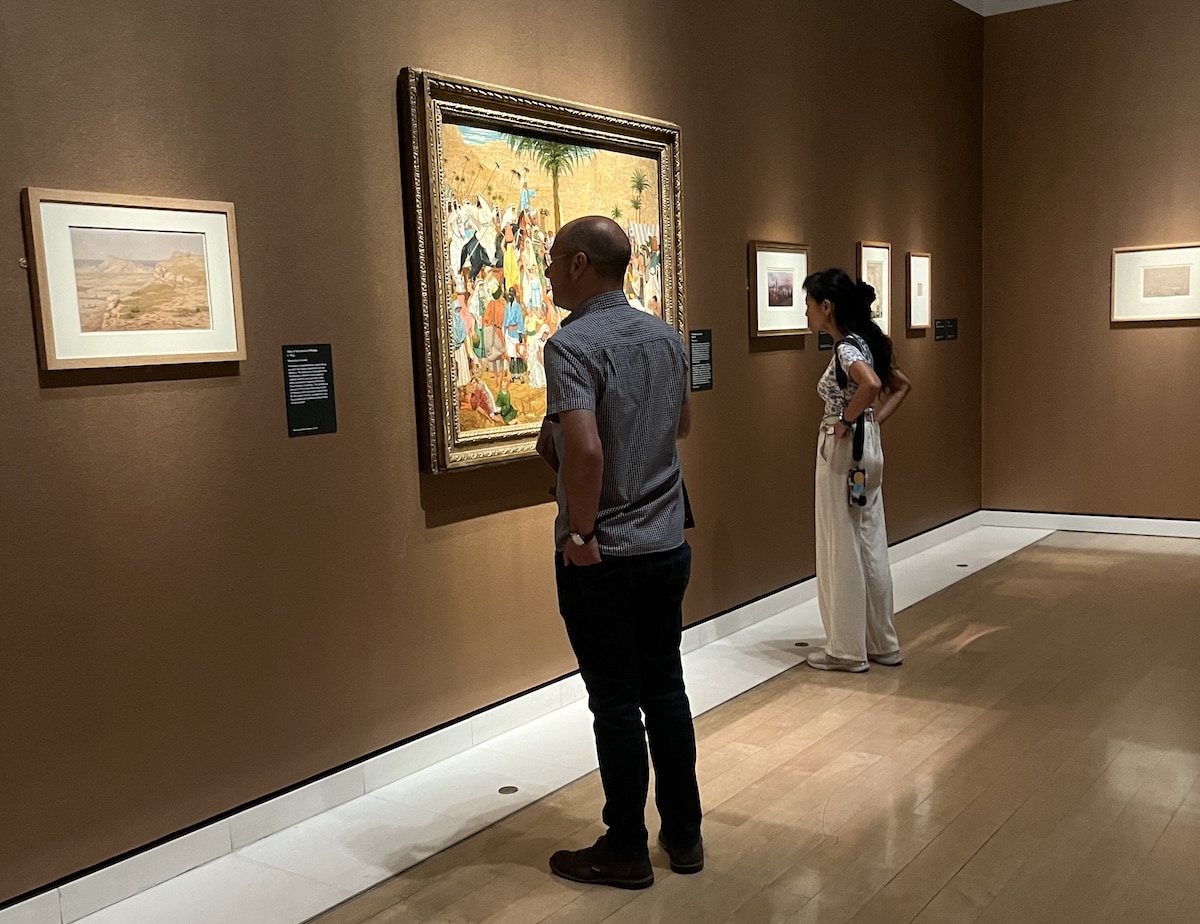
This first major retrospective of his work in over 50 years brings together around 100 oil paintings, watercolours and drawings that include sketchbooks and watercolours detailing the people, architecture and landscape of his Eastern Mediterranean tour.
In the late 19th century, madness was viewed through the lens of scientific objectivity, moral anxiety and social control. It had shifted from the brutal treatment of earlier eras when ‘lunatics’ were chained and their discombobulated behaviour considered entertainment for the toffs who came to gawp at them. The Victorians saw mental illness as needing ‘moral management’. This carried the eugenic-tinged fear of degeneration, the belief that ‘madness’ was a condition that could be inherited, thereby threatening the moral fibre of the British Empire. Asylums were structured to mimic traditional Victorian households where the superintendent acted as a firm but ‘benevolent’ father. Wealthier patients were given amusements like reading, writing and, in Dadd’s case, painting to distract them from their distress. Psychological interventions, such as Freud’s talking therapy, were still in their infancy. Though in La Salpệtrière Hospital, Paris, the French physician Charcot was beginning to experiment with hypnosis to alleviate hysteria.
Richard Dadd’s mother had died tragically when he was six, and his father, Robert, moved to Suffolk Street near the National Gallery, where he set up as a gilder to the artists of London, befriending the Orientalist landscape painter David Roberts and making other useful social contacts. In 1841 Richard began his studies at the Royal Academy, becoming an industrious and talented student. The early paintings exhibited here show subjects taken from English history, as well as classical and fashionable literature, painted not only to highlight his academic talents, but to sell.
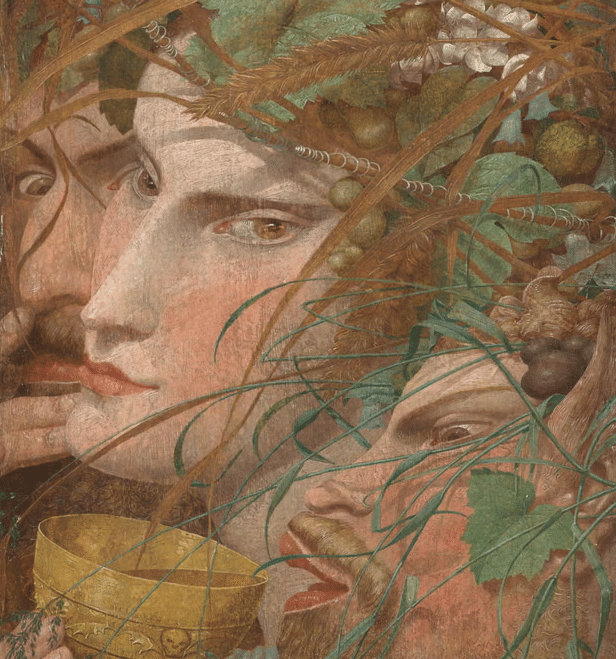
Bacchanalian Scene, 1862. Photograph: Oliver Cowling & RodTidnam/© Tate / Tate Images
Dadd, like the Pre-Raphaelites, the early Arts and Crafts movement and poets such as Keats (think La Belle Dame Sans Merci), drew inspiration from the Middle Ages, which was seen as a spiritually and aesthetically purer time. A reaction to the new industrialisation, Medievalism portrayed the ideal not as the polluted city with its belching factories but as a golden past filled with chivalry and feudal order. Fairy mania also gripped Victorian culture, providing psychological solace in a landscape of dark Satanic mills and scientific materialism, and filling the spiritual vacuum left when Darwin’s theories of evolution rocked long-held religious beliefs.
Shakespeare was another rich source for Dadd. He made his name with Titania Sleeping, shown at the Royal Academy first in 1841. Inspired by A Midsummer Night’s Dream, Titania lies lulled to sleep by her fairy attendants beneath a bower of entwined goblins and homunculus in pointy hats, playing petal trumpets. This is surrounded by a border of bats with entwined wings. Hidden in the shadows, Oberon prepares the magic flower juice to squeeze onto Titania’s eyelids. At the same time, a trail of toadstools leads to a group of naked Bacchanalian dancers exiting the canvas, stage left. This use of Shakespearean tales and myths gave the Victorians permission to indulge in covert eroticism.
Dadd worked on the Fairy Feller’s Master-Stroke, painted in Bethlem, for nine years, paying microscopic attention to detail. To give context to the painting, he wrote a long poem, the Elimination of a Picture & its Subject─called The Fellers’ Master Stroke, in which each of the characters is given a name, and there are frequent references to English folklore and Shakespeare in an attempt to show that his intricate work was not just the product of a fevered imagination. In the crowd of tiny Bosch-like figures hidden among giant flowers, berries and a lattice of twigs and blades of grass, is the ‘fairy-feller’, his axe raised to cleave a hazel nut to furnish Queen Mab’s carriage. A patriarchal bearded figure in a gold crown stands nearby ready to tell the axeman to strike. He is surrounded by an intricate tapestry of soldiers, peasants and winged fairies drawn from Dadd’s imagination. In the top right is a pharmacist (the same profession as his murdered father). The effect is obsessive, disturbing and uncanny, as if he is trying to come to terms with his guilt in this allegory of parricide played out in a miniature fairy domain. The painting would ultimately remain unfinished.
Despite his early academic training at the Royal Academy, Richard Dadd can be seen as a precursor to Outsider Art. Confined for a lifetime in Bethlem and Broadmoor, he was freed from the constraints of Victorian society. His intense visionary perspective with its obsessive, miniscule, crowded compositions without any discernible horizon line would influence surrealists and writers like Angela Carter and the LSD inspired graphics of 1960s underground magazines such as Oz, blurring the boundaries between academic painting, pure imagination and psychotic delusion.
Richard Dadd: Beyond Bedlam, Royal Academy of Arts, 25 July – 25 October 2026
Visit Here
Sue Hubbard is an award-winning poet, novelist and freelance critic. Her fourth novel Flatlands, from Pushkin Press can be bought here.
Her latest poetry collection God’s Little Artist: poems on the life of Gwen John can be bought here