
Anita and Poju, among the most important contemporary art collectors in Britain, will next month offer approximately 100 works from their 5,000-strong family collection at Christie’s London, which the auction house bills as the highlight of its summer season. With an estimated total of nearly £20 million, the sale marks the first time any portion of the Zabludowicz collection has come to public auction.
Updated Sales Results
The two-part sale featured 56 contemporary artworks from the collection of Anita and Poju Zabludowicz, followed by a 79-lot sale of postwar and contemporary art. A £4 million ($5.2 million) Philip Guston from the Zabludowicz’s holdings led the sale. The evening totalled £25.7 million ($34 million), with the first sale accounting for £15.5 million ($20.5 million) and the second for £10.2 million ($13.5 million).
The Zabludowicz works were estimated to total between £12.6 million and £19.3 million ($16.6 million–$25.5 million); the hammer total was £12.3 million ($16.2 million), just below the low estimate; with the house’s fees, the sale totalled £15.4 million ($20.5 million). Seven lots were guaranteed; three were withdrawn; seven failed to find buyers, for a sell-through rate of 89 per cent. Records were set for Anj Smith, Rose Wylie, and Jakub Julian Ziolkowski.
Guston’s Mirror Head (1977) led the Zabludowicz works, fetching just shy of £4 million ($5.2 million) on a £3.5 million ($4.6 million) low estimate, thus accounting for a third of the sale’s value. No other works reached nearly those heights, with the second-highest price coming in within estimate at £1.3 million ($1.7 million) for an 11-foot-wide Mark Bradford mixed-media collage, Farther South and Elsewhere (2015). Rashid Johnson’s 10-foot-wide Untitled Broken Crowd (2021) sold within estimate for £952,500 ($1.3 million), while a 1994 Richard Prince’s Untitled (Cowboy) exceeded estimate to fetch £1.6 million ($2.1 million).
The collection, formalised in 1994, has been one of the defining private accumulations of British and international contemporary art over the past three decades. Anita Zabludowicz, who received an OBE for services to the arts in 2015, served as a trustee of the Camden Arts Centre for fifteen years and was a founding benefactor of Tate Modern when it opened in 2000. Between 2007 and 2025, the family ran their own non-profit exhibition space in a converted chapel in Camden, providing a platform for cutting-edge work by artists who had not yet found institutional support. Their influence on the ecology of the British art world, particularly Anita’s, has been substantial and widely acknowledged.
The sale is considered a recalibration, a marking of the transition, with primary responsibility for the collection passing to the couple’s children, currently led by their daughter, Tiffany.
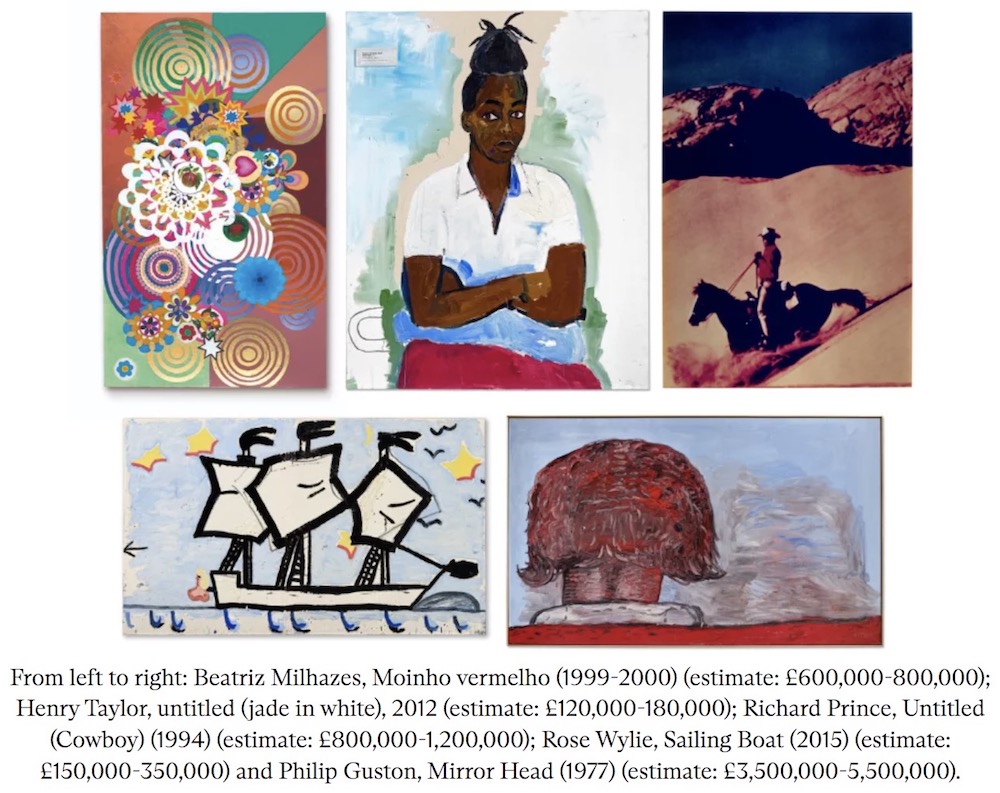
The top lot was Philip Guston’s Mirror Head from 1977, a panoramic canvas depicting the back of his wife’s dark-red head against an expanse of blue, estimated at £3.5 million to £5.5 million. The work is among the most significant pictures in a sale that also includes Damien Hirst’s I Love You from 1994 to 1995, one of the artist’s first butterfly paintings, estimated between £600,000 and £800,000, and Antony Gormley’s Quantum Cloud XXXIII from 2000, estimated between £300,000 and £500,000. Tiffany Zabludowicz describes the Gormley as having functioned as an impressive Christmas tree in the family home, a detail that humanises the institutional scale of the collection it comes from.
Yoshitomo Nara’s large white sculpture, Your Dog, from 2002, estimated at £550,000-£850,000, carries its own domestic history. Anita recalls encountering it at Art Basel Miami Beach and immediately putting her arms around it, an instinctive response to an object that has since become a family favourite. Henry Taylor’s Untitled (jade in white) from 2012, a bold portrait of the artist’s daughter, is estimated at £120,000-£180,000 and represents the personally significant work that gives a long-form collection sale its texture beyond the headline lots. Equally central to the Collection is the work of the ‘Pictures Generation’, who emerged in New York in the 1970s and 1980s. Richard Prince’s Untitled (Cowboy) (1994) (estimate: £800,000-1,200,000) belongs to his most iconic series, which used images from Marlboro cigarette adverts to interrogate the construction of American cultural tropes. Cropping out text to focus on the brand’s signature Lone Ranger, Prince invited the viewer to reconsider America’s ultimate heroic archetype: a cinematic symbol of masculinity and bravery embedded in the popular imagination. Other works broach the idea of appropriation from very different contexts. Neo Rauch, raised under Communism in East Germany, apes the language of Socialist Realism in his surreal, dystopian panorama Zähmung (2011) (estimate: £500,000-700,000), while Takashi Murakami borrows elements from Japanese manga and anime in Mushroom Painting #4 (2000) (estimate: £30,000-50,000) – an early example of his ‘superflat’ aesthetic.
Other artists in the selection explore human experience through meditations on history and culture, many of whom confront racial and social concerns through distinct material vocabularies. Mark Bradford’s monumental Farther South and Elsewhere (2016) (estimate: £1,000,000-1,500,000) made by layering saturated carbon paper onto canvas, takes its title from a chapter in Runaway Slaves: Rebels on the Plantation (2000) by historians John Hope Franklin and Loren Schweninger, its swirling composition reminiscent of a geological rupture. In Rashid Johnson’s Untitled Broken Crowd (2021) (estimate: £800,000-1,200,000), twenty-eight faces emerge from ceramic tile and mirror in a composition charged with the chaos and energy of contemporary urban life. Lubaina Himid – currently representing Britain at the Venice Biennale – is also included in the sale with Free Healthcare or Free Birdsong (2014) (estimate: £20,000-30,000), a work in which the artist engages with the politics of representation.
Anita Zabludowicz, Co-founder of the Zabludowicz Collection: “What began as a personal passion became a lifelong commitment — a way of living shaped by curiosity, instinct, and an openness to experimentation. The Collection grew dynamically and without fixed boundaries: it was never about following a single narrative, but about embracing discovery, dialogue, and risk. We are now in a period of reflection, preparing for the next generation and for future projects yet to be ignited. I feel incredibly proud to have arrived at this moment, where we can truly open up and share the collection with those who wish to continue its journey, giving other collectors and museums the opportunity to offer some of these works a new home and a new life. Art has no beginning and no ending — it is a story that continuously evolves. That is how I see the future: Then, Now, Next.”
The generational transition the sale marks is embodied most clearly in Tiffany Zabludowicz, who holds a master’s degree from the Courtauld Institute and has since expanded the collection in her own directions, bringing in digital practitioners including Jon Rafman and performance artist Puppies Puppies alongside ceramics acquired with her first small collecting budget at the age of sixteen. She now runs the family’s New York operation, Times Square Space, a residency and exhibition venue established in vacant offices. She articulates a philosophy of collection-building that emphasises platform provision and residency support over pure acquisition. Studio costs, she notes, are making it increasingly difficult for artists to work in both London and New York, and residency programmes represent a meaningful response to that pressure.
The family has also deepened its commissioning programme on the Finnish island of Sarvisalo, where works, including Matthew Day Jackson’s 2012 underground bronze skeletal sculpture Hauta, have been sited. Nearly forty works have been donated to national collections to date, with further donations planned in consultation with advisors who identify appropriate moments in each artist’s career.
Since 2014, the couple has faced undue criticism, campaigns and artist-led protests focused on their family wealth’s origins in the Israeli and Finnish defence company Soltam Systems, built by Poju’s late father, a Polish Holocaust survivor. The company was sold in 1991. A family spokesperson has stated that Tamares Group, the private equity firm through which the family’s current interests are managed, holds no investments in the West Bank or in military-related activities, with the majority of its portfolio concentrated in the United States, the United Kingdom and Finland across real estate, hospitality, technology and private equity.
Anita’s account of her own evolution as a collector traces a familiar arc from personal pleasure to institutional responsibility. What began as putting pictures on walls became about sharing, then about providing platforms, and finally about understanding when purchase is not the most useful form of support. Whether the market embraces the Christie’s sale with the enthusiasm the collection’s significance deserves is one question. What the sale represents beyond its commercial outcome, the closing of a chapter in British collecting that shaped the contemporary art scene for thirty years, is a rather more substantial one.
Top Photo: © Artlyst 2025
The Zabludowicz Collection sale at Christie’s London, 25 June, online 16 June – 30th. Further details at christies.com.