
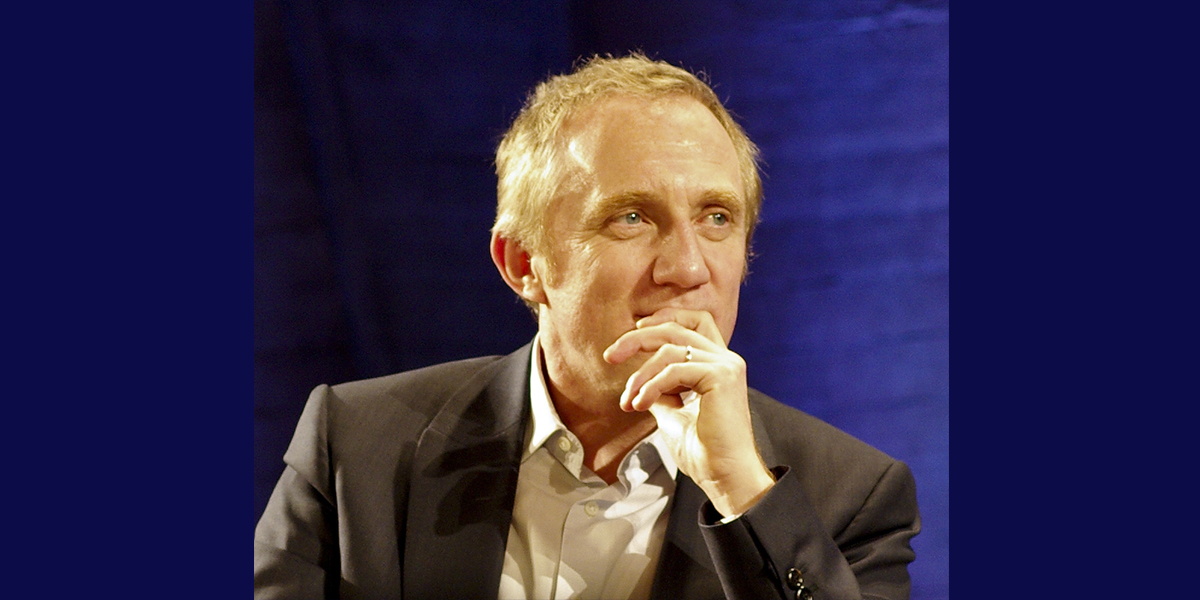
Christie’s released some noteworthy news last week, choosing the moment when the art world’s collective attention was locked onto Manhattan’s spring sales to announce a boardroom change that has been a long time coming. François-Henri Pinault is the new Chairman. The appointment is not exactly a surprise, but its timing and the manner of its announcement tell you something about how these things are handled at the very top of the market.
The Pinault family has owned Christie’s since 1998, when François Pinault senior acquired the house and gave it the kind of stable, long-term ownership that the institution had notably lacked in the years preceding the sale. That stability is the thing Bonnie Brennan, Christie’s current CEO, returns to most emphatically when she speaks about the change. Nearly three decades of consistent ownership, she says, has made it possible for Christie’s to grow and serve its clients in ways that simply would not have been achievable under more restless proprietorship. François Pinault remains on the board as Honorary Chair. His son now sits beside him as Chairman. It is, in its way, a family affair made official.
François-Henri is not a figure who needs an introduction in the luxury world. Since 2005, he has run Kering, the fashion group whose houses include Gucci, Saint Laurent, Bottega Veneta, Balenciaga and Alexander McQueen, transforming it into one of the most commercially powerful and publicly sustainability-conscious luxury conglomerates on earth. Before that, he took over as Chairman of Artémis, the family holding company, in 2003. Artémis sits at the centre of an extraordinary web of interests: fine wine through Château Latour and Clos de Tart, entertainment through Creative Artists Agency, luxury cruising with Ponant, and football through Stade Rennais, alongside the Pinault Collection’s museums at the Bourse de Commerce in Paris, the Palazzo Grassi and Punta della Dogana in Venice.
What he brings to Christie’s is not simply a famous surname but a particular kind of commercial intelligence, one shaped by years of thinking about how cultural institutions build and maintain relevance across shifting markets and changing audiences. His statement on the appointment was measured and carefully framed, emphasising scholarship and connoisseurship alongside innovation, which is more or less the line Christie’s always walks but feels worth restating when ownership transitions are involved.
Also joining the board is Bryan Lourd, who has been appointed as Non-Executive Director. Lourd runs Creative Artists Agency, which Artémis also owns, so this is less a new relationship than an existing one given formal expression. CAA started as a talent agency and has grown into something considerably larger, representing leading figures across film, television, music, sport, publishing and the creator economy while also offering strategic consulting to corporate clients worldwide. What Lourd offers Christie’s is a particular understanding of how cultural figures and global audiences connect, which maps fairly naturally onto what a major auction house needs to think about if it is serious about expanding beyond its traditional collector base.
Guillaume Cerutti, whose name does not appear anywhere in Christie’s announcement, is no longer Christie’s Chairman; his term ended last month. No statement, no polite expression of gratitude, no acknowledgement of his tenure in an institution whose communications are usually meticulous about such courtesies. Whether that silence reflects the circumstances of his departure or simply an editorial decision, it was noticed by everyone paying attention.
The art market has changed considerably since the Pinaults first acquired Christie’s in the late 1990s. Private sales now rival public auctions in significance. Online bidding has fundamentally altered the dynamics of the salesroom. Competition between the major houses has intensified at every price point, and the pool of serious collectors has both widened geographically and become harder to read. Against that backdrop, a chairman who understands global luxury markets and cultural institutions from the inside is a more useful figure than one who came up through the auction world itself.
What this means in practice for Christie’s direction remains to be seen. The Pinault family’s involvement in the house has always been hands-on compared with other auction-house ownership structures, and the formality of François-Henri’s board appointment suggests that involvement is deepening rather than relaxing. For specialists, for consignors and for the collectors who make the whole enterprise function, the question that matters is whether the change produces anything perceptible at the level of the business itself, or whether it simply reflects a generational passing of the baton within a family that has, by Christie’s own account, been a remarkably stable steward of one of the art world’s oldest and most significant institutions.
Photo: Portrait de François-Henri Pinault pris aux Journées de la Terre en 2011 à l’unesco Paris Leafar Raphael Labbé Courtesy Wiki Media Commons