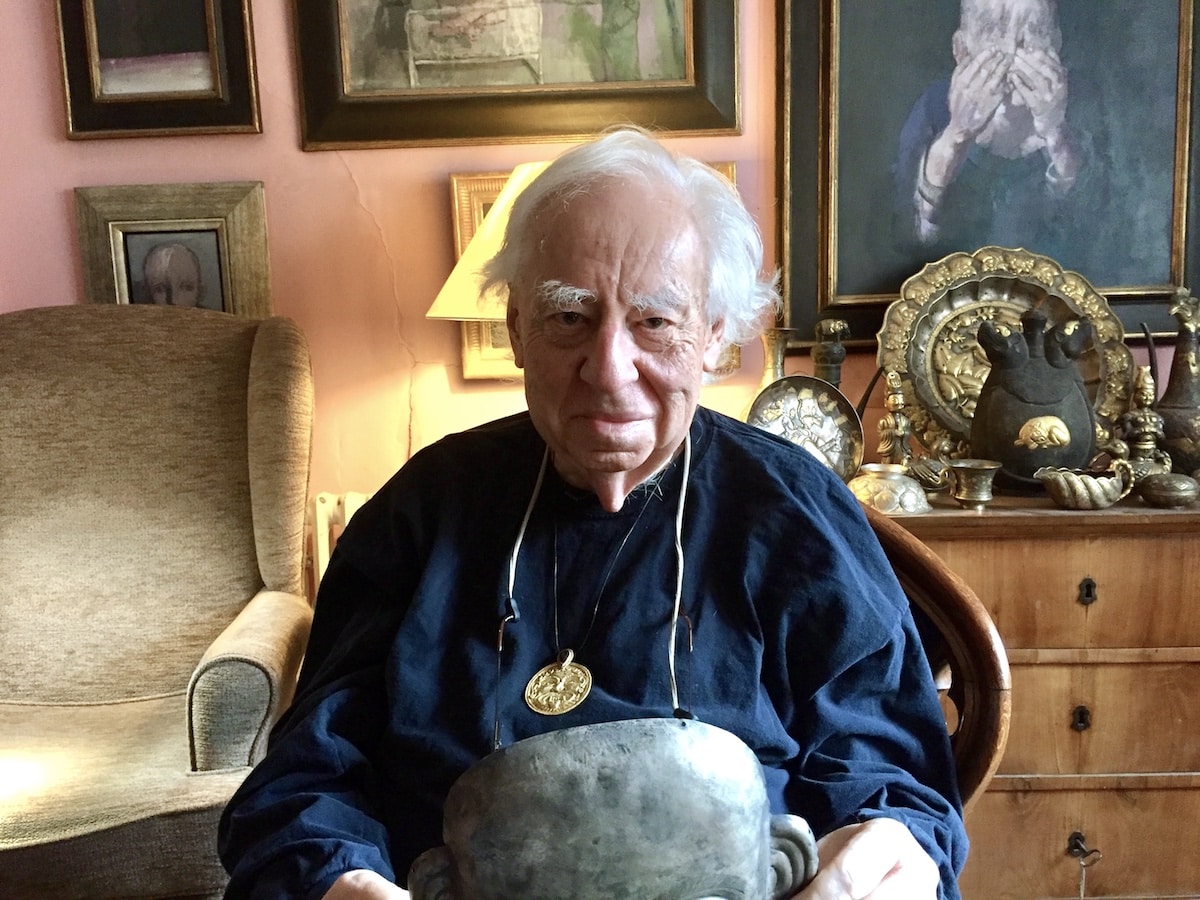
Edward Lucie-Smith, the Jamaican-born British art critic, poet and author whose output across more than six decades shaped how several generations understood modern and contemporary Art, has died aged 93. Born John Edward McKenzie Lucie-Smith in Kingston, Jamaica, on 27 February 1933, he published more than a hundred books. He remained a working critic until the last few years, as opinionated and as readable as he had ever been.
He came to Britain in 1946, was educated at the King’s School Canterbury, and read History at Merton College Oxford, graduating in 1954. After two years as an education officer in the Royal Air Force and a decade writing advertising copy in London, he committed to freelance writing in 1966 and never looked back.
His first reputation was as a poet. A Tropical Childhood and Other Poems, published in 1961, won the John Llewellyn Rhys Memorial Prize and the Arts Council Triennial Award, and announced a writer with an eye for concrete detail and an ear for rhythm that would serve him well when he turned to Art Criticism. He succeeded Philip Hobsbaum as leader of The Group, the influential mid-century circle of London poets, and was elected a Fellow of the Royal Society of Literature in 1964. He also co-founded the independent small press Turret Books the following year. Poetry and art criticism were never entirely separate activities for him, and it showed in the way he wrote: with a sense of rhythm, a preference for the specific over the abstract, and an instinct for the telling image that most art writers lack.
What made Lucie-Smith unusual, and unusually enjoyable to read, was that it was almost impossible to separate the critic from the man. His personality was fully present in his prose: curious, irreverent, occasionally mischievous, and always willing to say what he actually thought rather than what the institutional consensus required. He could be disarming and provocative in the same sentence, and he took genuine pleasure in puncturing solemnity wherever he found it. Reading him, you always knew exactly who you were dealing with.
In his private life, he was a proud Homosexual who lived through a time in the UK when being gay was criminalised. Lucie-Smith was also a talented photographer who explored erotic male imagery decades before Queer Art became an accepted art genre.
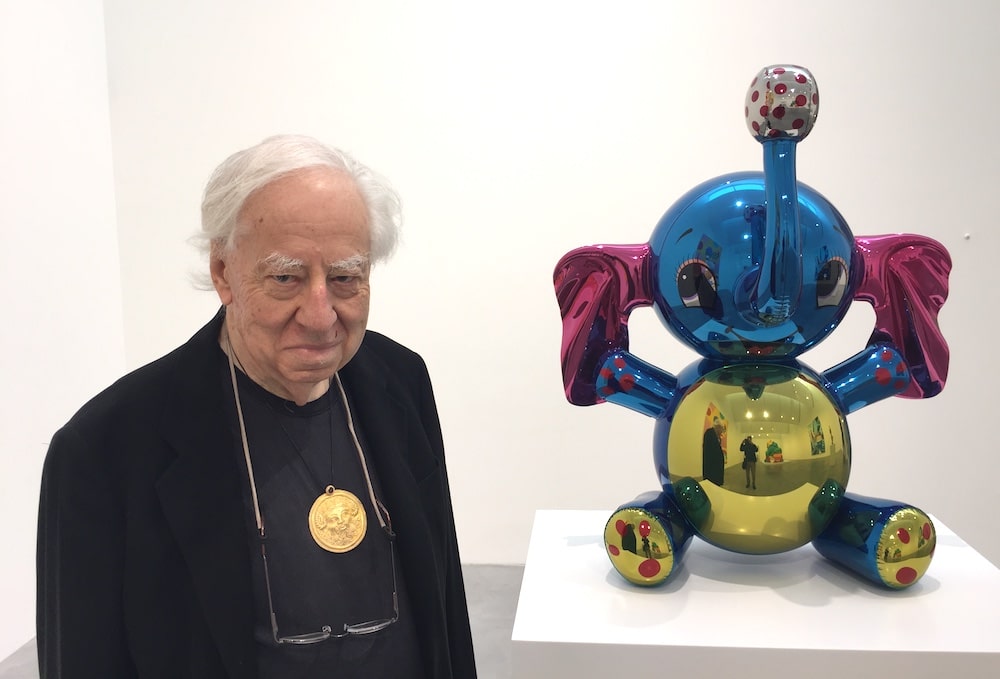
Edward Lucie-Smith with Jeff Koons Sculpture © P C Robinson Artlyst
His pivot toward art history and criticism in the late 1960s produced a body of work remarkable for both its range and its accessibility. Movements in Art since 1945, first published in 1969 and regularly updated over the following decades, became one of the most widely used survey texts in art education worldwide. This book managed to cover an enormous amount of ground without ever becoming dull. Symbolist Art from 1972 remains a standard reference for that movement, and The Invented Eye from 1975 offered a conceptual framework for thinking about photography that was ahead of its time. Art Today and Art Now, published in 1977, mapped the international contemporary scene with the kind of breadth only someone with Lucie-Smith’s extraordinary range of contacts could have achieved.
Those contacts were genuinely exceptional. He interviewed Andy Warhol and knew David Hockney. He was present in the circles that defined British and American Art through the swinging sixties, the seventies and the eighties, and he maintained active connections with the contemporary art world right up to the present, never retreating into nostalgia for the decades he had lived through. He seemed constitutionally incapable of losing interest. He was an early champion of the painter Sean Scully, whom he helped launch an international reputation. Sean was eager for Edward to receive an honour from the Queen, but came up against brick walls from the establishment.
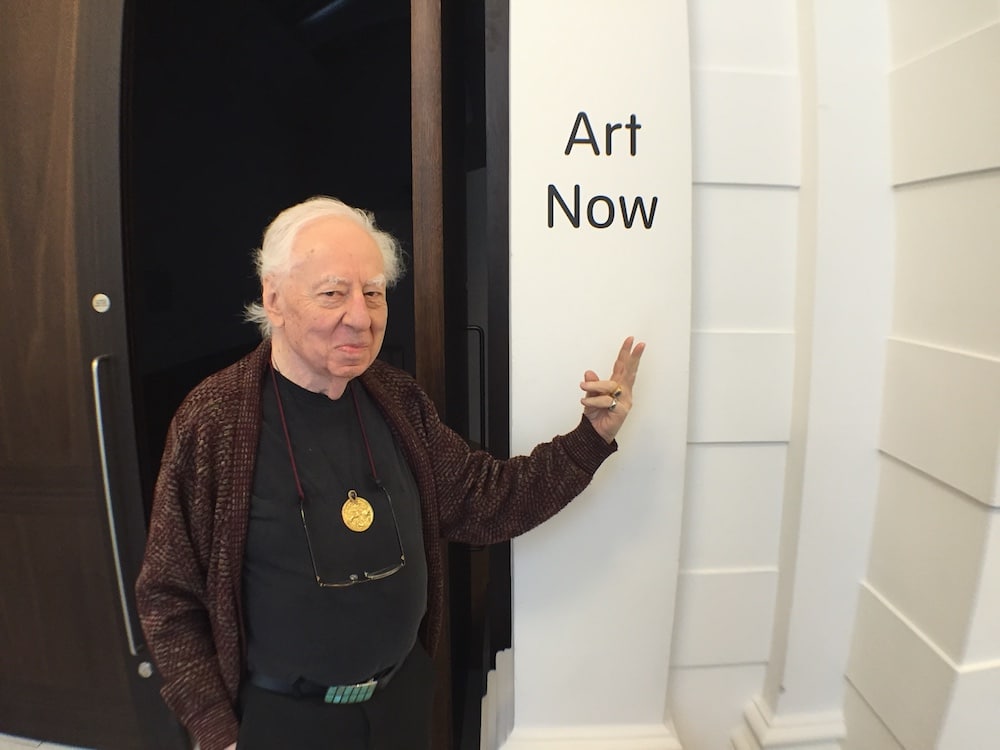
Edward Lucie-Smith Photo P C Robinson© Artlyst 2026
In the late 1990s he collaborated with the American feminist artist Judy Chicago on Women and Art: Contested Territory, published in 1999, and followed it with Chicago’s biography the following year. The collaboration was characteristic: Lucie-Smith was always drawn to artists whose ambition matched their seriousness, and he engaged with feminist Art at a time when many male critics of his generation found reasons not to do so.
Beyond writing, he broadcast for BBC Radio 3 in the early 1980s with Conversations with Artists, and spent decades contributing criticism to ArtReview, The London Magazine and The Spectator. As a curator, he worked widely, organising retrospectives at the New Orleans Museum of Art and providing a platform for emerging artists at the Bermondsey Project Space in London. He was a distinguished member of The Critics Circle. Artlyst was fortunate to have him as a Senior Art Critic for over 12 years.
Edward Lucie-Smith was one of those writers who made the whole enterprise of art criticism seem worthwhile: not as a gatekeeping exercise or an academic performance, but as a conversation between an alert and engaged mind and a public that deserved to be taken seriously. More than a hundred books across six decades is an extraordinary legacy by any measure, but what those books communicated, beyond information and analysis, was the particular pleasure of a man who genuinely loved looking at Art and never tired of writing about what he saw.
This year, the National Portrait Gallery accepted three portraits of him by well-known artists, including Beryl Cook.
Words/Photos Paul Carter Robinson © Artlyst 2026