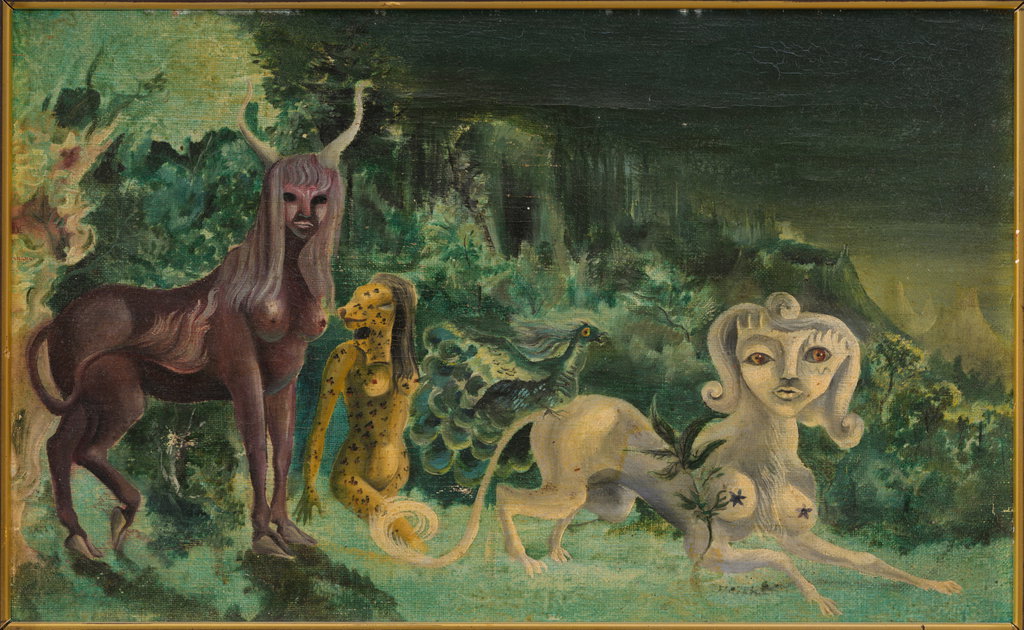
A painting by Leonora Carrington that has been missing from public knowledge for decades has been located in Spain, in the possession of the family of the psychiatrist who treated her during one of the most documented and least fully understood periods of her life. Villa Pilar, completed in 1940 during Carrington’s six-month stay at the Peña Castillo sanatorium near Santander, will make its public debut at the Freud Museum in London as part of Leonora Carrington: The Symptomatic Surreal, the first exhibition to bring together the artworks she produced during her hospitalisation. The discovery marks a significant moment in Carrington scholarship and lends the exhibition the weight it could not otherwise carry.
The circumstances that brought Carrington to the sanatorium are well documented in her own account. She had fled Nazi-occupied France following the detention of her lover Max Ernst, and arrived in Spain in a state of acute psychological crisis. Luis Morales, the psychiatrist who oversaw her care at Peña Castillo, administered shock therapy and encouraged her to continue drawing throughout her stay. The sketchbooks she produced there were given to the dealer Julien Levy during the year Carrington subsequently spent in New York before relocating permanently to Mexico. After Levy died in 1981, several works from this period were dispersed at auction in 2004 and acquired by private collectors.
Villa Pilar was one of only two paintings Carrington made at the sanatorium, the other being Down Below, whose title she used to describe her experience of the institution as something approximating the afterlife. A 2017 journal article by Frida Kahlo scholar Salomon Grimberg established that Carrington had given Villa Pilar to Morales. Still, attempts by the exhibition’s curator, Vanessa Boni, to contact the Morales family initially went unanswered. Persistence eventually paid off. Boni confirmed that the family held the painting and secured it as a loan for the Freud Museum presentation.
The work echoes its companion painting in its imagery while introducing distinct new elements. Like Down Below, Villa Pilar features breasted animal-human hybrids in verdant surroundings during the ambiguous hours between light and dark, their eyes carrying what Boni describes as an intimidating amusement. Where Down Below suggests interior, psychic space, Villa Pilar introduces what reads as safari overtones, evoking a lion, a leopard, a Cape Buffalo and a peacock in a composition that feels both grounded in observed reality and entirely removed from it.
Boni’s curatorial argument is that the Santander period should be understood as formative rather than merely biographical, a chapter in Carrington’s development as an artist rather than simply a record of her suffering. The themes she began exploring in the sketchbooks and paintings of that time, she argues, continued to inform her practice across the decades that followed.
Villa Pilar joins the exhibition from 1 July, with the closing date extended to 10 August. Both Santander paintings will be reunited when Symptomatic Surreal travels to the Faro Santander art centre on 8 September, returning Carrington’s full sanatorium corpus to the city where it was made.
Top Photo Leonora Carrington, Villa Pilar (1940) Photo by Nathan Keay, courtesy of Faro Santander.