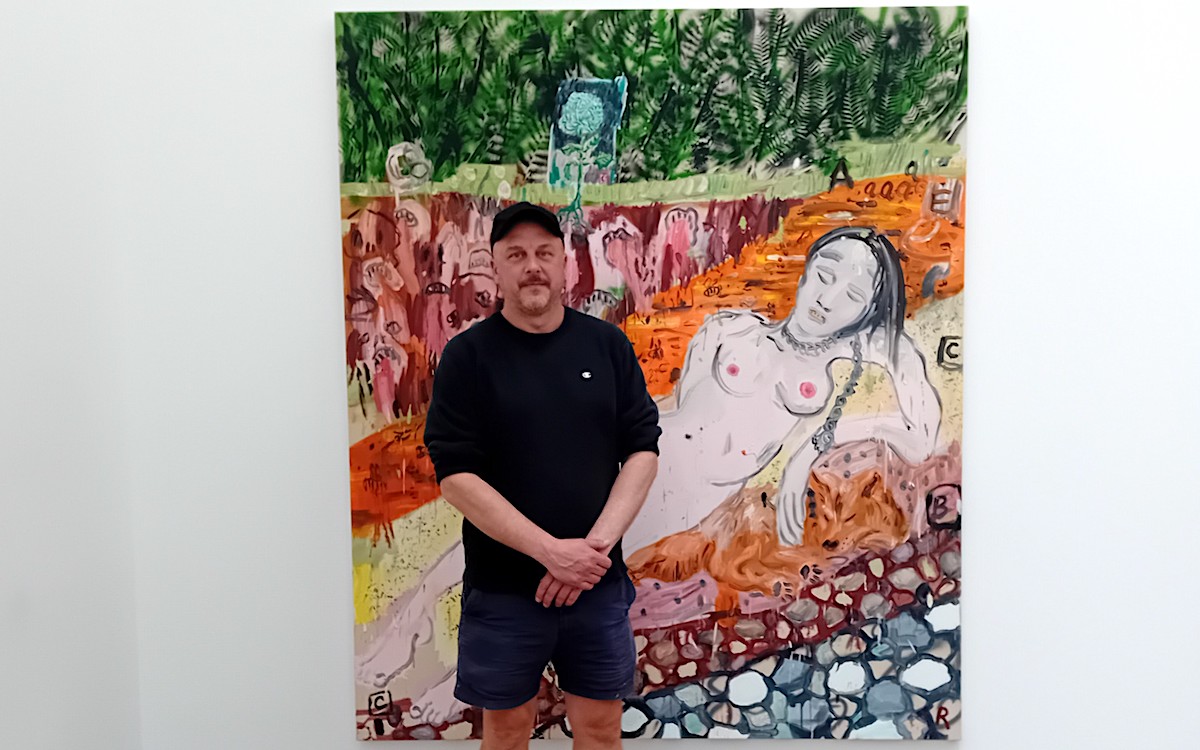
Dale Lewis’s solo show ‘Lost Illusions’ is his fourth with Edel Assanti in its Fitzrovia gallery, but his first in London for five years. As the gallery says, the paintings continue a line of enquiry into the social fabric of contemporary life underpinned by the themes that have always animated his work: class, national identity, sex, labour, mental health, nature and technology – but the way he does so has changed markedly…
If I can summarise your previous work: typically large-scale horizontal-format paintings depicting life in the East End through multiple figures, painted quickly by pulling together details from your sketched street observations to form narratives, all underpinned by compositional structures lifted from Old Master paintings. Not much of that is apparent here?
No, it had started to feel too much like a brand. I became aware that I was painting to meet expectations rather than for myself, and the work no longer felt like it was coming from me.
In Lost Illusions, I’ve made the paintings I actually wanted to make, which meant going back to my earlier practice – something more raw, more immediate, and deliberately less resolved – while still finding ways to hold multiple narratives within a single image.
The paintings in the exhibition are an entirely new body of work I made following Frieze London last October. I left the fair and realised I couldn’t really remember what I had seen, so I wanted to create something that actually stays with you, something more memorable and enduring.
And you’ve been studying?
Yes. After not having been in a classroom for 25 years, I began studying horticulture at Capel Manor College in Enfield. I’d always been interested in gardening and it runs in my family. Along with this class, moving from Leyton five years ago to the edge of Epping Forest has led to nature seeding itself through the works in Lost Illusions.
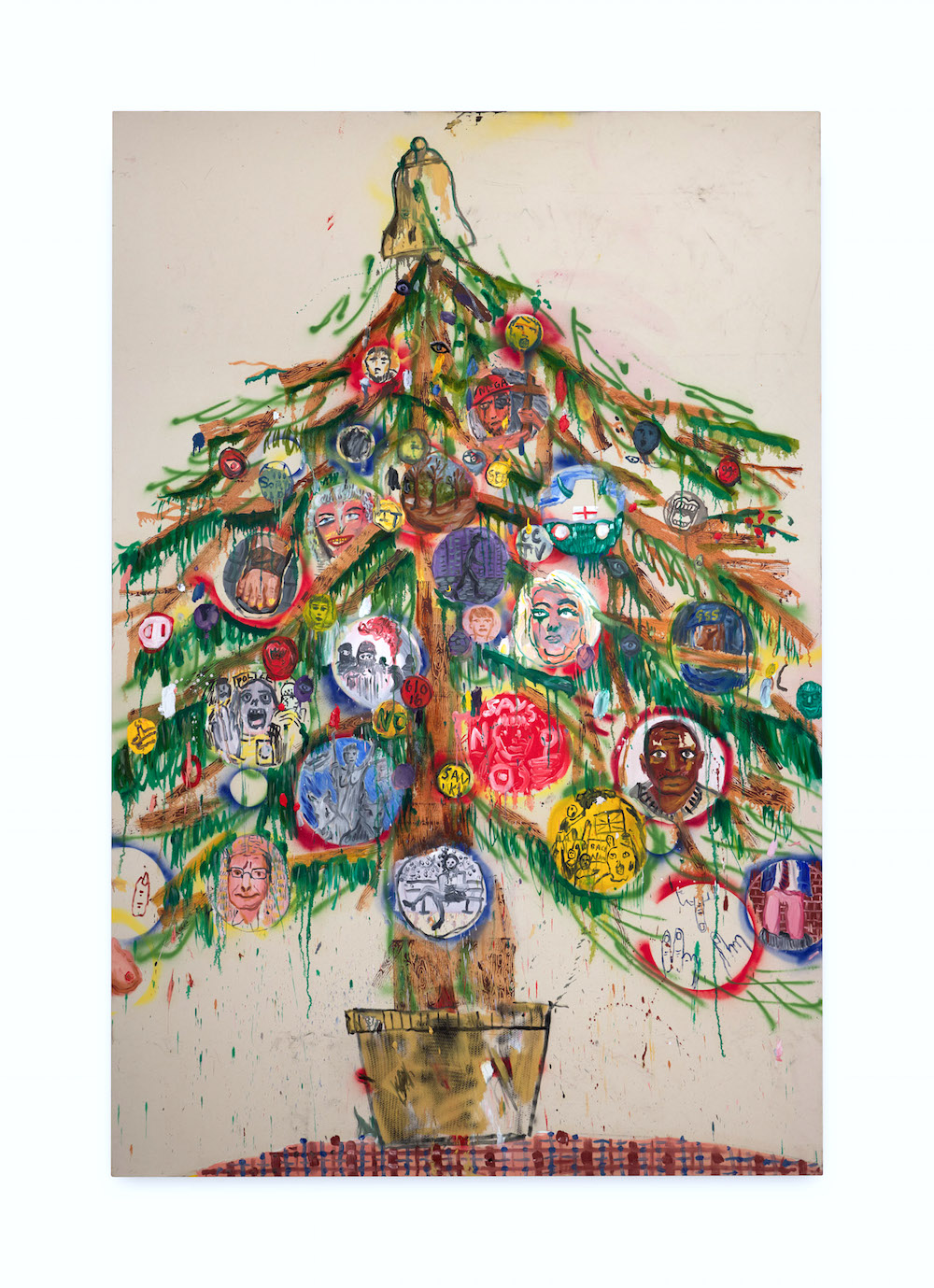
Dale Lewis: The Bell, 2025 – oil on canvas, 300 x 200 cm
Christmas in June is a rarity! What is The Bell about?
I made The Bell to capture the atmosphere in Britain right now through the story of The Bell Hotel in Epping, which became a national flashpoint in 2025 after protests over migrants being housed there.
For me, the painting isn’t just about migration or one specific event, but about the wider anger and frustration that’s built up over years – Brexit, Covid, rising bills, political failure – and how that frustration often gets directed towards particular groups or symbols. I used the structure of a Christmas tree because it already suggests something cut down, decorated, and eventually discarded, and then built the painting like a system of hanging stories, where each bauble becomes a compressed fragment of fear, resentment, or disaffection. I wanted the whole image to feel unstable, like a snapshot of a country that could tip over at any moment.
You show the asylum-seeking hotel resident who was convicted of sexually assaulting a teenage girl in July 2025. What else do we see?
Alongside the asylum seeker, schoolgirl and judges involved in the case, you have figures like TOWIE icon Gemma Collins rubbing shoulders with masked protestors holding flares, a man in a ‘Make Epping Great Again’ cap carrying a large wooden cross, surveillance eyes, slogans and fragments pulled from news coverage and everyday life. I made the painting just after putting up a Christmas tree, and using baubles to hold separate stories together felt right for a subject that’s so loaded and fractured. The bell itself became important too – it can signal celebration, an alarm, or mark the exact time, which, in this painting, really means now.
How did you paint it?
The canvas is sealed and treated, but not primed. I don’t really do preparatory drawings anymore like I used to – instead, I use spray paint directly onto the canvas to build the image from the start, so the painting becomes the actual process rather than a copy of an earlier idea. You never have full control with spray paint, and I like that unpredictability.
From there, I worked in lots of different ways: some areas painted quickly and loosely, others more slowly and carefully, just responding to what the painting needed. The texture in the trunk and branches came from repeatedly using a linocut, and I also sprayed through clothes from charity shops to create different marks and patterns. Even the baubles came from everyday objects around the studio, like coasters and plates.
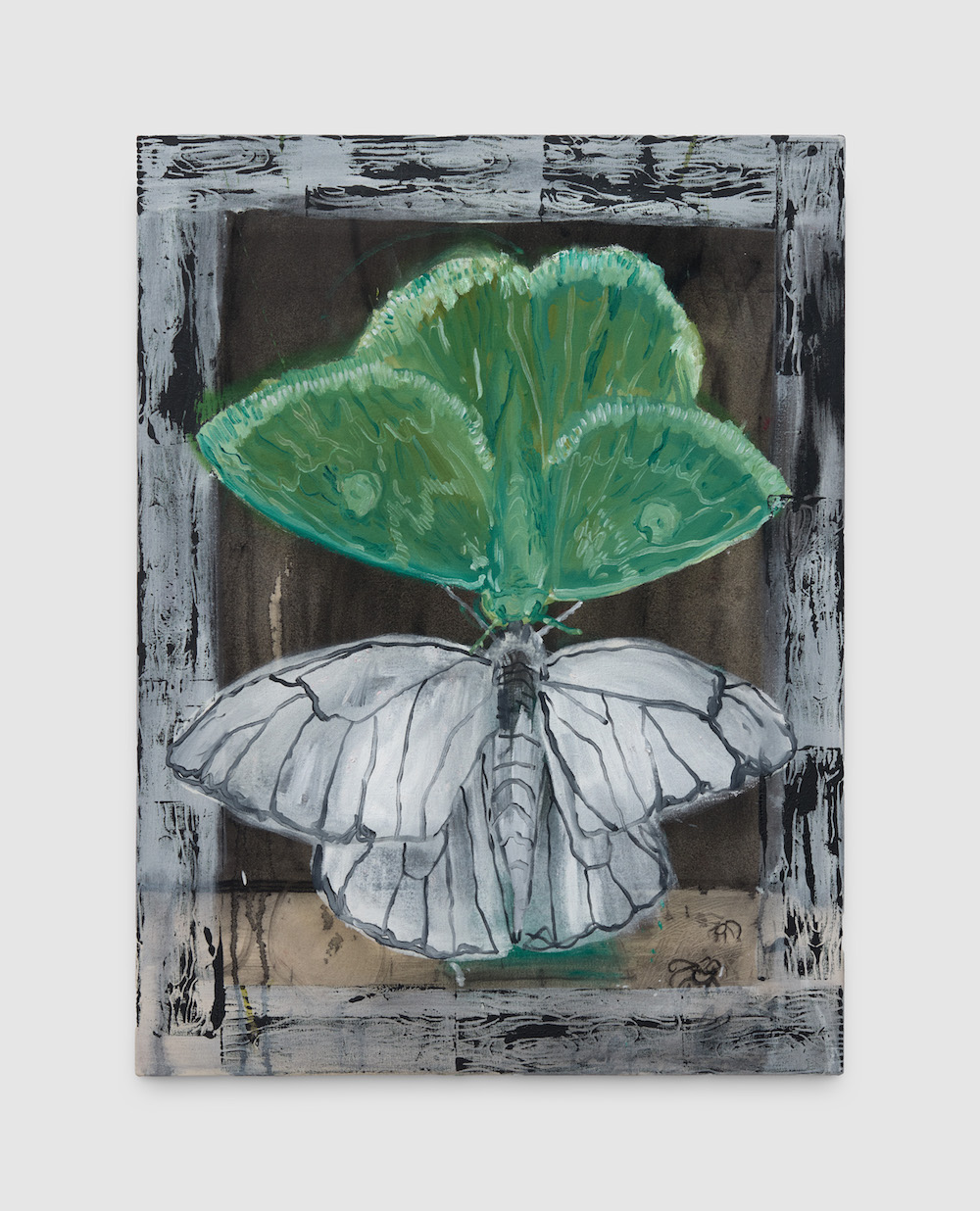
Dale Lewis: Kiss Goodbye, 2025 – oil on canvas, 60 x 80 cm
There are three paintings showing two butterflies. What led you to that subject?
We were studying pollinators at college, and I became interested in species that have gone extinct in Britain, especially the Essex Emerald moth and the Black-Veined White butterfly. I liked the idea of painting something incredibly delicate and beautiful that no longer exists here. When I first painted them, I remember thinking, this doesn’t really look like something I’d normally make – it felt softer, quieter, almost romantic in a strange way, a bit like a Luc Tuymans painting. But beneath that lies the reality of disappearing habitats, climate change, and the destruction of green spaces. The framing around the insects has this burnt, charcoal-like quality, almost like scorched wood or the aftermath of forest fires. I also used the same linocut process as in The Bell, so motifs and textures recur throughout the exhibition.
So I guess we’ve kissed goodbye to those species?
Yes, but they are also about people. The title Kiss Goodbye (2025) comes from blue-collar working couples like my parents and many of the families I grew up around, where people worked 12-hour shifts and kept opposite schedules. One person would come home just as the other was leaving, so they’d literally kiss goodbye in passing. I started thinking about how people can become like pollinators – constantly moving, working, keeping systems alive – but eventually disappearing in the same way. So the painting is about extinction, but also labour, exhaustion, time passing and quiet human connection.
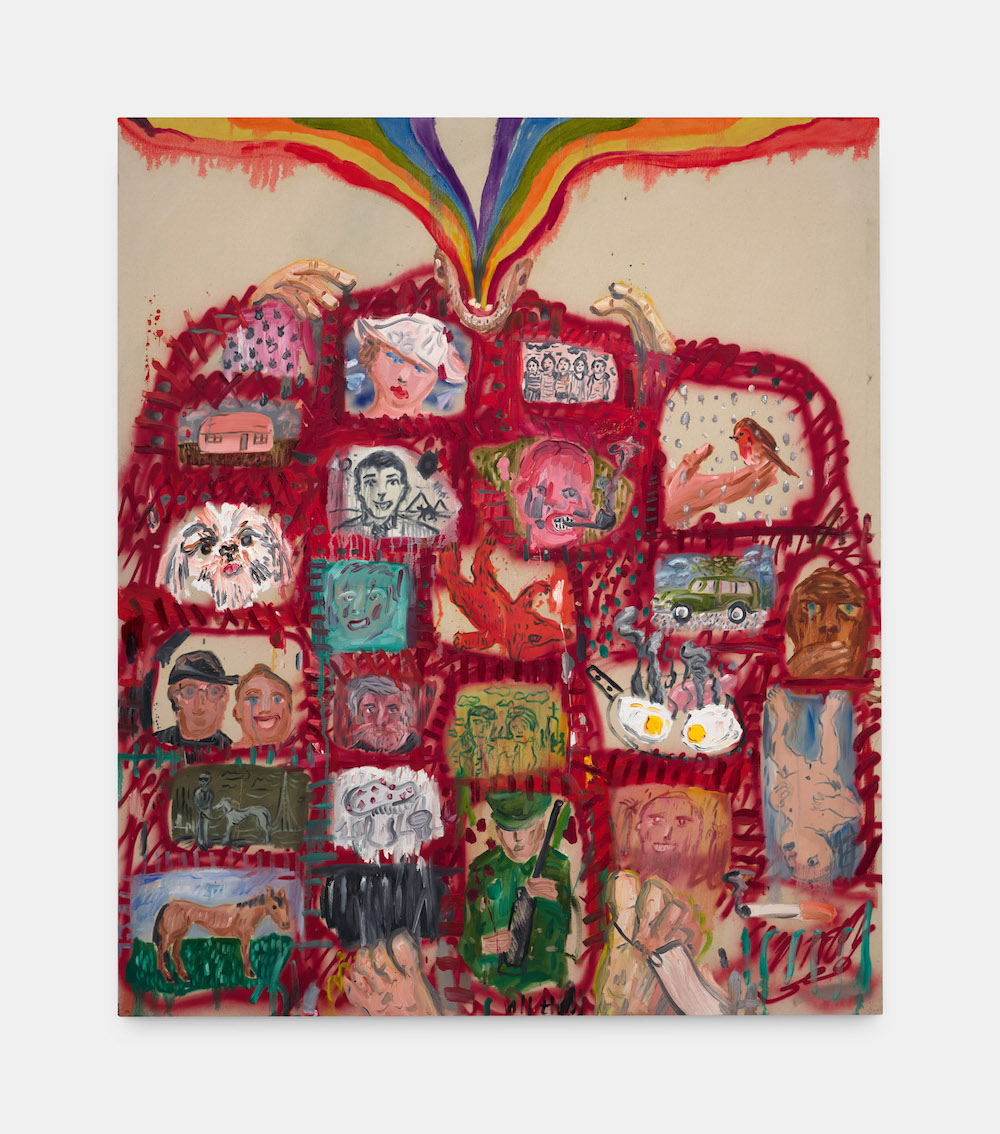
Dale Lewis: Shroud, 2025 – oil on canvas, 200 x 170 cm
What are we looking at in ‘Shroud’?
Shroud is based on my grandfather, who died last year, and the time we spent as a family sitting with him on the morning of his death. It’s built around a novelty blanket my cousin bought for him, which brought together images from his life and ours – him in Libya, his job as a factory worker, his love of horses, family moments, and everyday details. I reworked those fragments into a kind of patchwork, so the painting feels like multiple small scenes held within one larger image, almost like a quilt.
At the top, there’s a faint rainbow-like form suggesting something leaving the body, and below that, an empty area of canvas, which felt important as a space of absence and transition. The painting moves between different textures and speeds, from soft detail to more open, unresolved areas, reflecting how memory works. The title also references the idea of a shroud as something that both covers and reveals, the Shroud of Turin, and the idea of an image holding something physical and spiritual at once.
So we have two Christmas paintings in June! Is that a real cigarette, next to where his foot has been labelled for the morgue?
Yes – that’s a real cigarette. At the end, he was asking, in Arabic, for a very specific brand of cigarettes, even though they don’t sell them anymore, and he hadn’t smoked for years. We couldn’t get them, but I put one in the painting.
The hands seem Guston-like to me, and the rainbow effect – I take it as his spirit leaving – looks like Morris Louis?
I can see what you mean about Guston and Morris Louis. Now that I’m not structuring paintings around Old Master compositions, I feel much freer to draw from across art history – whatever feels right in the moment, rather than staying within one system or reference point.
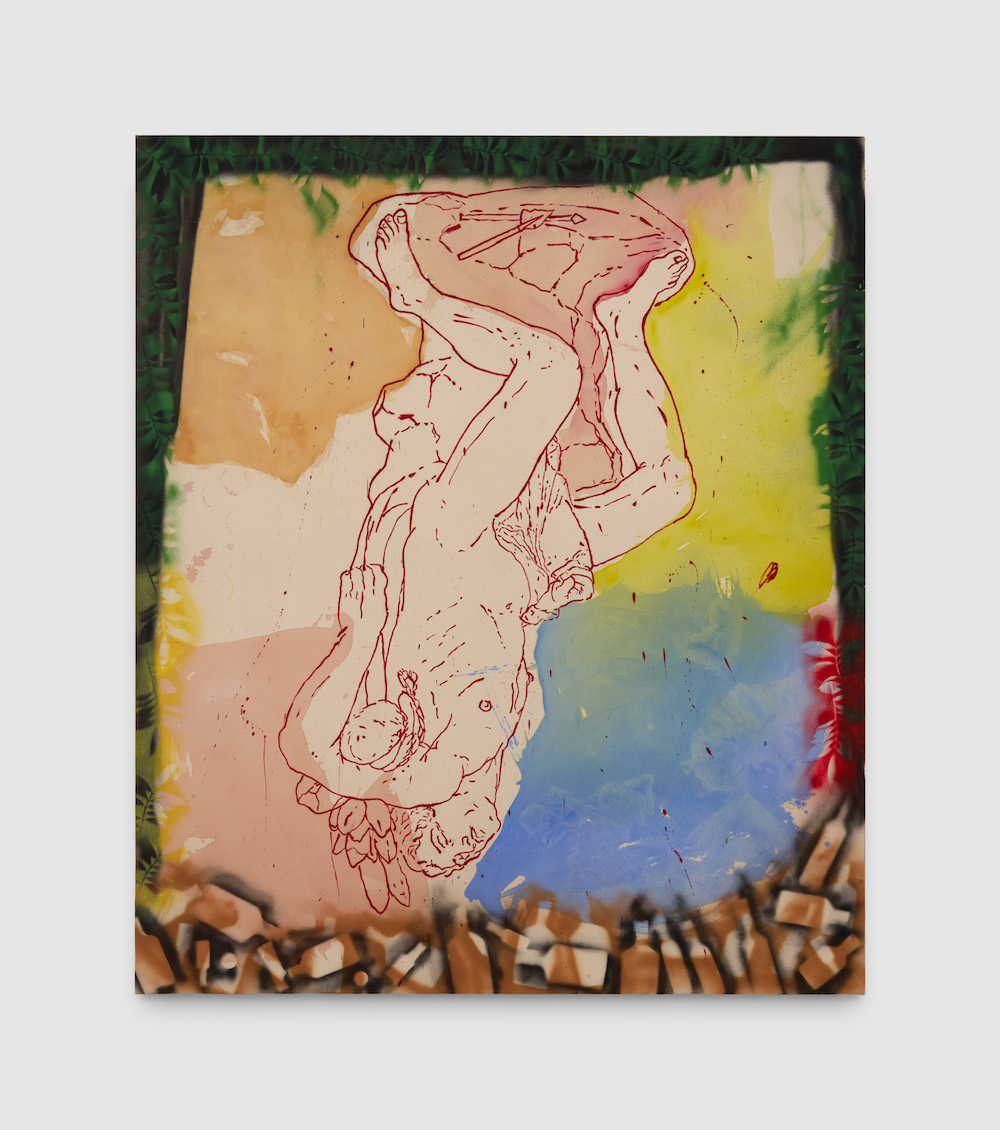
Dale Lewis: Bad Day, 2025 – oil on canvas, 200 x 170 cm
‘Bad Day’, on the other hand, looks like Renaissance meets Baselitz?
I guess people will say that because of the inversion, but it actually starts elsewhere. It draws from William Blake’s Albion, from Matisse’s colour palette in the Snail cut-outs, and there’s probably more Polke in it than Baselitz. There’s also Bernini’s St Sebastian reimagined as a kind of queer icon – the arrows have been removed and placed on the ground, so it’s less about martyrdom and more about what comes after.
The central figure is deliberately destabilised, almost falling, and I’ve used bodily fluids – tears, blood, vomit and piss – as colour fields around him, with a red outline suggesting veins and circulation. The idea was to turn everything upside down, quite literally, but also to collapse different art historical references into a feeling of malaise and disaffection in the present. It’s a bit absurd, but that’s part of it – a way of showing things slipping out of control.
Why are the bottles there?
They’re about being gay, middle-aged, and drinking too much. I was trying to stop drinking but I had a relapse, and that became part of the work rather than something I edited out.
I used the actual bottles I had been drinking from as part of the making process, spraying around them and around leaves from my garden, so the frame carries those traces directly. It’s not symbolic in an abstract way – it’s just embedded in the reality of how the painting was made and what was going on at the time.
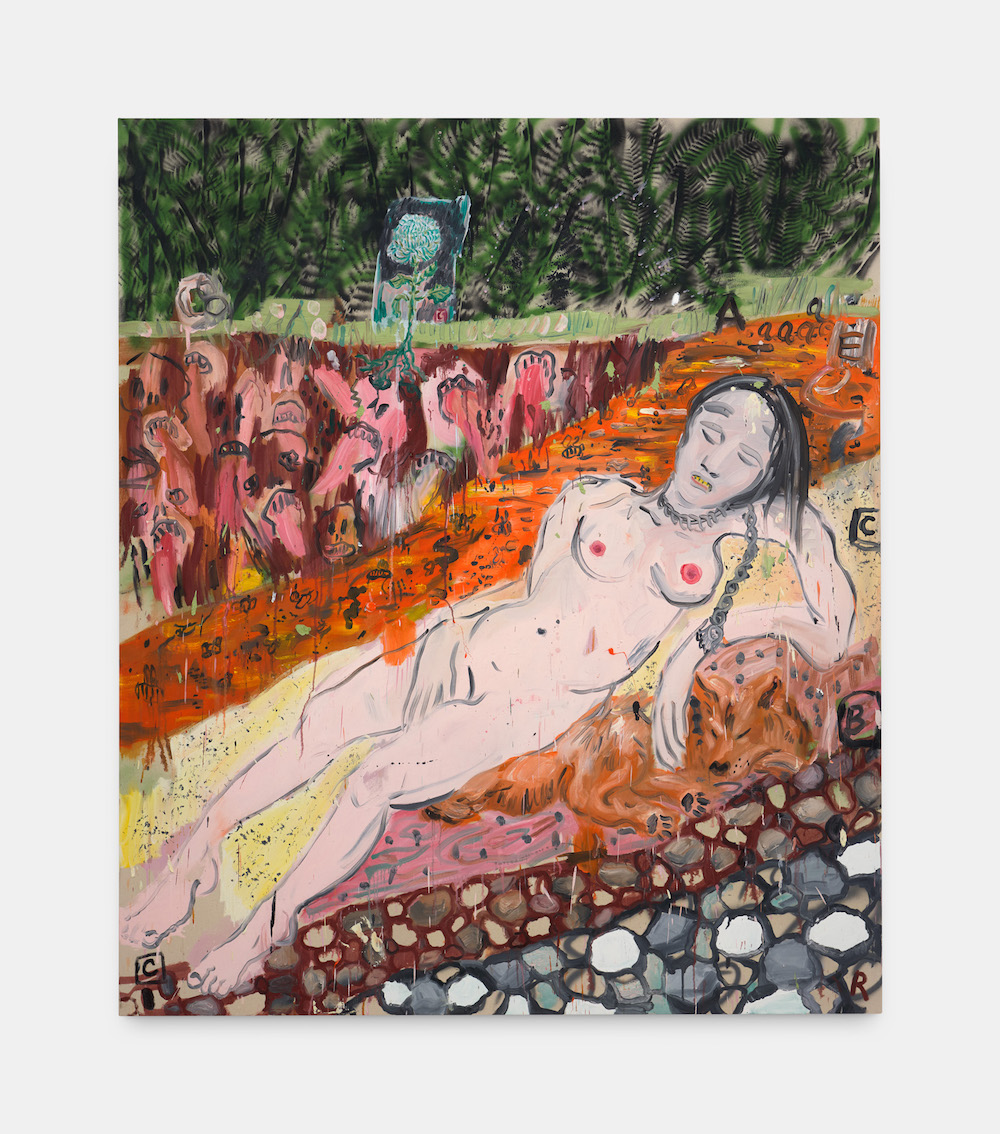
Dale Lewis: Horizon, 2025 – oil on canvas, 200 x 170 cm
Who’s this?
She was a family friend’s daughter who died last summer. In the painting, she’s shown buried underground, as if part of a cut-away landscape – something I developed through studying soil and geological layers at horticulture college. The markings on either side refer to scientific codes for those layers, but they’re deliberately not fully legible, more like traces than information.
The figure itself draws on Japanese visual references, including early 20th-century printmaking and a subtle use of a Noh mask for the face, which gives her a pale, almost corpse-like quality rather than a traditional European nude. Above her is a chrysanthemum, the flower associated with death in Japan, and the top of the painting uses stencilled ferns from my garden to suggest the forest floor.
Horizon isn’t just a portrait but also a way of thinking about layers of earth, time and memory – how everything, living or dead, eventually becomes part of the same ground we stand on.
Dale Lewis: ‘Lost Illusions’ runs to 14 August at Edel Assanti, 1B Little Titchfield Street, London W1W 7BU. Images courtesy the artist and Edel Assanti, photographs by Tom Carter (except portrait, by Paul Carey-Kent)