
Looking at one of John Constable’s sketchbooks and seeing one of his drawings of a fir tree on Hampstead Heath, the poet William Blake exclaimed, “Why, this is not a drawing, but inspiration.” (1)
And in the words of John Constable,
“The world is wide; no two days are alike, nor even two hours; neither were there ever two leaves of a tree alike since the creation of the world; and the genuine production of art, like those of nature, are all distance from one another.” (2)
The recent Lucien Freud show at the NPG featured Constable’s Study of the Trunk of an Elm Tree (1821), an inspiration for Lucien Freud’s etching After Constable’s Elm (2003). The everyday, omnipresent tree inspires an inner identification and universal interest. The ephemeral yet eternal presence of trees, part of a living ecosystem when cared for, generates a healthier environment, reduces heat in cities, and maintains a water table.
Herman Hesse reveals the spirit of the tree… “For me, trees have always been the most penetrating preachers. I revere them when they live in tribes and families, in forests and groves. And even more I revere them when they stand alone. They are like lonely persons. Not like hermits who have stolen away out of some weakness, but like great, solitary men, like Beethoven and Nietzsche. In their highest boughs the world rustles, their roots rest in infinity; but they do not lose themselves there, they struggle with all the force of their lives for one thing only: to fulfil themselves according to their own laws, to build up their own form, to represent themselves. Nothing is holier, nothing is more exemplary than a beautiful, strong tree. When a tree is cut down and reveals its naked death-wound to the sun, one can read its whole history in the luminous, inscribed disk of its trunk: in the rings of its years, its scars, all the struggle, all the suffering, all the sickness, all the happiness and prosperity stand truly written, the narrow years and the luxurious years, the attacks withstood, the storms endured.” (3)
Artists, in each and every way, embody a spirit of transformation through their artwork, and trees become a metaphor for this process of identification and transformation.
In ancient times, the Vikings had many stories and believed the World Tree was the source of unborn souls the World Tree referred to as Yggdrasil, was the centre of the whole world and a place that protected the Gods. In a way, Yggdrasil fed the worldview of their culture, with its roots leading in three directions: the kingdom of the Gods, the giants and the Dead. The World Serpent lay at the base of the tree and the Eagle at its crown. In the Edda poems the eternal tree is constantly being destroyed and continually renewed. Even as Gods are destroyed, and whole worlds die, the eternal tree remains. Similarly, the Tree of Life exists in the Bible and occupies a central place in all of life, and forms the axis for a cosmological worldview. The Tree of Life, of course, continued to exist in the Garden of Eden, where the tree of knowledge of good and evil likewise existed for a time after the apple event with Adam and Eve… And it can be found in cultures worldwide as myth or archetype, notably the Kabbalah, the Buddhist Bodhi tree of enlightenment under which Buddha sat, and the tree of immortality in the Quran, and it can be found in Mayan, Aztec, Olmec and ancient Chinese mythology.
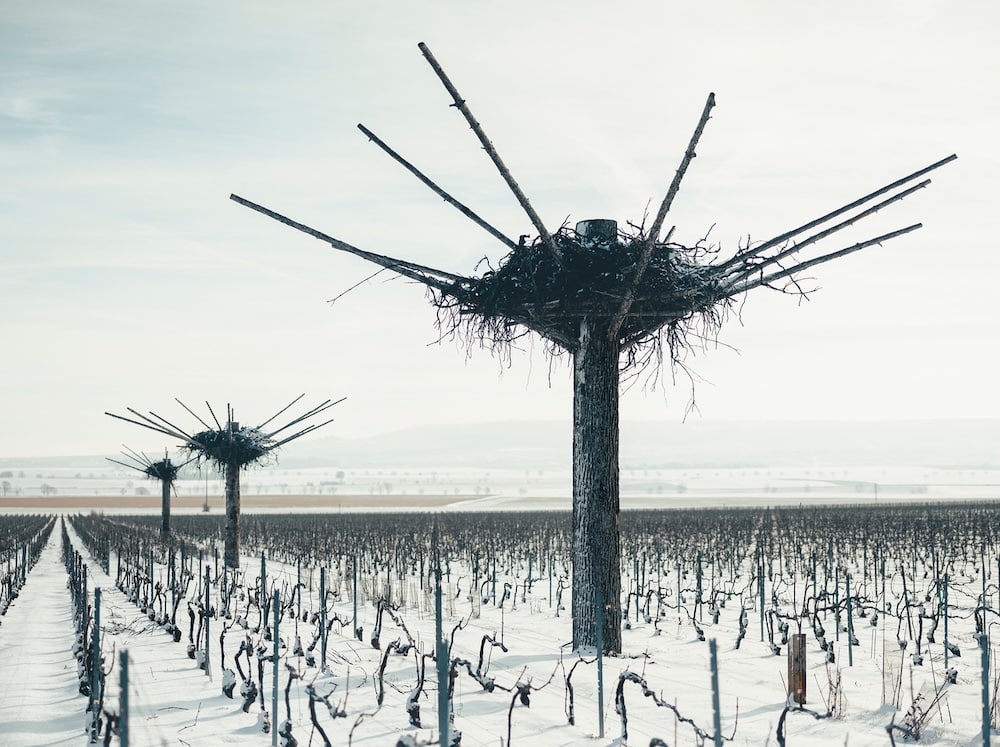
NILS UDO -PHOTO Habitat sous la neige OK HD print
The tree is a part of the great theatre of nature we are a part of. Trees communicate underground via their root systems and can be interdependent regardless of species. Nature is a stage where all elements are actors, in endless movement, change and transformation.
Albrecht Durer’s The Pine Tree (1495-1497) is a work of genius precisely for its remarkable ordinary universality. This tree communicates the miracle of life with its every branch, needle and organic structure. Hungarian artist and painter Csontvary’s The Lonely Cedar (1907) is equally powerful in a stoic and enigmatic way. This is not the typical iconic symbol of the world and the tree, but more a non-conformist artist’s metaphor for the enduring character of life. In Canada, Emily Carr’s paintings express the immense power of West Coast forests of Canada as encountered nearly a century ago, before they were logged and clear-cut. These forests are a spiritual painterly source for Carr, whose paintings expressed the supernatural energies she felt in these places. When looking at Emily Carr’s painting of a huge forest, it has an overwhelming power and puts in perspective our small place in the cosmos. As Emily Carr wrote, “Look at the earth crowded with growth, new and old bursting from their strong roots hidden in the silent, live ground, each seed according to its own kind…each one knowing what to do, each one demanding its own rights on the earth. So artist, you too from the depths of your soul…let your roots creep forth, gaining strength.” (4)
And so wood from the tree becomes the source of a voyage or journey, not entirely allowing the artist an answer but further unlocking a mystery. A universal mystery. Nash’s now renowned Millennium Dome involved carefully planting a circle of ash trees in the Ffestiniog Valley in Wales, where Nash’s studio was. As he says, “In the early 1970s, the question I had for outside sculpture was how to make it genuinely integrated with its environment. Most outdoor sculptures are made to resist the elements, made somewhere else, and then taken to the site and then placed on a plinth.” (5) Through the action of “fletching”, cutting and rebinding the branches of 22 ash trees to achieve a certain curving shape, these trees eventually procreated into a living dome structure in nature – a house of nature, if you will. Patience and vision guided this 30-year project, and the living result is exactly the integration Nash sought. After years, David Nash’s Ash Dome is no longer due to ash dieback.
Giuseppe Penone’s remarkable vision embodies the integration of the human spirit with nature and has transfigured in so many sculptural and installatory configurations over the years. The most powerful, of course, is his The Hidden Life Within, where inner parts of a mature tree are carved away to reveal the earlier stages of a tree’s life. In a sense, this embodies a journey through or back in time, each stage of a tree’s life being contained within. Alternative works created by Arte Povera artist Giuseppe Penone at the Château de Versailles include The Tree of Versailles, this being and other works in the 18th-century gardens created by Andre Le Notre for the 400th anniversary, created from trees that fell during a storm at the Palace of Versailles. Penone not only monumentalises the trees as a cultural and universal symbol, but gives them a voice in civilisation’s nature theatre we are a part of.
When Joseph Beuys enacted his 7000 Oaks performances and actions for Documenta 7 in Kassel, Germany, 1982, he enabled each and every one of us to participate in actions of renewal for the earth. Such ecological actions by Beuys were motivated by universal beliefs that art could transform the real world. Likewise, in 1988, the Dia Foundation sponsored a cross-Atlantic continuation of the 7000 Oaks project in Chelsea, New York, where the trees planted stand next to basalt columns. “A living part” (the trees) and a “crystalline mass” (the columns) that would change in relation to one another over time. Any changes would mark “a symbolic beginning,” Beuys wrote. “And such a symbolic beginning requires a marker. The intention of such a tree-planting event is to point up the transformation of all of life, of society, and of the whole ecological system.” (6)
Other artists whose ecological actions cannot be forgotten include Friedensreich Hundertwasser, whose manifesto Your window right — your tree duty. Planting trees in an urban environment was to become obligatory: “If man walks in nature’s midst, then he is nature’s guest and must learn to behave as a well-brought-up guest.” Hundertwasser propagated a type of architecture in harmony with nature in his ecological commitment. He campaigned for the preservation of the natural habitat and demanded a life in accordance with the laws of nature. His ultimate actions included planting thousands of trees on his land in North Island, New Zealand.
Ichi Ikeda’s Future Compass (2009), installed as part of Earth Art at the Royal Botanical Gardens in Ontario, Canada, highlighted the holistic bioregional and a mutualist exchange between humanity and nature. Future Compass becomes a cultural rendezvous between water and the human being. The tree forms in Ikeda’s piece personify all that is exotic and essential to us. The tree is a beautiful living storage container.
Water, underground and within, moves in and around the tree. Water is maintained as a resource instead of running off. In this way, trees maintain a soil surface and stabilise the grounds they grow in. Trees strengthen the world we are a part of. To progress, to design better environments, to produce products that use replaceable processes and materials, to use nature design as bio-mimicry, and to use energy and forms efficiently with nature as a principle for the conception and manufacture of things we depend on, we can evolve. Future Compass (2009) was, for Ichi Ikeda, a way of engaging sustainability, for the ghosts of first-growth trees Ikeda created in the Rock Garden are rooted in water and guide us like a compass towards a future direction of nature integration. Trees as structures are procreative, interactive living designs that ensure water is retained in the soil, and plant and animal diversity can flourish. All these living elements, ourselves included, are mutually connected. Understanding the subtle relation between the world we build, shape, change, and alter in the Anthropocene, we can design and work with nature instead of against it.
As significant are the works created by Frans Krajcberg in the Amazon, often recycling the burned carcasses of trees destroyed by the ongoing destruction of the Amazon rainforest, where Krajcberg lived. With Pierre Restany and Sepp Baendereck, Krajcberg created the Manifesto of the Rio Negro while travelling up the Amazon in 1978. The massacre of nature and Krajcberg’s recycling of the burned and blackened corpses of mature trees he found in this war-like zone of destruction were turned to good, to express a love of the nature he witnessed disappearing around him. Gathering pigments in the grounds of the Mato Grosso and Amazon to decorate the carved, transformed trees, Krajcberg never gave up on nature’s right to exist as an equal partner with humanity. After studying at the Stuttgart Academy under Willi Baumeister and later with Braque, Dubuffet and Miro in Paris, Krajcberg wanted to escape the destruction of the 2nd World War in Europe, only to experience it again as nature being destroyed in Brazil. Krajcberg is a great artist with an earth conscience…
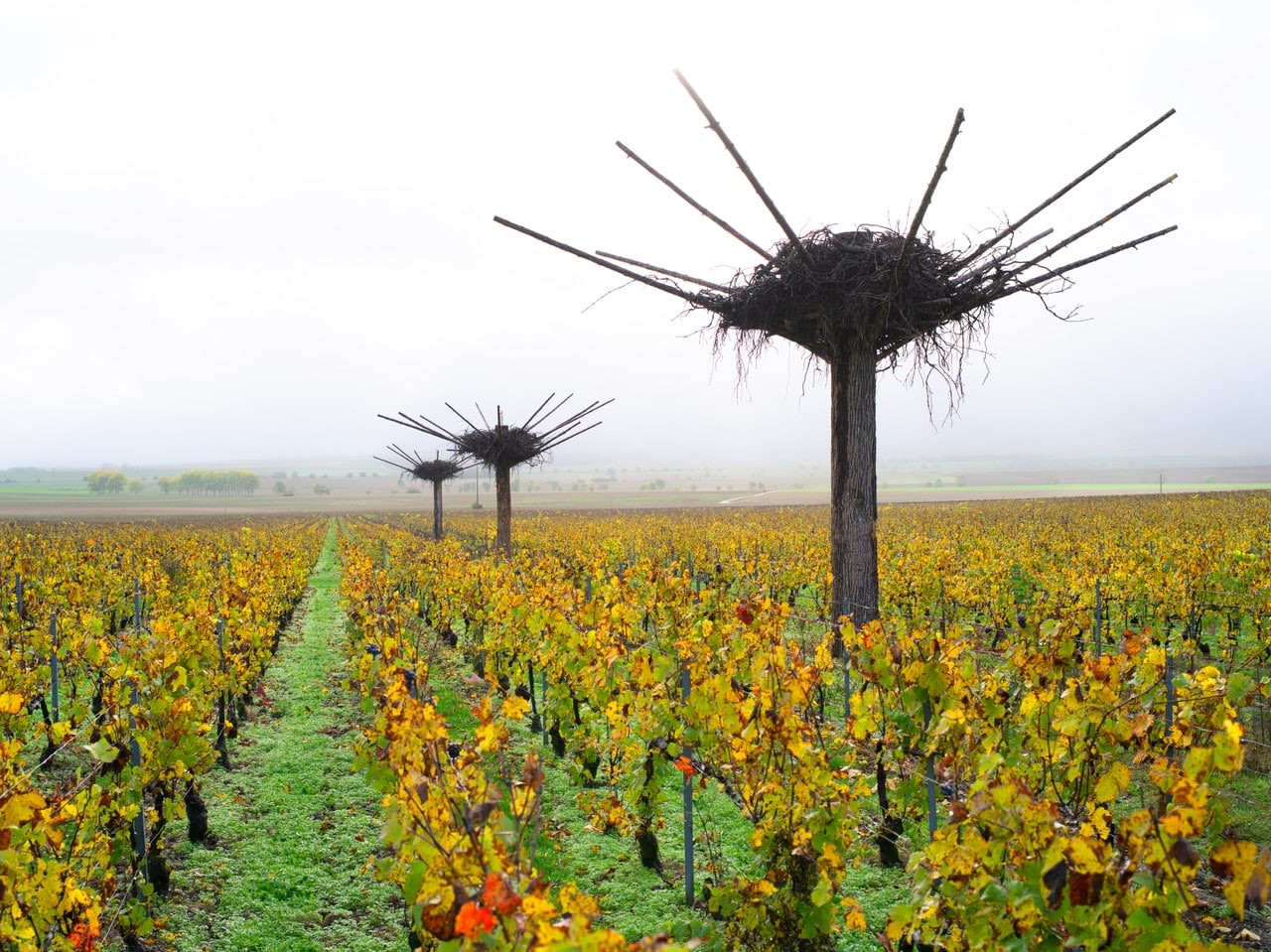
Earth Art brings the creator to that point between civilisation and nature per se. And walking that line can be as exciting as defining it. How to place sculpture, or art, how to integrate details within a large environment. All these choices involve the conscious effort of the person developing the space. NILS-UDO’s Ruinart piece called Habitats, commissioned for their extensive vineyards in Reims, France, is an art of biodiversity that builds the ecosystem to invite other species to live in what can be quite a monocultural vineyard environment… Ruinart took out thousands of vines and planted in their place thousands of bushes. The Habitat series of sculptures integrated into RUINART’s vineyards encourages diversity and breaks down the monocultural monotony of the standard vineyard. These habitat structures encourage nesting birds, bugs and bees in what was a monocultural vineyard environment. NILS-UDO brought biodiversity to a spectacular historical vineyard in Reims. In NILS-UDO’s own words, “I set foot in a given landscape without any preconceived notion of a project concept. The work is always a reaction and response to the situation in nature I encounter. (…) My work is part of life. An intervention in nature is subject to and focuses on the subject of temporality. I am ephemeral. You are ephemeral. Life.” (7)
Images of nature, images that represent culture, are superseding the living culture. Images enable a disconnect to occur between cause and effect, between social desires and global capital needs… scales that no longer have a dimensionality or a physicality that accords with the ecosystems we humans are part of.
Nature, like humanity, has a memory. Nature designs effortlessly, and at no excess. Resource use is simply a cyclical life system.
Nature designs unconsciously. Nature runs on sunlight. Trees grow. Nature fits form to function. Trees grow.
The earth is neither object nor subject. And we are a part of nature’s flow process. So many urban art projects involving nature are decorative and quite beautiful, but they do not encourage a true integration of human culture’s links to nature. Nature will, independently of our belief systems, our ideologies, our concepts, our egos. Eco-systems, not ego-systems!
Carbon capture, the drawdown of CO2, and reducing city temperatures on a planet that is eating up, as so many identify, involves a variety of initiatives. One positive action involves planting trees in volume to offset the effects of human actions in the Anthropocene. Doing so in cities directly affects the temperatures – water is “held” in place instead of sent out via sewer systems, and photosynthesis then takes place.
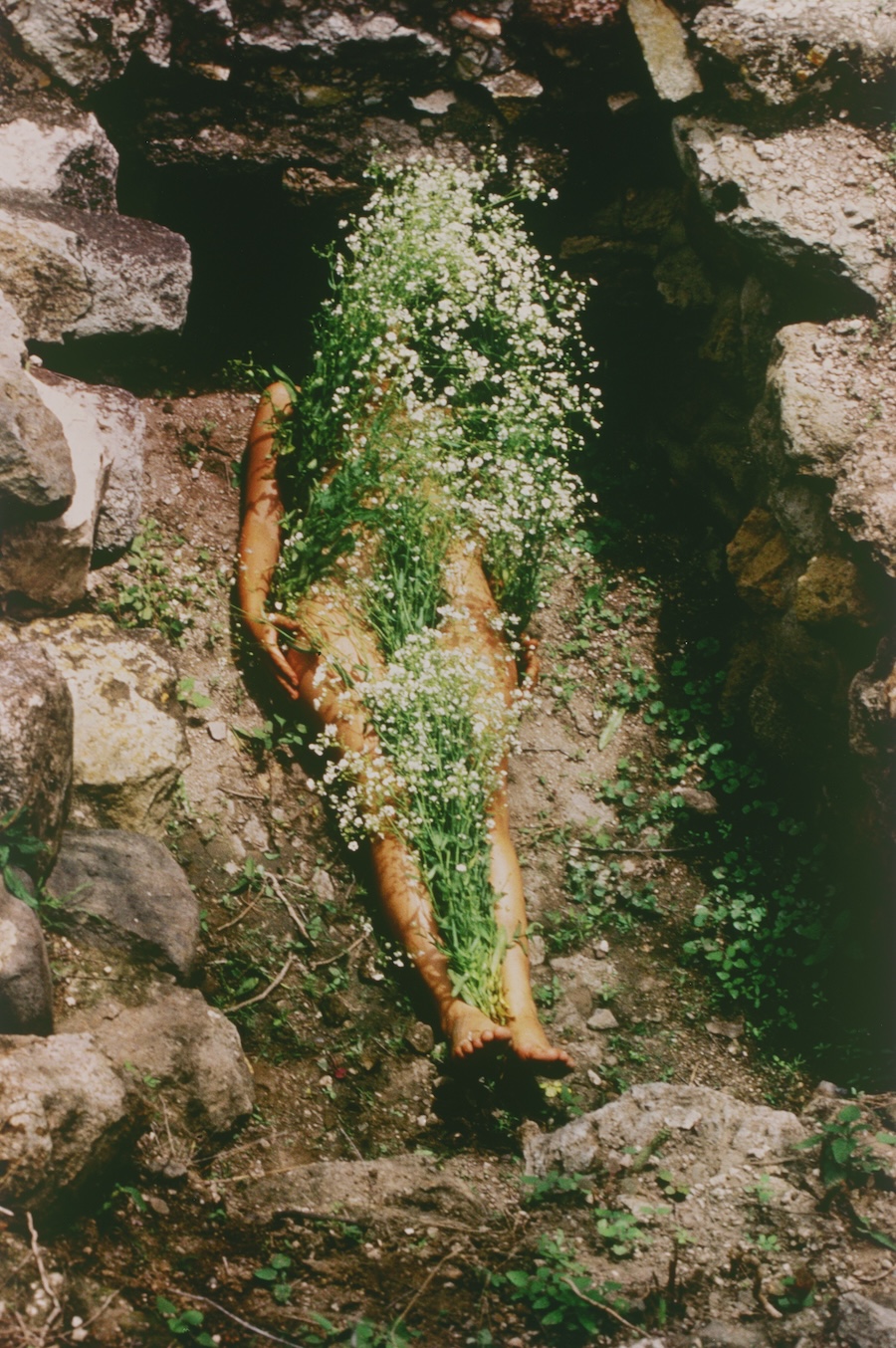
Ana Mendieta, Imágen de Yágul, 1973 ©The Estate of Ana Mendieta Collection, LLC. Licensed by Artist Rights Society (ARS), New York / DACS, 2026 / Courtesy Marian Goodman Gallery and Alison Jacques, London.
Ana Mendieta’s recently opened exhibition at the Tate Modern derives from a direct encounter with the earth, a source both of privation and nourishment. Before her untimely death in 1985, Mendieta, a Cuban-American exile, would use her own body to create images in the landscape that identified with nature as a procreative force. In part an offering, in part a vehicle of transformation, Mendieta’s silhouettes of her own five-foot body gave form to her vision of an intense union with nature. Her earth goddesses, images of violence and procreation, are like Goldsworthy’s ephemeral works, made with leaves, sticks, seed pods, flowers or simply mud and water. Notable for their temporal character, these works are part of a search for a point of belonging, an identification with something greater yet environmentally specific. In 1981, on a return visit to Cuba, Mendieta carved “siluetas,” ferocious fecund symbols of fertility goddesses, deep in the soft limestone caves of Jaruco, a mountainous region of Cuba that has traditionally been a shelter for Cuban rebels. Among Mendieta’s untitled works is a beautifully lyrical fertility goddess, all the more sacred because it is painted on a leaf. Another piece, a large vertical slab of wood carved with undulating rhythmic patterns, contrasts with the delicacy of the former piece. For its explicit, macho use of gunpowder as a medium to burn the wood, it is a gifted, urgent allegory that underlines humanity’s need to shift its priorities, to respect the procreative capacity, and to merge with, rather than destroy, nature as a life- giving source.
Art, for Ana Mendieta, becomes an impromptu performance, simultaneously primordial and contemporary. With Tree of Life 1976, Mendieta poses upright with arms raised against a tree trunk, her body covered in mud and grass, melding into its bark. In her original proposal, Mendieta referred to the performative sculpture Árbol de la Vida / Mother of All Things (1982) shown at the Lowe Art Museum, University of Miami as ‘irrigation veins’ through which ‘ascend the ancestral sap’. (8)
Throughout her practice, Mendieta returned to the Tree of Life, a cross-cultural iconographic theme popular in Mexico. She often travelled to Mexico, a place where she could work as an artist outside the United States. As effective spiritual sites, trees were long-established metaphors for life itself, a passage from death to life, a conduit. Trees were eternal reference points regardless of the actual place. Mendieta’s practice changed, moving from recording ephemeral constructions in nature to a more on-site, performative language of creation. The tree and land are seen as a living presence and symbiotic link between human and environment.
We can see the earth as a body. We can treat the earth as a body. We could see our bodies as the land. We could treat our bodies as the land. We can respect the land as if it were our own bodies. In permaculture, the permanence of resources is a value, and the caring and regulation of resource use, as well as the regeneration of renewable resources, are the true economics of the future.
May we understand we are part of a much grander diversity and process than art… and the art is nature, like the trees, that have so inspired us all, over time.
– John K. Grande
Footnotes
1. C. R. Leslie, Memoirs of the Life of John Constable, London; Phaidon, 1995
2. Ibid
3. Hermann Hesse, Wanderings Notes and Sketches, 1920
4. Emily Carr cited, See here
5. David Nash at Kew Gardens, Kew Gardens, 2012, p. 80
6. Andy Battaglia, “Tree’s Company”, ARTnews, Jan 3, 2019
7. John K. Grande, Art Space Ecology; Two Views Twenty Interviews, Black Rose / University of Chicago, 2019, p. 148.
8. NILS-UDO in conversation with John K. Grande, Bavaria,, Germany 2025
Ana Mendieta cited in Ana Mendieta,
Ana Mendieta, Tate Modern, 15 July 2026 – 17 Jan 2027
Visit Here