
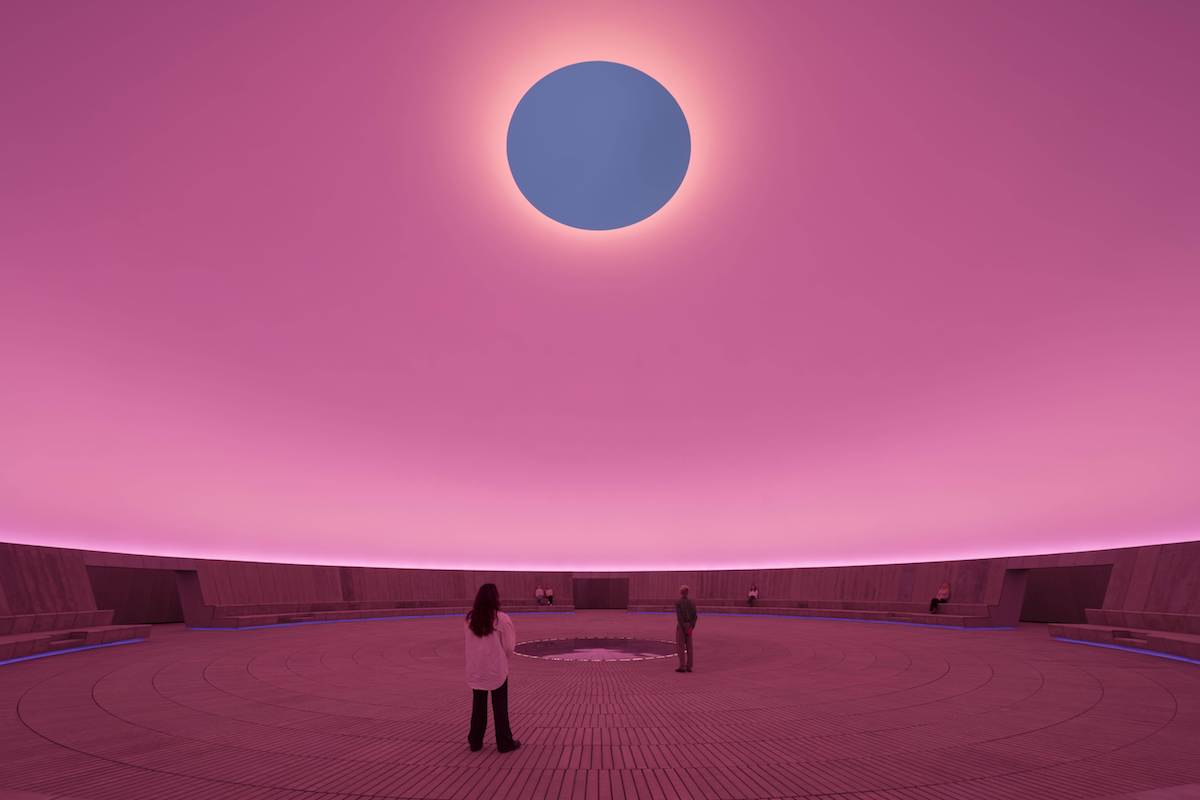
James Turrell has been making Skyspaces since the 1970s. There are now one hundred of them in the world. As seen below, which has just opened at ARoS Aarhus Art Museum in Denmark, is the hundredth and the largest he has ever installed in a museum context. It is 16 metres high and 40 metres in diameter. The comparison is to the Pantheon in Rome, which is not idle, given the structural logic the works share: a domed interior, a circular aperture open to the sky, a space organised entirely around the relationship between architecture and light.
You enter through an underground corridor and emerge into the domed chamber. What happens next depends on when you arrive and what mode the work is operating in. In Open Sky mode, the aperture is open, and the visible sky fills the circular opening above, framed by the dome in a way that strips away familiar points of reference and turns the sky into something else, a field of colour, intense and immediate, closer than sky normally feels. In Colour Shift, the aperture is sealed, and the experience changes entirely. The walls dissolve into light. The light becomes the subject rather than the medium, tangible in a way that Turrell has spent fifty years trying to make people feel. The third mode is Twilight, available at sunrise and sunset on selected days and bookable in advance, in which the aperture opens and the interior lighting shifts gradually in harmony with the changing sky. Turrell has said, with characteristic directness: “I can change the sky to any colour you want.”
Turrell was born in Los Angeles in 1943 into a Quaker family, and the influence of that upbringing on his practice is something he has spoken about directly. Silence. Contemplation. The quality of attention that both require. He trained in art and the psychology of perception, became a licensed pilot in his youth, and has described the experience of flying as formative, the absorption into sky and light and the way both change with altitude, weather and time of day. In the 1960s, he began working with projected light in enclosed spaces, and the Skyspace series developed from there, becoming the most sustained and geographically dispersed body of work in contemporary art concerned with a single material: light itself, not as metaphor or decoration but as the thing being looked at.
The installation at ARoS completes a significant expansion of the museum developed in collaboration with architects Schmidt Hammer Lassen and Aarhus Municipality. The Salling Gallery, a subterranean exhibition space for annual contemporary art commissions, opened in June 2025. The ARoS Art Square, a new outdoor space for permanent art presentations, is part of the same development. As seen below, it sits at the centre of the project, which has been years in the making and has drawn support from the Salling Foundations, the New Carlsberg Foundation, Aarhus Municipality, and a private, anonymous donation.
Aarhus is not a city that announces itself loudly on the international art circuit, but ARoS has consistently punched above its weight as an institution. The museum already holds Olafur Eliasson’s Your Rainbow Panorama, the circular walkway installed on the roof that has become one of the most visited permanent works in Scandinavia. Turrell’s dome, underground and vast, is something of its opposite: inward rather than outward, contained rather than panoramic, demanding stillness rather than movement. The two works make a strange and interesting pair for a single building to hold.
James Turrell was born in Los Angeles in 1943, and his fascination with light began early, partly inspired by his upbringing in a Quaker family where silence and contemplation played a central role.
As a young man, Turrell became a licensed pilot and spent significant time in the air, captivated by light, the colours of the sky, and the nature of perception. He has described flying as a meditative experience – being absorbed by the sky and its vastness – and observing how light and colour change with altitude, time of day, and weather conditions.
Turrell is trained in art and the psychology of perception, and in the 1960s, he became part of the Light and Space movement, where he found his calling in creating experiences that reshape how we see and feel light.
While the Skyspaces are his best-known works, Roden Crater, an unprecedented large-scale artwork created within a volcanic cinder cone in the Painted Desert region of Northern Arizona, is Turrell’s magnum opus and lifelong project. A gateway to the contemplation of light, time and landscape, nearly five decades in the making, development on Roden Crater is ongoing. Once completed, the project is intended to last for centuries.
Twilight sessions are bookable at aros.dk/en/skyspace. Open Sky and Colour Shift run during standard museum hours from 20 June.