

Leighton House closes its centenary year with what promises to be one of the more absorbing exhibitions it has staged, an exploration of the nineteenth-century artist’s Studio as both a working environment and a carefully constructed expression of artistic identity. Magic and Mess opens on 31 October and runs until 21 March 2027, bringing together 56 paintings, drawings and photographs that take the viewer behind the scenes of some of the period’s most significant creative spaces.
The setting could not be more apt. Leighton House was itself one of the most celebrated studio-houses of the Victorian era, built and constantly modified by Frederic Leighton as an environment that was simultaneously his workplace, his collection and his public face. The great painting studio at its heart was the room where all of these things converged, and the exhibition is designed to be experienced in relation to the building itself. Visitors move between the galleries and the historic house, reading the images in the show against the actual space Leighton created and inhabited.
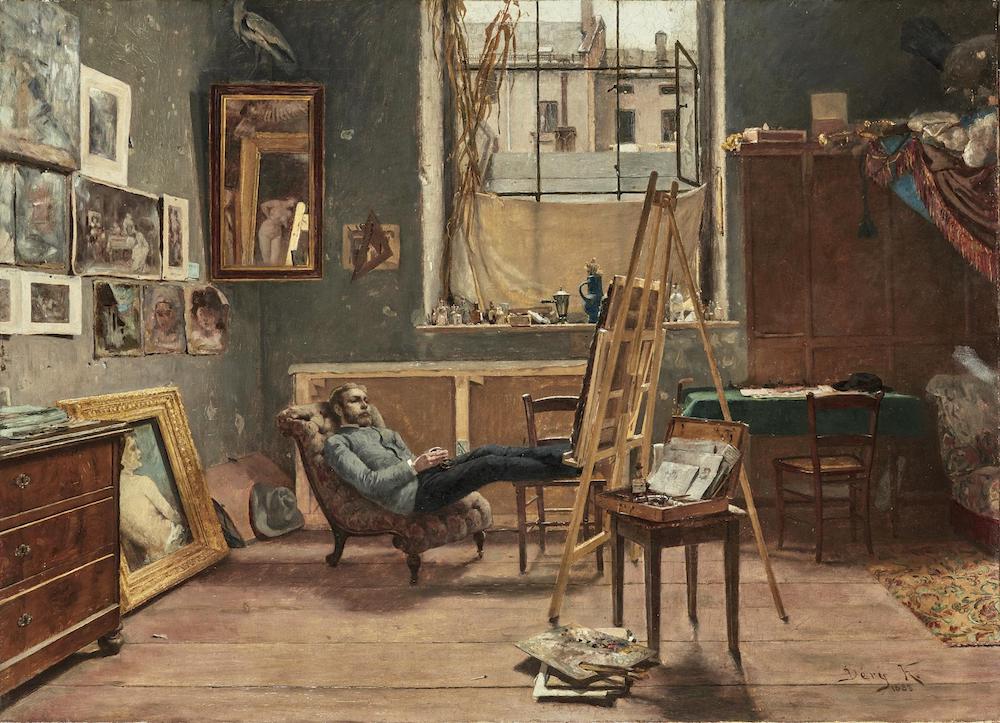
Kalman Dery, The painter’s studio, 1883. Katrin Bellinger Collection, London.
The exhibition has been developed in collaboration with the Tavolozza Foundation and the Katrin Bellinger Collection, one of the world’s leading collections devoted to images of artists at work. It was partly inspired by the museum’s 2023 acquisition of Lawrence Alma-Tadema’s In My Studio, painted in 1893 and gifted by Alma-Tadema to Leighton, who hung it in his Silk Room. That painting, which treats the Studio as a statement of personality and ambition rather than a mere functional space, provides a kind of conceptual anchor for the whole exhibition.
The works in the Verey Exhibition Gallery are organised around four themes: Light, The Female Model, The Stove, and The Corner of the Studio. These groupings allow the show to move between the grand and the intimate, between studios staged for visitors and studios caught in their natural disorder. Among the highlights are Paul Cézanne’s The Stove in the Studio, lent by the National Gallery, and Henri Matisse’s Studio under the Eaves from the Fitzwilliam Museum in Cambridge, two works that demonstrate how the Studio as subject could carry very different emotional and pictorial weight depending on who was looking at it and when.
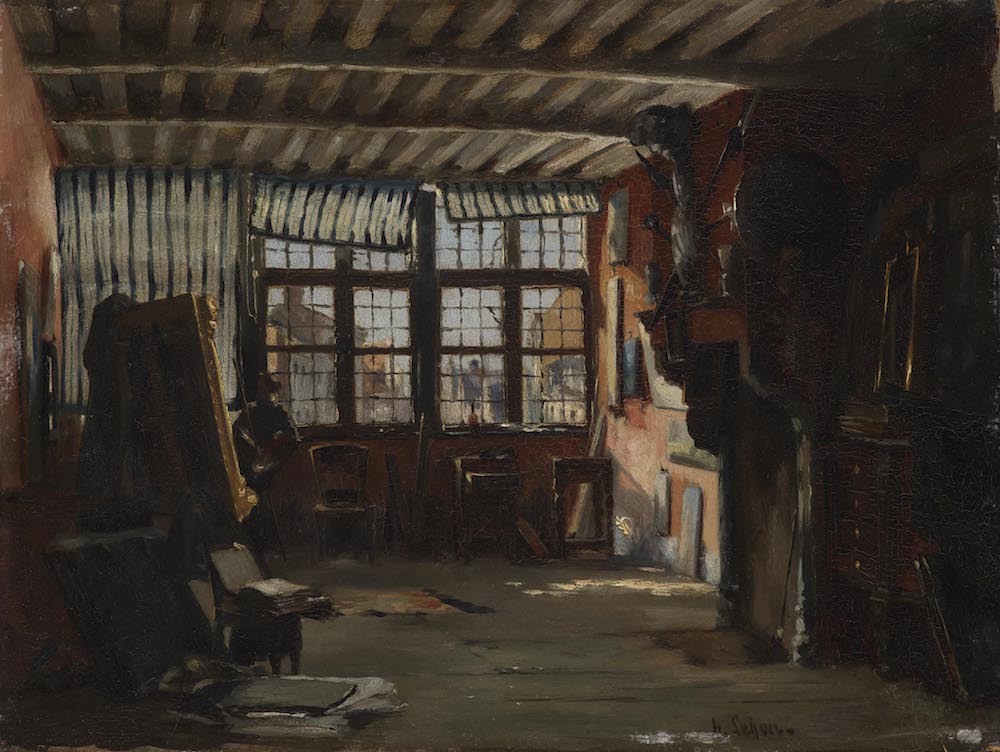
Henri Le Hon, The artist in his studio, c. 1853. Katrin Bellinger Collection, London.
The Tavolozza Drawings Gallery takes a different approach, presenting a remarkable selection of nineteenth and early twentieth-century photographs showing artists actually at work. These include rare interior views of the studios of Leighton himself, John Singer Sargent and Mariano Fortuny. As documents they are extraordinary: studios that were both genuinely private workplaces and settings their owners managed with great care whenever outsiders were admitted. The gap between those two versions of the same room is one of the more interesting subjects the exhibition opens up.
Katrin Bellinger, whose collection forms a significant part of the show, said her interest in the Studio as a subject began when she started collecting in the late 1980s and found herself drawn to the mystique of the creative process. The collaboration with Leighton House, she noted, offers the opportunity to share that fascination while provoking conversations between works that might not otherwise find themselves in the same room.
Senior Curator Daniel Robbins described Leighton’s Studio as the room where life, work and display came together. He said the exhibition encourages visitors to look at that space again and consider what it reveals about the man who made it.
A specially commissioned film accompanies the exhibition, featuring the curators, Katrin Bellinger and leading art historians, as well as the contemporary artist Suzy Murphy filmed in her Chelsea studio, extending the story of the working space into the present. A fully illustrated catalogue published by Paul Holberton Publishing includes essays by James Hall, Anita Sganzerla, Hannah Lund, Daniel Robbins and Rachel Esner of the University of Amsterdam.
Top Photo: Walter Greaves, Whistler in his studio painting the portrait of his mother, c. 1910s. Katrin Bellinger Collection, London.
Magic and Mess: The Artist’s Studio Revealed, Leighton House, London, 31 October 2026 – 21 March 2027