
The Saatchi Gallery has launched a series of exhibitions that survey how the natural world inspires creativity across art and culture. Following ‘FLOWERS – Flora in Contemporary Art and Culture’, ‘The Sun and The Moon: Art Inspired by the Celestial’ explores how the two most powerful and enduring phenomena in the sky have shaped art, science, beliefs, and imagination across cultures and over centuries, inspiring creativity, curiosity and belief.
With artefacts relating to ancient mythologies and early cosmologies progressing through to works of contemporary art and popular culture, the exhibition explores the profound influence these celestial bodies continue to have on human imagination. As such, the show brings together contemporary artworks, rare objects, and large-scale immersive installations across nine gallery spaces on two floors, with a huge number of artists’ works included.
With such a wide range of artists and media, there is no way of categorising the diversity of work other than by content. Therefore, the exhibition unfolds as a journey through a complete 24-hour cycle, moving from dawn through daylight, into the depths of the night. Each chapter of this sequence – Dawn, The Sun Rising, Zenith, Setting Sun, Evening, Midnight and Darkest Hours – features a large central work surrounded by a selection of paintings, sculpture, fashion items, textiles, photographs, films and/or installations.
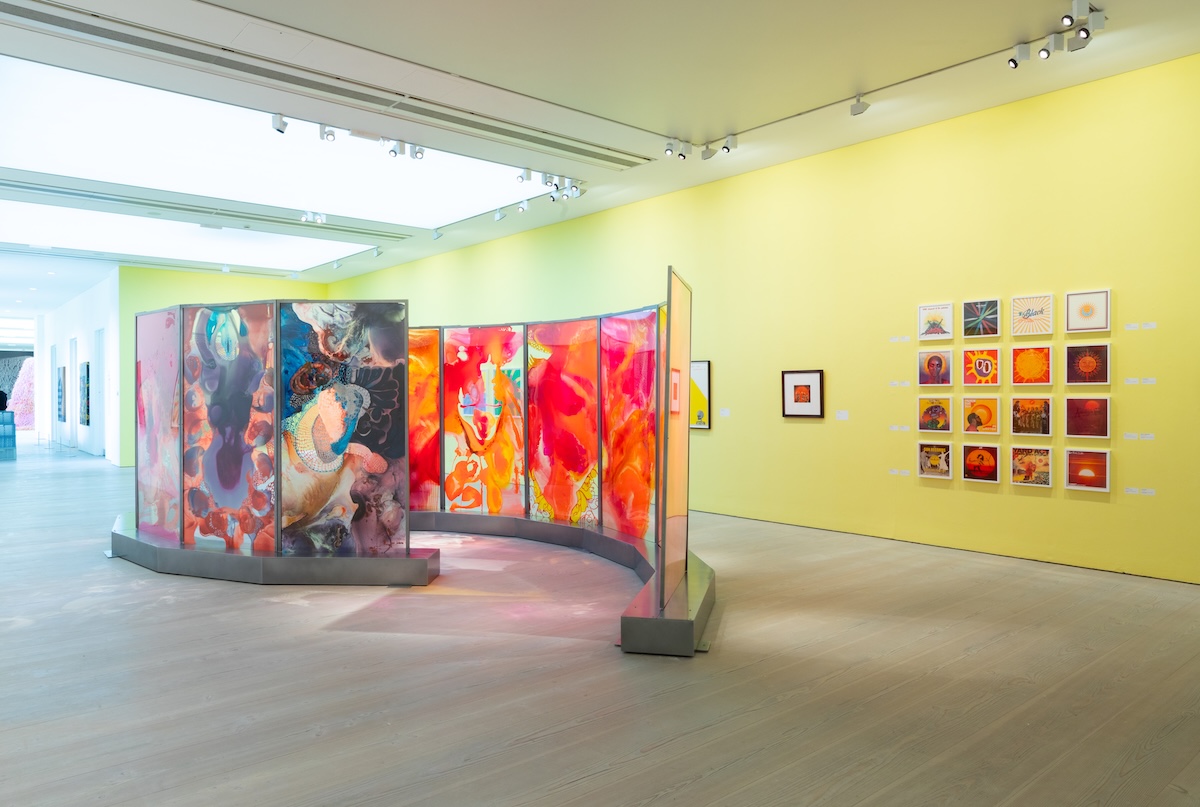
The Sun and Moon, installation view, Saatchi Gallery
Dawn reveals how the Sun and the Moon were integral to early belief systems and mythologies. The Sun Rising reflects on time, seasons, and rituals. Zenith examines how artists respond to the Sun at its highest point and its relationship to our bodies. Setting Sun, focuses on transformation. Evening considers the Moon’s enduring fascination for artists and introduces us to some of its qualities and influence. Midnight delves into the Moon’s long association with folklore, magic, dreams and the ‘witching hour’. The Darkest Hours invites viewers to reflect upon the majesty of the universe in which we live.
‘Helios’ by Luke Jerram, an enormous reproduction of the Sun as a globe featuring a collage of over 400,000 photographs of its surface, is an additional sun space, complete with deck chairs and a soundscape. Walking on the Moon is an additional chapter on the Moon that focuses on the cultural impact of the Apollo missions and lesser-known stories behind space exploration, including the contributions of craftswomen and designers who helped make the missions possible.
Historical artefacts range from the Sol Invictus Celtic Bust, dated between the 1st century BC and the 1st century AD, to first-edition tarot cards designed by Pamela Colman Smith in 1909, and on to vintage travel posters and fashion objects, including swimsuits, fans, and eyewear. Many of the world’s religions and other belief systems are represented through the range of works included. Artworks range from works by Albrecht Dürer, Joseph Wright of Derb,y and JMW Turner to contemporary emerging artists such as Sunju Jin, Jai Khanna and Lian Zhang. The exhibition is like a treasure chest, and among the plethora of riches, some gems to seek out include works by Cecil Collins, Ithell Colquhoun, Barbara Hepworth, Henry Moore, Paul Nash, Shanti Panchal, Paula Rego and Elizabeth Vellacott.
The central works include Darcey Fleming’s ‘Totem’, a sculpture crafted from baling twine previously used by farmers, and referencing traditional celebrations connected to the land, Bryony Ella’s ‘My Body is a Sundial’, which invites visitors to consider the body not only as a record of solar time but also as a focus of solar intensity, Saad Qureshi’s large-scale split moon suspended from the ceiling, and ‘Moon Landing’, a collaborative work by Margo Selby and composer Helen Caddick, combining an original score with a large textile installation to celebrate the technical possibilities of weaving and the shared languages of mathematics, colour and rhythm found in both music and textiles.
The Saatchi Gallery’s Director, Paul Foster, says that the exhibition is concerned with wonder, uplift and celebration: “In 2026, we are reflecting in wonder at objects in the sky that we too often take for granted but which represent amazing and beautiful essentials to all life on Earth. Artists working today are as influenced and inspired by these bodies as those who have created works throughout human history. The exhibition is designed to be an uplifting celebration of the world and solar system in which we live.”
This intention, combined with its historical breadth, leads to the profusion of works and media gathered together with the intent to overwhelm our senses in order to, as Jerram states of his installation, “inspire awe and wonder and prompt visitors to consider the importance of the sun in all our lives; for light, warmth, energy for our planet and how our nearest star has inspired culture and religion throughout history, all around the world.”
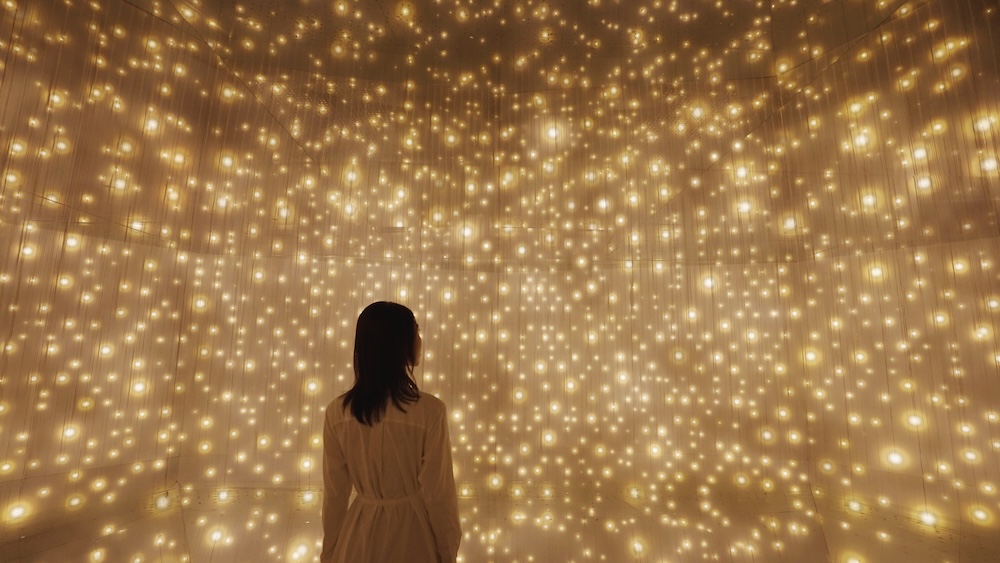
teamLab, Massless Suns and Dark Suns. Installation image courtesy of teamLab
This is particularly so with the final installations, ‘Massless Suns and Dark Suns’ and ‘Massless Sun and Surface of the Sky’ by teamLab. These immersive works present spheres of light and darkness that appear to take form in space, yet have no physical substance. Shaped by light, environment and perception, they invite reflection on the nature of existence.
teamLab’s collaborative practice, which seeks to navigate the confluence of art, science, technology, and the natural world, serves as an exemplar for the approach this exhibition takes as a whole. This is one of seeking to transcend boundaries in our perceptions of the world, of the relationship between the self and the world, and of the continuity of time, seeing everything that exists in a long, fragile yet miraculous, borderless continuity. As such, teamLab’s installations provide an appropriate and wonder-filled conclusion to a sublime show that focuses on the sublime.
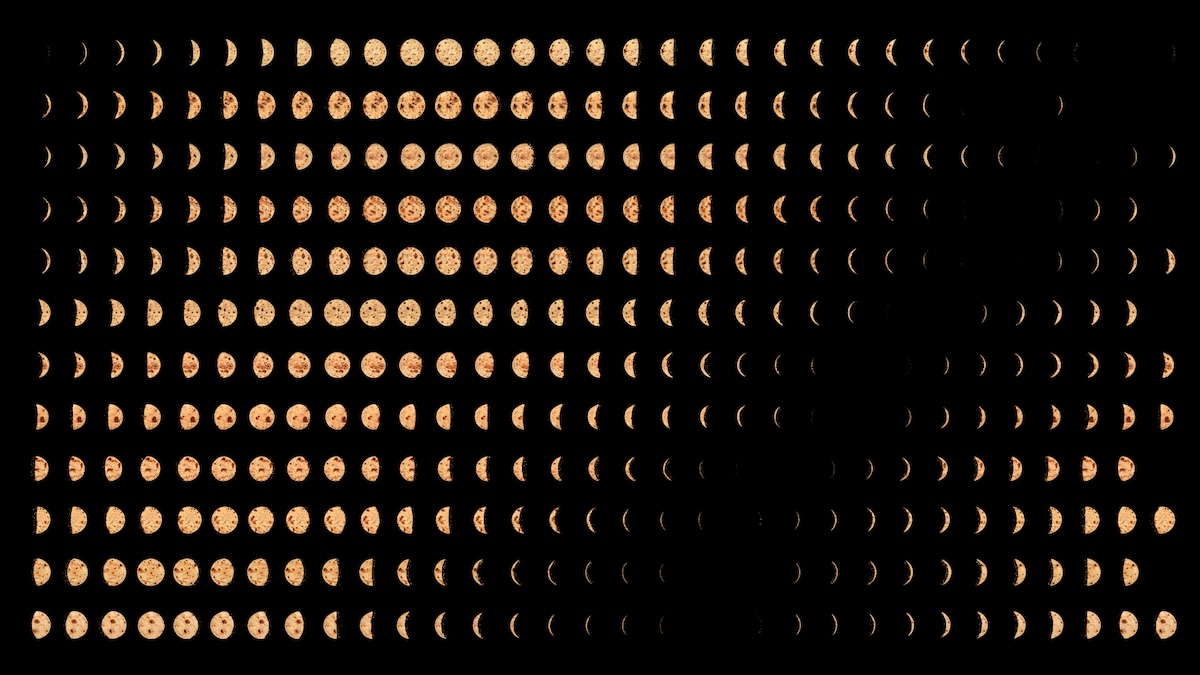
While the exhibition continually exceeds and evades categories and conceits, one work miraculously manages to encapsulate the diversity and scope it seeks to show. ‘The Eternal Gradient’ by Jitish Kallat is a single-channel video in which 365 rotis morph with the waxing and waning images of the Moon as if aeons of time were passing through an ever-changing annual lunar almanac. As each individual cycle completes, the entire lunar year shifts moment by moment, showing the eternal flow of time compressed into a parenthesis of duration shaped like a year.
This show deserves to be as popular as ‘FLOWERS – Flora in Contemporary Art’ (new works by some of the artists who featured in that exhibition can also be seen in a side exhibition entitled ‘Inflorescence’) and augers well for the later exhibitions in the series. At a time when reflecting on our relationship to the natural world has never been more urgent and more necessary, this exhibition and the series of which it is part point a way forward by bringing together art, science, myths, and belief systems to show our need to understand as fully as possible the ways that each influences how we understand the world around us.
‘The Sun and The Moon: Art Inspired by the Celestial’, 5 June 2026 – 8 September 2026, Saatchi Gallery
Visit Here