“I want sculpture to be as awkward as possible, to feel unstable, as if it might fall apart.” Phyllida Barlow 1944-2023
Disrupting the hallowed halls of Wolterton is an apt description of how Barlow’s works interject with the fabric of the building itself; her use of more everyday, temporary materials contrasts strongly with the permanence of the traditional marble and bronze. Hierarchy is out the window.
Due recognition was afforded Barlow late in her career – known for her 2014 Duveen Gallery commission at Tate Britain, representing Britain at the 2017 Venice Biennale, and a Royal Academy exhibition in 2019.
Wolterton’s nascent programme is led by artistic director Simon Oldfield, with this exhibition guest-curated by Clare Lilley, former director of Yorkshire Sculpture Park and a leading voice on modern and contemporary sculpture. This is only the second year of its programme, the Ellis family having bought the 1724 Thomas Ripley-designed house in 2024. Showcasing contemporary art in an historic setting isn’t a new idea, but the programme here seems particularly lively, with Daisy Parris exhibiting here alongside Barlow, following last year’s combination of Maggi Hambling and Ro Robertson.
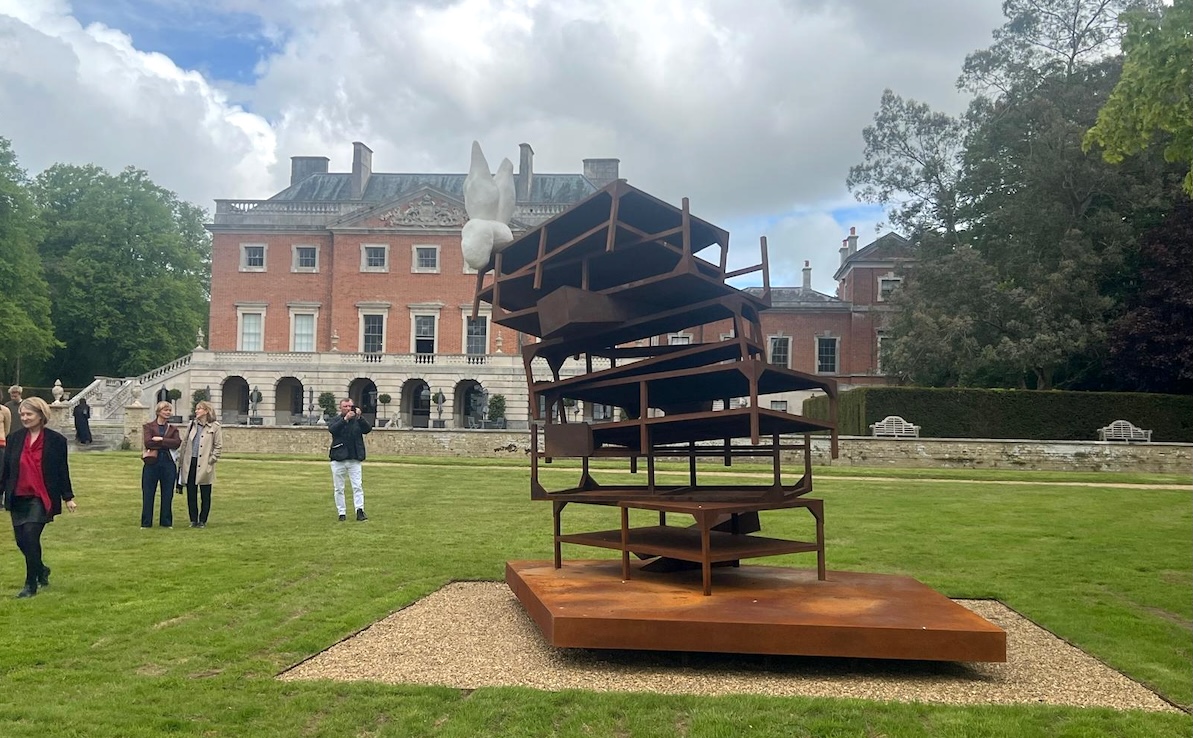
Phyllida Barlow, PRANK: jinx 2022-23
Clare Lilley talked to me about curating this exhibition: “Phyllida was without doubt one of the most unique voices in British art over the last 50 years. I think one of the reasons is that she had no selling career at all until she was in her 60s and had retired from teaching at the Slade, so her work has enormous integrity running through it like a stick of Blackpool rock. She was never working for the market, never working towards a gallery career. Her work was about sculpture and about the exploration of sculpture. We’d had various conversations over the years, and I’d visited her studio, but I’d never worked with her. So when I was offered this opportunity by Simon, and I knew Wolterton, I could see what Phyllida could do in that very precise and carefully designed and managed environment, and I got a lot of pleasure from thinking that it would have delighted and fascinated her because a Palladian house like this is all about consistency and time, past, future. And her work is about precariousness and change, the very opposite of everything that Wolterton is about.”
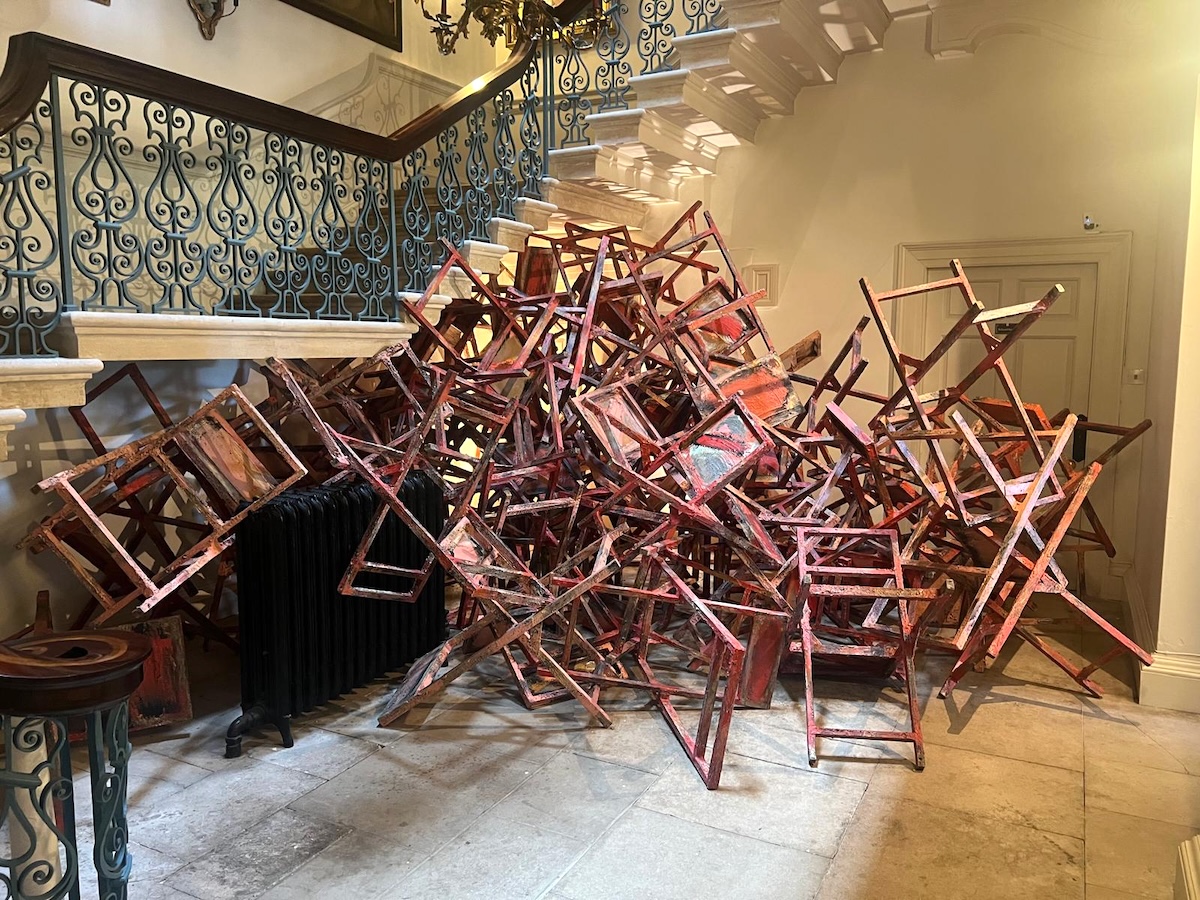
Crammed under the main staircase, untitled: stackedchairs 2014 blocks a doorway and climbs over a large iron radiator. Not all have seats or backs, are painted thickly red, blue and brown/orange, and are constructed from wood and cement. They look like deckchairs after a bluster on a beach collecting under the pier, and bring to mind Barlow’s untitled: brokenupturnedhouse 2013, in the collection of the Art Gallery of New South Wales in Sydney, where I worked, made after Barlow heard stories of people returning to their homes after Hurricane Katrina. It also likely recalls the bombed-out houses of WW2 Barlow would have seen growing up.
I asked Lilley about the placement of this work: “The stacked chairs – we wanted to kind of stuff them under that staircase, which is all about status, all about hierarchy. It’s one of the earliest cantilevered stone staircases built in Britain. They were first shown at Roche Court in 2007 and, more recently, in 2024 at Hauser & Wirth in Somerset, where they tumbled out of the granary building. With Barlow, you get the sense of found objects, and you think of her initially as a kind of Duchampian follower, but actually, she isn’t at all. She’s all about making. It’s all about hands, about labour. These chairs are created, they’re not found objects. It’s about how materials join together – chairs are self-supporting, so they’re already a sculpture. The chair is the object, the plinth, it’s already a complete sculpture before you ever do anything to it, in the sense of how you think about sculpture, about scale, weight, heft, material and substance. Barlow’s journey was very much about subverting that, about considering what objects could be in their own right.”
Upstairs in the formal Marble Hall overlooking the front of the house, there is a gathering of sculptures dating from 1986 to 2021, some creeping across walls breaking the constraints of the formal mouldings, others precariously balanced on or overflowing tables incorporated into the work, with tripod-like tapering entomoid too-long legs or balanced on cubes of steel. You can almost taste the delicious cream and flakiness of millefeuille, tempted to nudge and topple a tray of mycetoid forms. LOAF is the oldest work in this room and resembles a giant seed pod.
Lilley tells me, “What we wanted to do was to create a sort of forest of sculpture, and we managed that by clustering them into groups. The ones in the centre, their plinths are made from stacked boxes. They’re not cast, they’re boxes made in mild steel, that she’s obviously rusted out in the garden. If you touched one of those bases, it would all come tumbling down. So of course she’s looking at Brâncuși, she’s looking at Serra and Caro.”
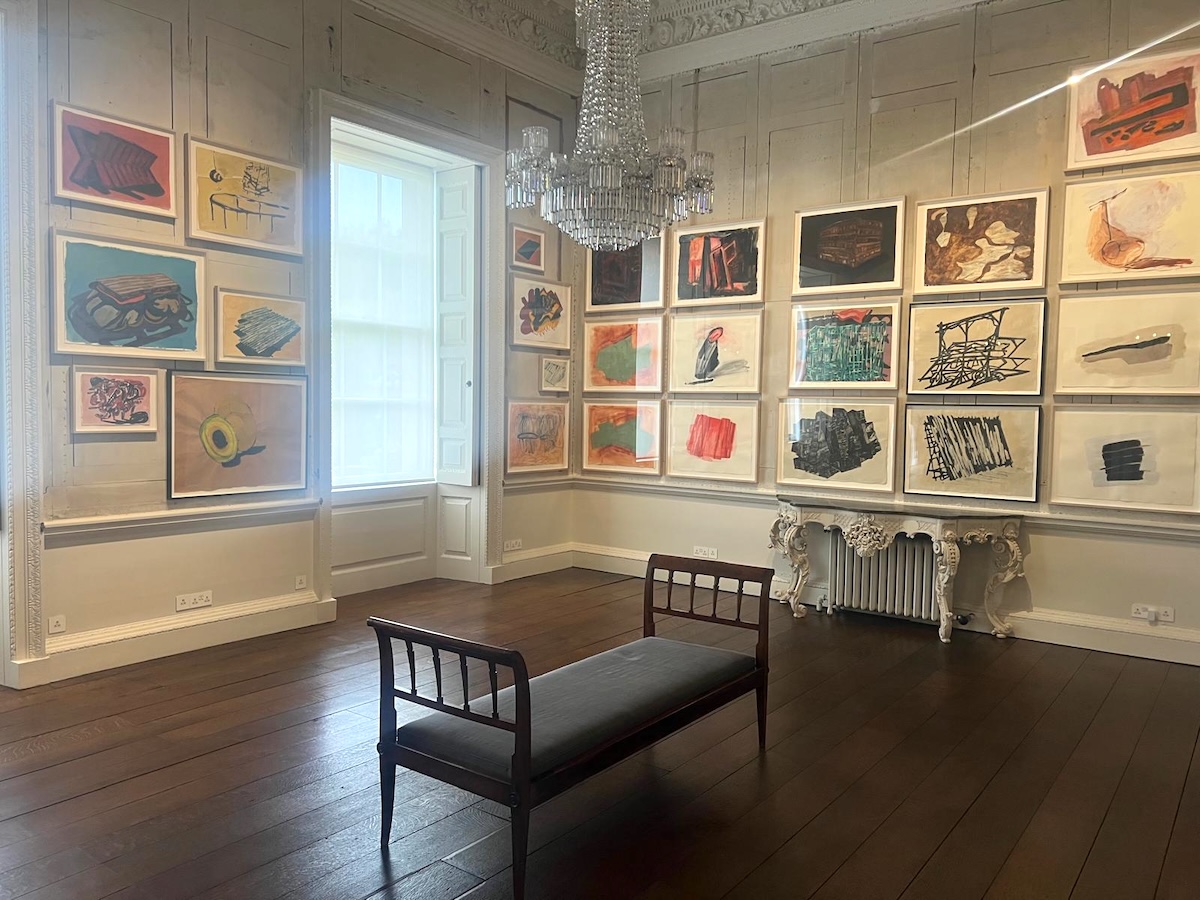
intallation view Phyllida Barlow drawings, The Portrait Room, Wolterton
The Portrait Room overlooks the formal garden at the back of the house and is densely hung with drawings and works on paper. The walls have been stripped back to their bare bones, the silk wall covering removed, and annotations from centuries ago and more recently are scrawled here and there across the wall. Here are early charcoals from 1977-80, pencil, collages, colour creeping into watercolours and finally acrylics from the 2020s, studies for Barlow’s 2017 Venice Biennale British Pavilion. They are mostly abstract, though some show the forms she used in her sculptures – folding chairs, grids, wedges – it’s like viewing Barlow’s mood board. There’s a drawing with green stacked tables in a cube, a red flag flying atop like Delacroix’s Liberty, in the background, a train on a viaduct. A black and white stack of chairs topped with an ambiguous object. Here’s something that looks like half an avocado. And then to the right of the ornate fireplace, a vivid yellow projector took me back to memories of my father screening cartoons at birthday parties – the film spool getting overheated, the image suddenly disappearing in a blaze of light, and he’d curse under his breath.
The only Barlow work outside is PRANK: jinx; 2022/23, a monumental steel piece featuring upturned studio tables balanced precariously on a platform, supported though also interrupted by giant wedges, the whole topped with a brilliant white irregular shape. This oft-repeated device first appeared placed atop a TV in Object for the Television 1994, and perhaps labelled ‘rabbit ears’ for the aerials necessary in the past. Seven PRANK works were made for New York City Hall Park in 2023, and each bears one of these fibreglass forms. This series was Barlow’s final completed body of work. Even outside Barlow’s work breaks the symmetry of the formally laid-out gardens and parterres, its precarity and impermanence made from everyday studio tables threaten the longevity and history of Wolterton as if challenging the hierarchy.
Phyllida Barlow: disruptor, Wolterton, North Norfolk, 20 May – 31 October 2026
Visit Here