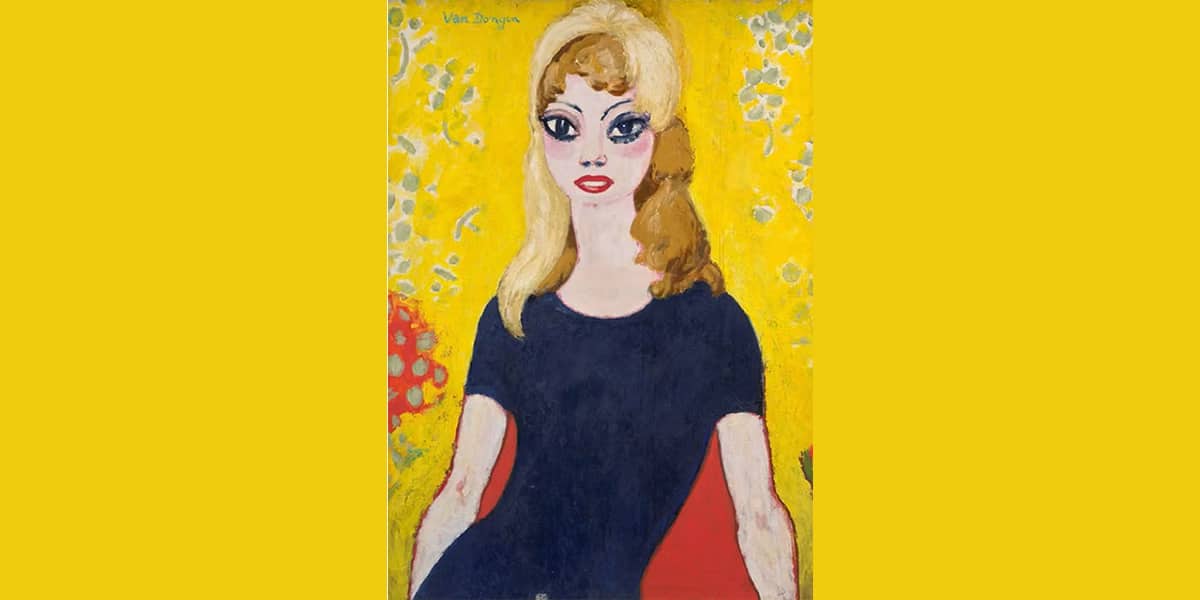
It has been sitting in a family estate for more than 60 years, unseen, and is now set to come to auction. Kees van Dongen’s portrait of Brigitte Bardot, painted in 1959, will be one of the highlights of Artcurial’s Selected 20/21 sale on 24 October 2026, timed to coincide with Art Basel Paris. The estimate is between 800,000 and 1.2 million euros. The work, an oil on canvas measuring 130 by 97 centimetres, comes directly from the artist’s estate and has not been publicly exhibited in living memory for most collectors.
Van Dongen painted the portrait in his studio at 75 rue de Courcelles in Paris, at a point when he had become, somewhat improbably for a former Fauvist, the favoured portraitist of European high society. He had a base in Monaco and an active social calendar, and over the years he painted Arletty, Maurice Chevalier, Sacha Guitry, the kind of cultural figures whose faces defined French public life across several decades.
Bardot in 1959 was something else entirely, a genuinely global phenomenon following the success of Roger Vadim’s And God Created Woman in 1956. Paris Match arranged the sitting on 12 September 1959, and the photographer Izis documented the encounter, which has since taken on a certain legendary status in its own right, the meeting of an old master of modern French painting and the emerging face of a new and considerably more audacious model of femininity.
The painting itself, set against the intense yellow that recurs throughout Van Dongen’s late palette, is built around the incisive economy of line that became his signature: a direct gaze, a luminous treatment of skin, very little wasted gesture. It is titled, somewhat mysteriously, B.B. aux yeux d’autruche, B.B. with Ostrich Eyes, and it ranks among the more accomplished works of his final creative period.
This was not their first encounter. Van Dongen had painted Bardot once before, in 1954, during a televised sitting organised at Maurice Chevalier’s home in Marnes-la-Coquette, when she was still a promising actress rather than an international icon. By 1959 the dynamic had shifted considerably. She was now, in some respects, the more famous of the two, and her visit to his studio on rue de Courcelles produced the portrait now coming to auction. Bardot herself wrote about the encounter in her memoir Initiales B.B., describing how deeply she had been struck by meeting a painter she regarded as a towering figure in the history of art.
The portrait achieved considerable circulation in its own time. A lithographic edition of 150 copies was produced, with 21 artist’s proofs. In 1964, it was selected to illustrate the poster and catalogue for the Salon des peintres témoins de leur temps at the Musée Galliera. This institutional endorsement firmly placed the work within the period’s visual record. It functions, in retrospect, as something of a hinge between two eras, the world of early twentieth-century Parisian painting and the emerging globalised popular culture of which Bardot became one of the first true icons.
Bardot died last December at the age of 91. She had been an actress, singer, model and, in her later decades, a committed and often controversial animal rights activist, and remains one of the defining cultural figures of mid-century France. The reappearance of this portrait, kept within Van Dongen’s family for six decades, offers a rare combination: clean provenance, a universally recognised subject, and a genuinely significant moment of French cultural history captured on canvas.
Kees van Dongen (1877–1968) was a leading Dutch-French painter renowned for his role in the Fauvist movement and his vibrant, highly stylised portraits of Parisian high society. He joined Henri Matisse and Maurice de Vlaminck in the famous 1905 Salon d’Automne exhibition, where critics dubbed them the “Fauves” (Wild Beasts) for their radical, unblended use of electric colour.