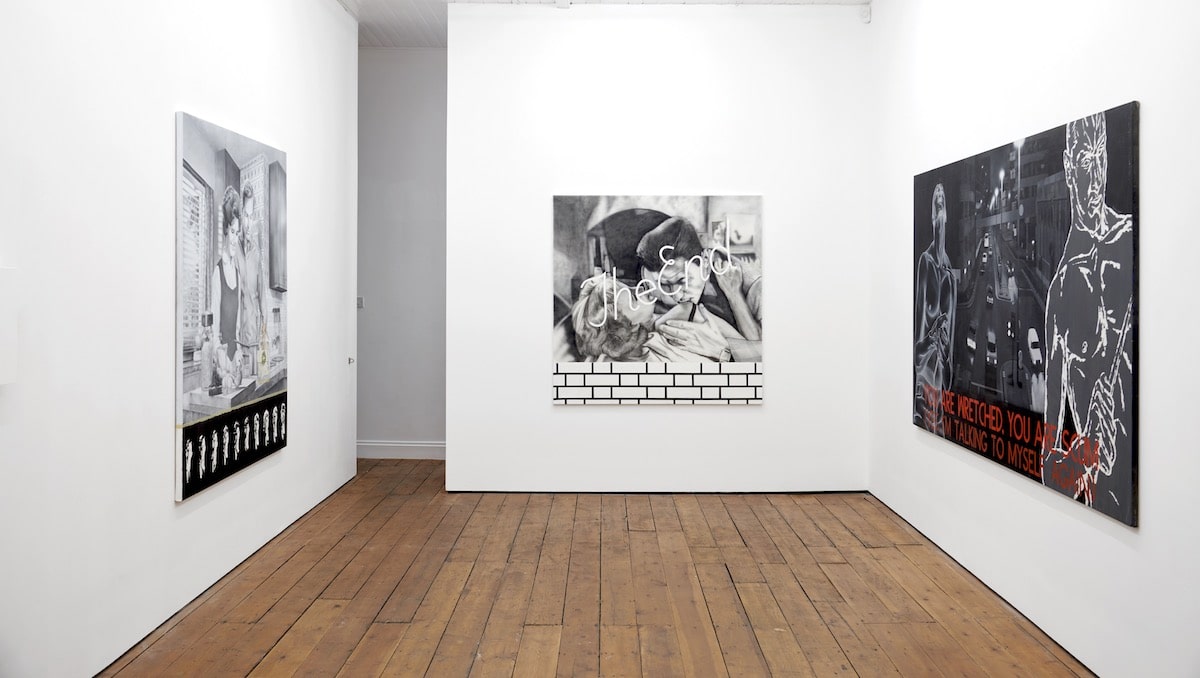
A rare opportunity to experience the work of the late Andrew Heard, currently exhibiting at the Amanda Wilkinson Gallery in London. Guest-curated by Dominic Johnson and running until August 8, the exhibition titled ‘I Want To Be Good’ covers Heard’s brief but impactful career cut short by his early death in 1993. Heard, born in Hertford in 1958, was prolific and successful both critically and commercially in his lifetime. He was highly regarded by key figures including his mentors Gilbert & George, as well as by David Hockney, John Stezaker, and Derek Jarman. The exhibition is fully supported by Heard’s estate, which is now represented by Amanda Wilkinson. Here Dominic Johnson tells us more:
Dominic, congratulations on bringing Andrew Heard’s work to life with I Want To Be Good at the Amanda Wilkinson Gallery. How did you discover Andrew Heard? Also, when you first saw his paintings, what impact did they have?
I learned about Andrew Heard’s paintings a few years ago while writing a book about British art in the time of HIV/AIDS. I was taken by the singularity, vivacity and beauty of the paintings, which I could only find in reproductions online and in a few old catalogues. I was also struck by how an artist who was so commercially successful and well-regarded in his lifetime could become largely forgotten, as if struck from the historical record after death. Surprisingly, this is his first exhibition in Britain since 1994.
You’re currently writing about Heard’s life and work. When you began, did you envisage an exhibition? Also, why this title?
Two years ago, I located and started spending time with Heard’s surviving partner, Chris Hall, who runs Heard’s estate. The idea of an exhibition crystallised quickly, especially as I’d recently curated an exhibition of sculptures and paintings of Hamad Butt, an artist whose trajectory is comparable, in the sense that they were both important in their own time, died very young, and have since been absent from institutional histories of British art. I feel this tendency is a key part of the history of artists who died from AIDS-related illness in Britain: a story of institutional squeamishness, negligence, oversight, and the failure of collective memory.
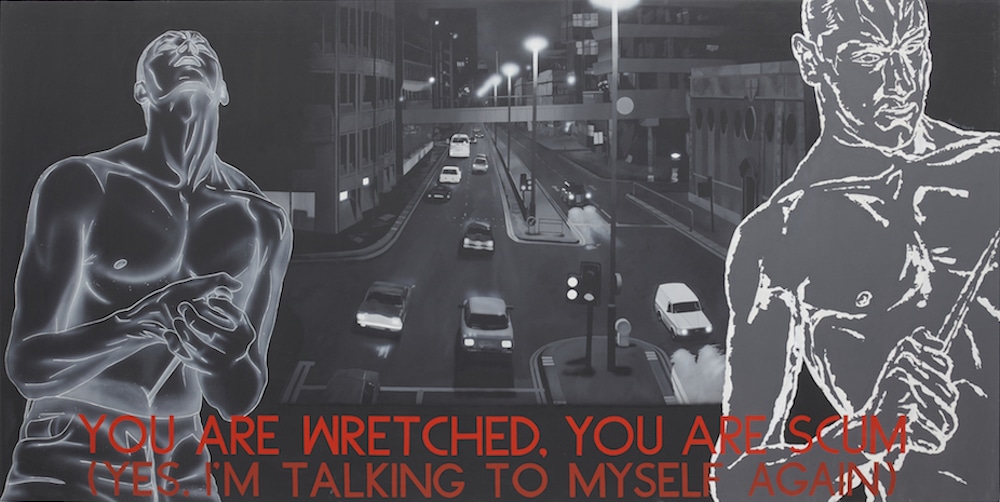
Andrew Heard ‘I WANT TO BE GOOD’ 1992
The title comes from one of the paintings in the exhibition – Heard’s last, which was on his easel when he died. The painting has ‘I WANT TO BE GOOD’ emblazoned on the canvas as a feature of the image, and I was moved, perhaps rather romantically, by this phrase as his ‘last words’, of dying with the desire simply to be good: as a person, friend, lover or painter. It lends the exhibition an emotional coolness and a sense of sadness or loss, perhaps undercut by irony.
The exhibition features a small selection of works ranging from the irreverent Cowboy Can Can (1980) to I Want to be Good (1992). How easy has it been to source the paintings and do you know if many more are at large?
There are eight large paintings in the exhibition, all of which are borrowed from Chris Hall’s collection. There are many more out there – at least a hundred. I’ve located six or seven more in collections. Many are unaccounted for, partly because when Heard died, his paintings were sold without records, sometimes by unscrupulous dealers.
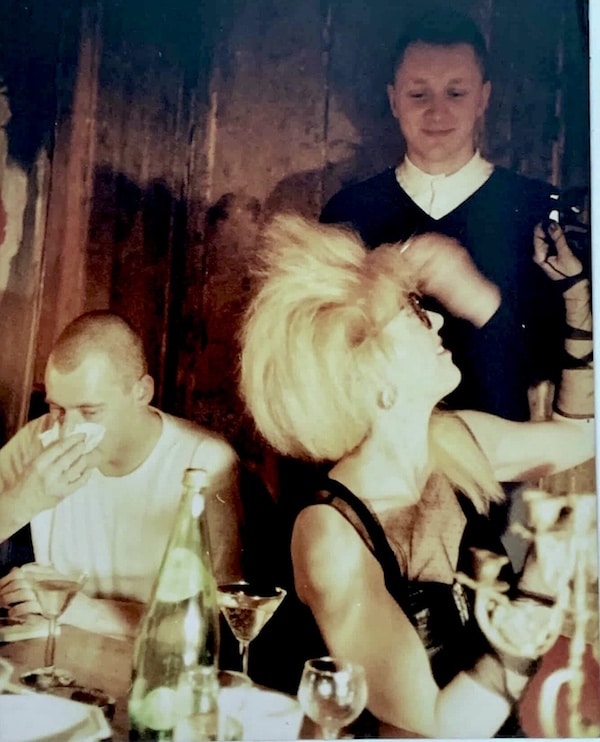
As one of a handful of bartenders who worked at the Blitz club at the onset of the1980s, it’s clear that Heard wasn’t a ‘Blitz kid’ as much as a young, gay outsider. Despite this, to what extent was this timing and environment pivotal?
Heard worked at the Blitz for about a year in 1979 and 1980. He didn’t have an outlandish look, though his style developed into a gay skinhead aesthetic from 1984. He is remembered fondly by ‘Blitz kids’ and contributed to the resurgence of nightlife, the emergence of the New Romantics, and the recuperation of that which was outdated, passé, or naff in recent British fashion and popular culture.
When he met Gilbert & George, how did their friendship and mentorship take shape?
Gilbert & George were the most influential people Heard met at the Blitz. They told me Heard gave them a free (I suppose stolen) bottle of wine when he recognised them, and they were smitten after their impression of him as ‘the perfect gentleman’ – after his death, they’d go on to describe him as a ‘saint’. Heard’s boyfriend from the late 1970s until 1985 was the painter and poet David Robilliard (they remained very close and lived together until Robilliard’s AIDS-related death in 1988). Heard and Robilliard were fixtures in Gilbert & George after about 1980, appearing in their works, helping in the studio, casting models, and generally keeping the older patrician artists connected to youth culture.
Volker Stox
Do you think he may have been a fellow contrarian?
Yes. His politics are ambivalent. He’s not ‘problematic’, but his skinhead look certainly gave people pause in the 1980s when it was often associated (crudely) with nationalism. His paintings display a sensitivity to the sense that something apparently essential to Britishness was being lost, and he attributes this, in his interviews, to the effects of waves of Americanisation in the 1960s. This now seems like a risky gesture, because the idea of cultural ‘dilution’ can slide into a fear of change due to other kinds of ‘external’ influences.
Heard’s popular-culture references from his formative years evoke domesticity and comfort, but also bleakness; would you agree?
Yes. His paintings can be sentimental and nostalgic, two ways of being or thinking that are often dismissed or ridiculed, but also ways of looking backwards with sadness, love, or desire – although he’s never mawkish or reactionary. There’s a thread of gloom and bleakness in his paintings, especially after 1987, when he was diagnosed with HIV, and his world started to change drastically.
The End (1987) references Simone Signoret and Laurence Harvey in the film Room At The Top. What’s the significance of Heard creating this emotionally charged work at that time?
My reading of this painting is that he’s thinking about endings: the end of a film (signalled by the shape of the words blasted across the canvas); the end of a fateful relationship (between the characters played by the appropriated production image of Harvey kissing Signoret’s shoulder); the end of Signoret, who was a somewhat tragic figure; and the coming end of other lives outside the painting, including Robilliard’s and Heard’s own, which were pulled into view by their diagnoses in a time long before effective treatments.
The exhibition has a fresh, intergenerational appeal. Why do you think Heard’s art still packs a punch?
It’s partly due to the style in which he painted: it’s a cliché to say an artist was ‘ahead of his time’, but in this case it does seem pertinent, in that he was regarded as out of step with the emergent styles and postures of art in the 1980s and 1990s, especially as the Young British Artists came to dominate the British art world. Heard provides a viable alternative to that mode.
After this exhibition closes, will you and Amanda Wilkinson work towards a larger retrospective?
Yes! The plan is to work towards a larger, more ambitious and comprehensive exhibition of Heard’s paintings, videos, and archival materials.
Dominic Johnson is a writer and curator. Most recently, he guest-curated Hamad Butt: Apprehensions at the Irish Museum of Modern Art (IMMA), Dublin (2024-5) and the Whitechapel Gallery (2025), and he has programmed performance events at Human Resources (Los Angeles), Whitechapel Gallery, Tate Modern, and Tate Britain. He is a Fulbright Scholar and a professor in the School of the Arts at Queen Mary University of London.
Anna Goodman of Abstrakt helped coordinate this interview.