

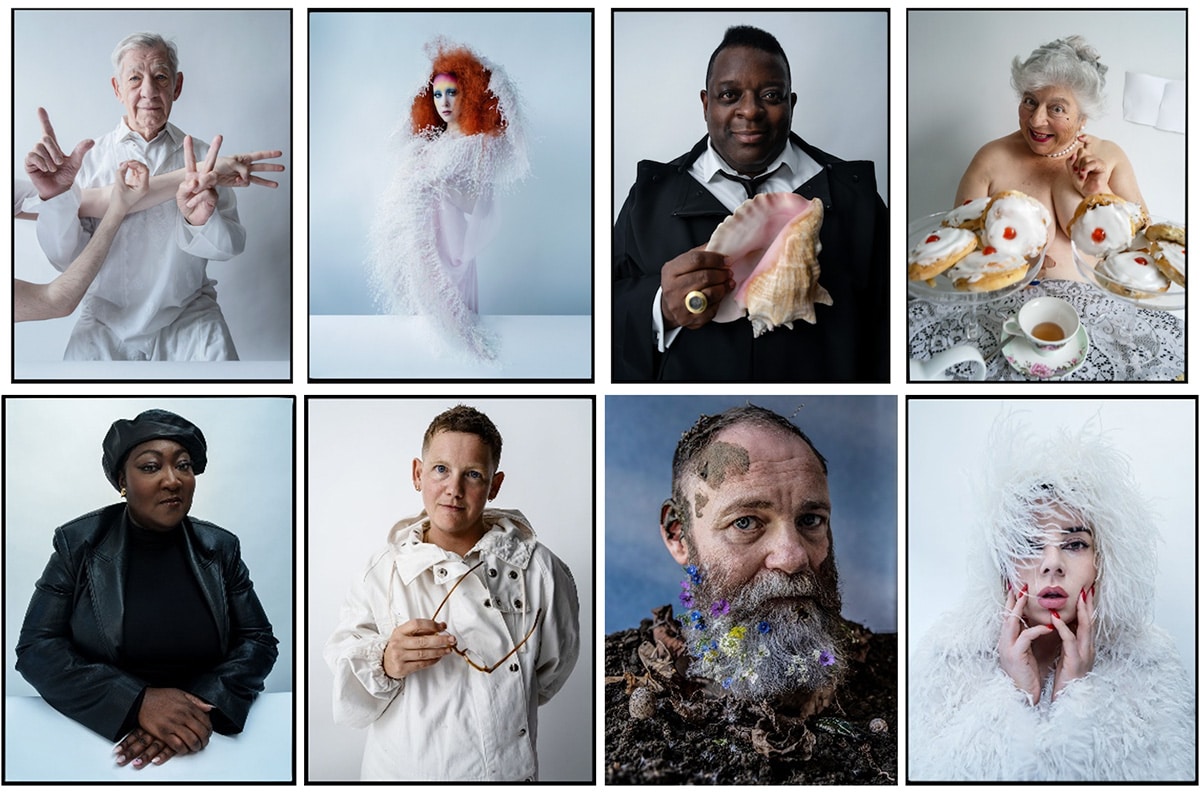
The first thing to understand about the scale of this exhibition is that Tim Walker has spent five years on this project. Fairyland: Love and Legends, running until 7 February 2027, is a new body of photographic works, 250 specially created portraits of Queer people and their allies, built through half a decade of sustained engagement with a community the photographer has described as his own.
Walker came to prominence in the 1990s with a particular kind of fantastical, elaborately staged photography that became synonymous with a certain strain of high-fashion image-making. His work appeared in Vogue, Vanity Fair, W, i-D and elsewhere, and he published seven books and showed internationally. The work in Fairyland represents something different, a decisive shift in focus and intention. The fashion context falls away. What replaces it is something more direct and, in places, more plainly moving.
The exhibition is curated by Susanna Brown and designed by Walker’s longtime collaborator Shona Heath. It opens with portraits of people who spent the 1970s and 1980s advocating for the right to love, founding members of the Gay Liberation Front and Stonewall among them, including Olivette Cole-Wilson, Andrew Lumsden, Lisa Power and Tom Robinson. Walker has described this section as his own queeristocracy, photographed in a style drawn from sixteenth-century Tudor portraiture, specifically the formal intimacy of Holbein the Younger and Nicholas Hilliard. The historical gallery setting at the NPG is not incidental to this decision. Placing these figures within a tradition of portraiture that has long excluded them is itself an argument.
Each sitter was invited to bring a meaningful object to their sitting. Author Jane Cholmeley holds the original shop sign from Silver Moon Women’s Bookshop, founded in 1984. Photographer Sunil Gupta holds his camera. Filmmaker Isaac Julien holds a conch shell, a motif from his 1989 film Looking for Langston. These are not props chosen for visual effect. They are evidence of lives and histories. The portraits of activists and changemakers, including Peter Tatchell, Caroline Paige, Ted Brown and Gilli Salvat, are set against deceptively simple white backgrounds, a nod to Richard Avedon, with whom Walker worked as an assistant in the 1990s. The restraint is deliberate and effective.
A significant section of the exhibition addresses the HIV/AIDS crisis of the 1980s, the people who died, the healthcare workers and nurses who developed treatments, and the musicians whose work soundtracked that period of fear and loss and solidarity. Marc Almond, Holly Johnson and Jimmy Somerville are among those photographed. Walker has spoken about wanting to bring the disco to the ward, to honour the tireless work of those who pushed for proper care while also celebrating the defiance of the music made under those conditions.
At the centre of the exhibition is a room of large-scale portraits of the Rebel Dykes, the post-punk collective whose campaigns spanned nuclear disarmament, environmentalism, sex-positive feminism and HIV solidarity. These photographs take Karlheinz Weinberger’s images of 1960s biker gangs as a visual reference. A short film accompanies them in which the women reflect on community and activism.
The second half of the show moves into fashion, performance and transformation, the territories where Queer culture has long done some of its most significant work. Portraits include designers Jean Paul Gaultier and Michaela Stark, drag performers Paul O’Grady, David Hoyle and Midgitte Bardot, actors Ncuti Gatwa, Hunter Schafer, Fiona Shaw and Ben Whishaw, and musicians including Björk, Lady Gaga, Boy George, Frank Ocean and Chappell Roan. The exhibition ends with a room of staged erotic scenes that rework fairy tales and nursery rhymes through a Queer lens. Walker has said that the greatest thing he learned from the activists, storytellers and performers he photographed is how essential eroticism and humour are to the subject. Not decorative elements but central ones.
The exhibition spans just over fifty years of Queer activism, community and love in Britain and beyond. Walker has described it as placing himself in the Queer realm with confidence and as telling visitors that their difference is their power. The curatorial ambition and the personal investment are both evident in the project’s scope.
A book accompanies the exhibition with contributions from Travis Alabanza, Susanna Brown, Russell T Davies, Shon Faye, Lisa Power and Joelle Taylor.
Tim Walker’s Fairyland: Love and Legends is at the National Portrait Gallery, London, from 9 October 2026 to 7 February 2027.