The August Art Diary focuses on retrospectives for a range of artists whose work engaged with aspects of spirituality, including Mark Rothko, Paul Thek, Peter S. Smith, John Piper, and John Constable. Group shows at the National Gallery of Ireland, Interchurch Center in New York, and Benjamin Rhodes Arts explore aspects of the environment and of art itself. Finally, there is news of and information about the Faith Art Prize.
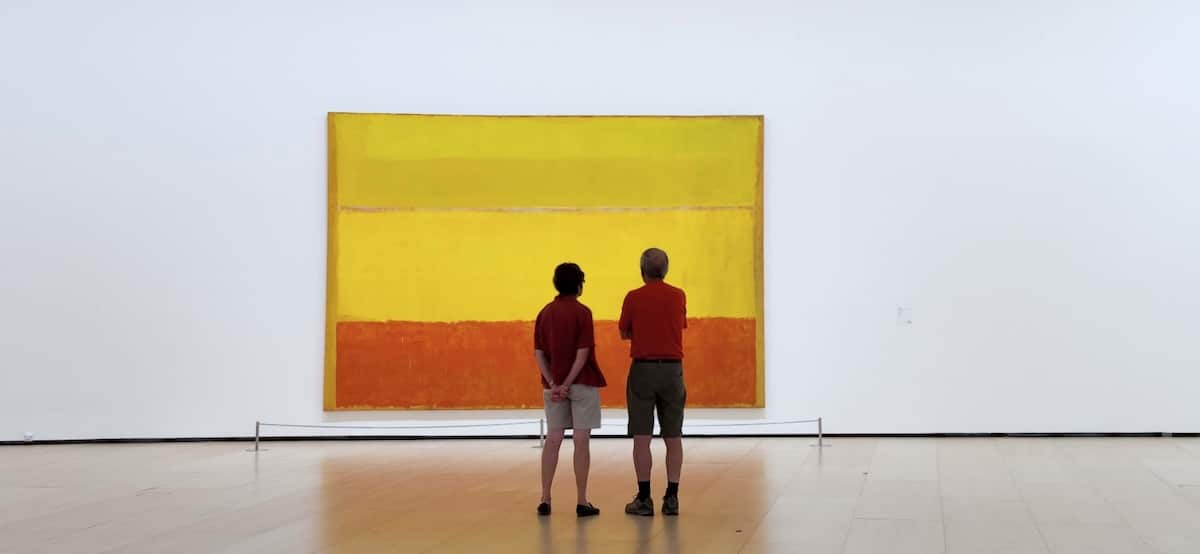
‘Rothko in Florence’ is a unique project conceived specifically for Palazzo Strozzi to celebrate the artist’s special bond with Florence. The palace’s architecture and the city itself provide the ideal backdrop to explore how Mark Rothko translated the tension between classical measure and expressive freedom into painting, creating through colour a new perception of space that transcends the two-dimensionality of the canvas.
The exhibition at Palazzo Strozzi traces Rothko’s entire career with over 70 works from prestigious private collections and leading international museums. From Palazzo Strozzi, the project extends into the city of Florence, through two special satellite interventions at locations particularly significant to the artist: the Museo di San Marco, where a selection of works are presented in dialogue with the frescoes of Fra Angelico (five of Rothko’s paintings hang alongside Fra Angelico’s monastic frescoes), and the Vestibule of the Biblioteca Medicea Laurenziana designed by Michelangelo (two studies for his Seagram Murals hang in the Laurentian Library).
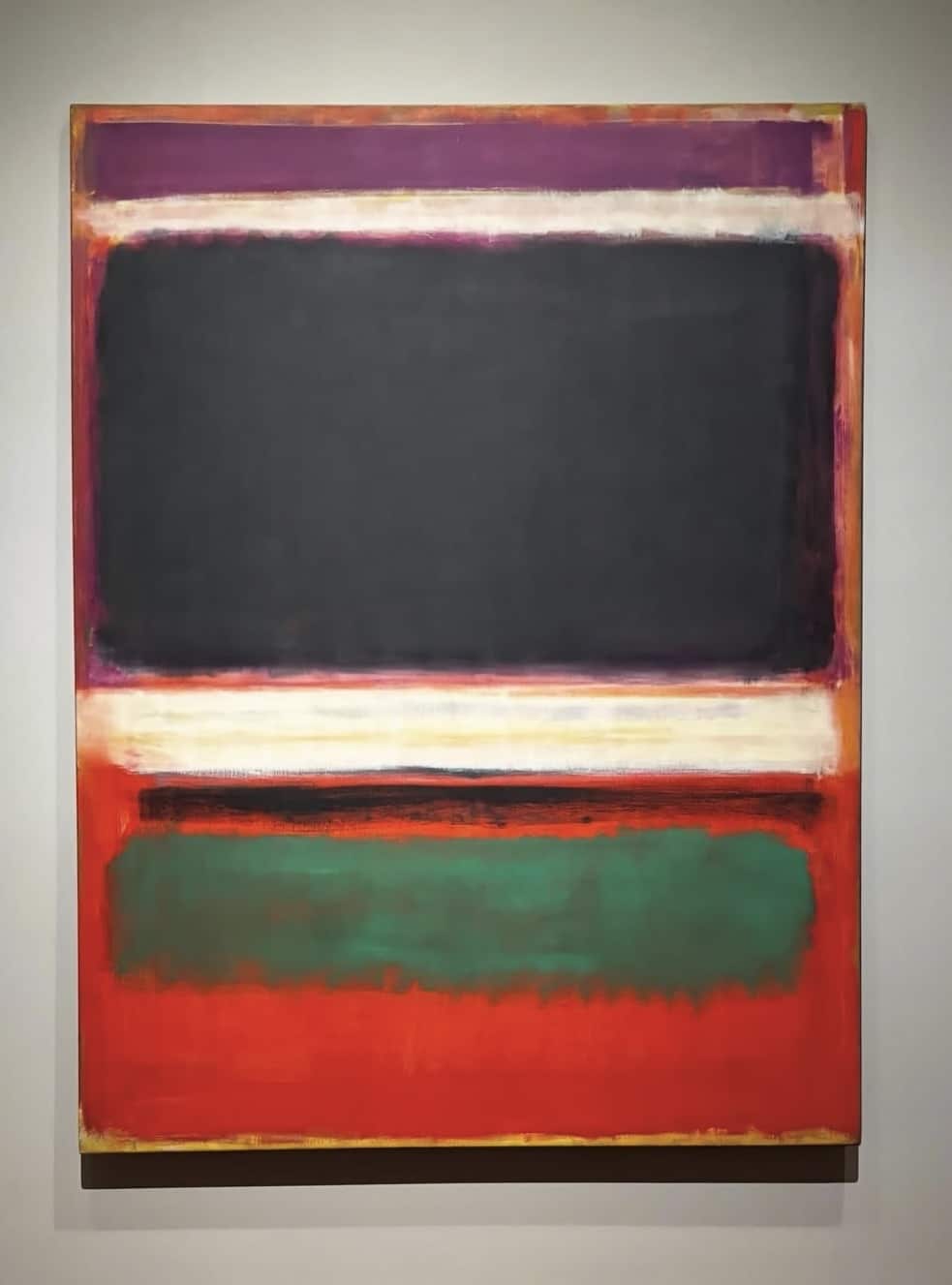
Mark Rothko, No.3/No. 13, 1949, New York, MoMA-The Museum of Modern Art, Bequest of Mrs. Mark
Rothko through The Mark Rothko Foundation, Inc. 428.1981
Rothko’s first encounter with Florence dates to 1950, during a trip to Italy with his wife Mell. He was deeply moved by Fra Angelico’s frescoes at the Convent of San Marco and by Michelangelo’s architectural vision in the Vestibule of the Biblioteca Medicea Laurenziana, which would inspire the Seagram Murals painted in the late 1950s—a dialogue that Rothko further developed during his second visit to Florence in 1966. In some of his more delicate works, one can also perceive the influence of fifteenth-century Italian art and, in particular, of Angelico’s fresco technique. Rothko and Angelico shared a desire to evoke a sense of transcendence, a dimension at once distant and profoundly familiar. While Angelico achieved this through the emotional resonance of divine figures in dialogue with earthly reality, Rothko created colour fields capable of accompanying viewers into different emotional depths, challenging accepted notions of abstraction and colour theory.
It was towards the end of the 1940s that Rothko’s work underwent this decisive shift as he abandoned figuration, including its Surrealist variations, to concentrate on abstract compositions that became his distinctive hallmark. His large-scale canvases were then built from floating, layered expanses of colour. In 1954 he held a major solo exhibition at the Art Institute of Chicago, and in 1958 he exhibited at the Venice Biennale. That same year he accepted the celebrated commission for a cycle of paintings for the Four Seasons restaurant in New York’s Seagram Building. Later, Rothko withdrew from the commission, and these works were donated to Tate in London, with the agreement that they be displayed together in a dedicated room. Further exhibitions followed at the Musée d’Art Moderne de la Ville de Paris in 1962 and the Guggenheim Museum in New York in 1963. Then, from 1964 to 1967, Rothko worked on a major cycle commissioned by collectors and patrons Dominique and John de Menil for a Catholic chapel designed by Philip Johnson in Houston. Now an interfaith space.
Rothko held that painting was a deeply psychological and spiritual experience through which basic human emotions could be communicated. He famously commented to a critic that ‘the people who weep before my pictures are having the same religious experience I had when I painted them’ and spoke of the ‘inner light’ in his paintings. His approach to painting enabled him to experiment with processes to develop a universal expression.
Paul Thek was one of the most mysterious, provocative, and quietly influential figures in the history of post-1960s art. Pace’s ‘Dream of Vanishing’ brings together more than fifty works of painting, sculpture, and drawings by the artist, including a suite of never-before-seen ink drawings resembling scrolls, presented in dialogue with some of the artist’s most celebrated and best-known works, including his ‘Technological Reliquaries’.
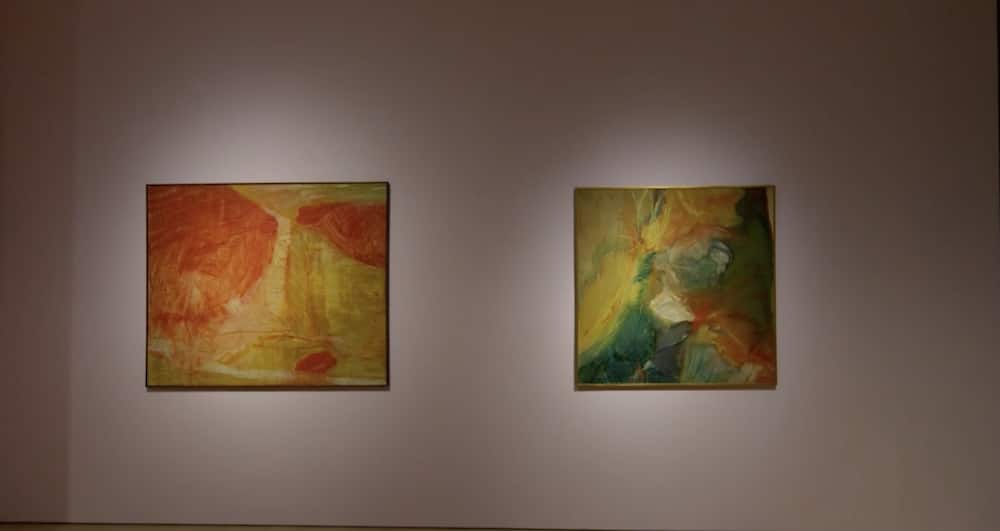
Paul Thek, Pace Gallery, installation view
Thek remains infamous today for these works, his so-called “meat pieces” made between 1964 and 1967. Mixing Catholic religiosity with posthuman technological critique, Thek produced these shockingly lifelike representations of human flesh by carefully sculpting and painting wax. He sectioned his ersatz meat into grotesquely geometric sections and encased it inside transparent vitrines, offering acerbic commentary on the aesthetics of Minimalism and Pop.
While Thek remains best known for his meat pieces, he always defined himself first and foremost as a painter. ‘Dream of Vanishing’ foregrounds his painting practice, examining the full arc of his mature work from canvases he made in Italy in the early 1960s to the “picture light” series of the 1970s and the small, colourful “bad paintings” he produced during the 1980s. These paintings provide a powerful and important context for Thek’s better-known sculptural practice. The exhibition also includes several deeply elegiac works from the final two years of the artist’s life, a period in which he dealt directly with questions of mortality and transience in the face of his AIDS diagnosis.
Among the exhibition’s key revelations is the suite of large-scale “scrolls,” works on paper that Thek produced in the 1970s and later gifted to his friend and collaborator Robert Wilson, an artist and dramaturg who became the executor of Thek’s estate. These five scrolls, previously unseen, each measure ten feet in length. Unlike anything previously known in Thek’s oeuvre, they testify to the artist’s virtuosic powers of draughtsmanship as well as his lyrical approach to mark-making. Entirely abstract, they evoke landscape with fields of black watercolour and ink that become coruscating currents, suggesting the movement of the tides or wind sweeping across expansive planes of grass. Thek’s scrolls are inventories of marks, rhyming with abstractions he explored in works made in Italy a decade earlier, several of which are also included in the exhibition.
This exhibition marks the first major presentation in New York to survey a wide breadth of Thek’s work since the 2010 retrospective at the Whitney Museum of American Art. The show takes its title from a line in one of the artist’s notebooks, in which he jotted down the words “dream of vanishing.” The phrase suggests both reverie and provocation and underscores Thek’s lifelong preoccupation with disappearance, erasure, and the ephemeral, which was reflected in his materials and methods. It also suggests an admonition: to actively dream of vanishing as a way of meditating on time, desire, and the body—ideas that cut to the heart of Thek’s idiosyncratic yet deeply philosophical engagement with the tragedies and ecstasies of life. Compendia of his correspondences, watercolours, diary entries, poetry, and more —a group of Thek’s notebooks, which he considered artworks unto themselves—are included. A new facsimile edition by Pace Publishing of Thek’s Notebook #41 from 1977 has also been released to coincide with the exhibition.
As much myth as historical figure, Thek has often been called the quintessential “artist’s artist.” By the time of his death in 1988, he had attained the status of legend among other artists but has long been absent from art history textbooks and unknown to the wider public. Deeply fugitive, Thek’s periods of wilful concealment—such as his abrupt disappearance from the New York art world in 1967, followed by nearly a decade of residing primarily on the small and remote Italian island of Ponza—were always followed by moments of re-emergence in the New York art world, though with increasing degrees of obscurity. In many ways, his efforts at self-erasure reflect his unique philosophy of artmaking, imagining his work not as fixed historical object in time but as a body capable of rebirth, disappearing and reappearing again in some later moment with renewed meaning.
In her film ‘Artists on Artists: Anicka Yi x Paul Thek’, artist Anicka Yi explores ‘Dream of Vanishing’ with what psychologists call a “lantern consciousness,” inviting open association and reflection. In Thek’s vivid paintings, visceral sculptures, and personal notebook pages, Yi finds a kindred spirit, one whose artistic concerns have echoes in her own practice: “I feel a deep kinship here.”
The exhibition runs in parallel with a solo presentation of Thek’s work at Galerie Buchholz in New York. These exhibitions also precede The Watermill Center’s upcoming exhibition ‘The Disappearance of Landscape: Oakleyville, 1964–2022’ (29 August, 2026 –20 March, 2027), investigating the practices of a group of artists in Thek’s circle who lived and worked between New York City and the sparsely populated Fire Island community of Oakleyville from the mid-1960s to the present day.
What emerges across these various bodies of work, which span the early 1960s until Thek’s untimely death in 1988, is a vision of the artist’s approach to painting as an activity that attests both to presence and absence. ‘Dream of Vanishing’ celebrates the lasting mystery surrounding Thek as an extension of his enduring commitment to mythmaking.
Peter S Smith is a Painter/Printmaker with a studio at the St Bride Foundation, Bride Lane, off Fleet Street, London. He studied Fine Art at Birmingham School of Art and Design (BA (Hons) Fine Art, 1969) and Art Education at Manchester (Postgraduate Certificate in Education,1970). Then, in 1992, he gained an MA (Printmaking) at Wimbledon School of Art. A member of the Society of Wood Engravers and the Royal Society of Painter-Printmakers, he taught, full- and part-time, in Secondary and Further Education from 1971. Between 1979 and 1981 he was West Midlands Fine Art Fellow working as Artist in Residence with Dudley Education Services. He was later Head of the School of Art and Design at Kingston College from1983 until 2010. He exhibits his paintings and prints in the UK and overseas, with work in public and private collections, as well as teaching workshops in the visual arts.
Spanning 1963–2026, ‘NOW & THEN’ brings together prints, drawings and paintings that reflect over six decades of Peter S Smith’s artistic journey, from a drawing made at age sixteen to his most recent work. Peter says: “Looking through some folders of past work, I came across a drawing I made in 1963, when I was sixteen years old. It gave me the idea for these two exhibitions. NOW&THEN span the years 1963 to 2026. The Bridewell Theatre Bar is suitable for smaller works. A series of prints, drawings, paintings and studies for larger works have been selected. They provide a snapshot of some of the various themes and processes which have engaged my attention over the last six decades.”
Edwina Ellis notes that: “Peter’s work has always arrested me: stopping an amble down a gallery wall, making me lean into a small but fierce engraved image, startling me with a wave of recognition of strength in a drawing” Simon Brett suggests that: “Peter’s wood engravings and etchings are so much expressions of the identical sensibility, rather than exercises in contrasted media, that they subliminally make one think of him not as a wood engraver or an etcher as such, at all, but as a printmaker and an artist. Not all wood engravers achieve that, let alone effortlessly. He has done his printmaking MA; he knows all about techniques, but he never succumbs to the flash or relies on technical accomplishment. He keeps his work and us always on the edge.”
Drawing on insights from the work of Hans Rookmaaker, Smith believes that artists who are Christians “are free to explore and disclose Christian attitudes and ways of thinking in a contemporary way in a contemporary context”.
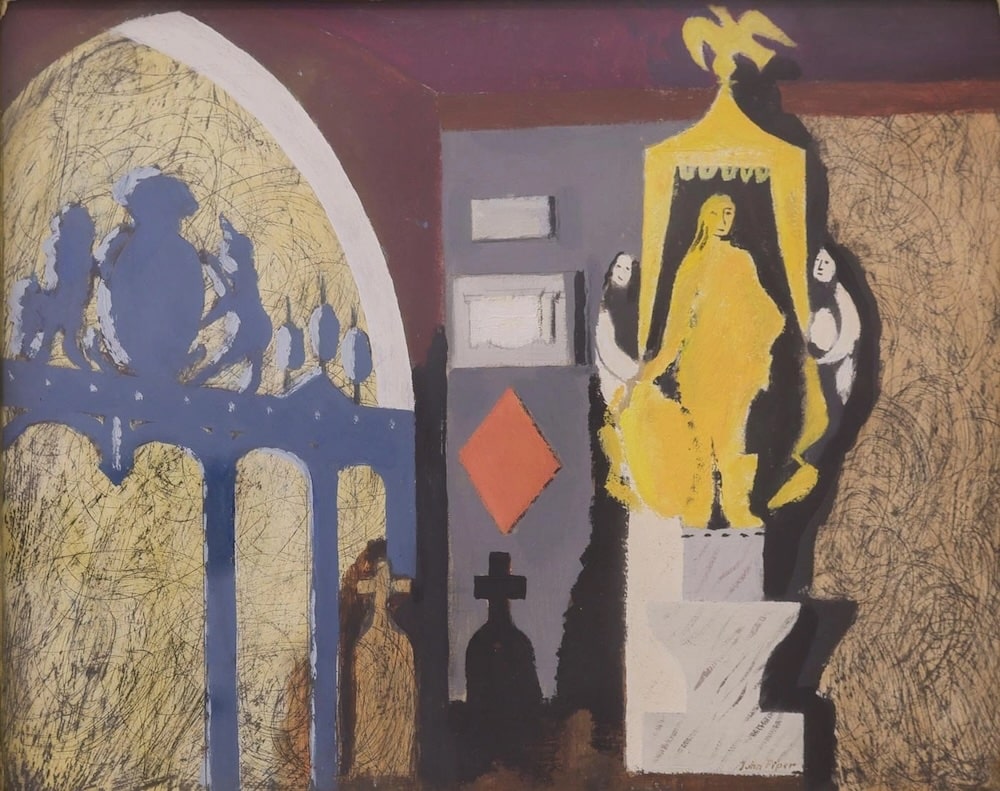
John Piper in the South Country, Museum & Art Swindon
John Piper is a widely popular artist, but there has been no previous exhibition of the work he did in the south and south-west of England. Yet he made some of his most significant paintings of subjects from this area, including Stourhead, Fonthill and Lacock, and one of his finest early collages is of the Neolithic site at Avebury. ‘John Piper in the South Country’ at Museum & Art Swindon includes examples of all these, plus a number of the churches in the locality, from Inglesham to Knowlton and Britwell Salome. Piper also painted different aspects of Salisbury Plain: a view of a Neolithic barrow, the land under plough in the Second World War, and the great monument of Stonehenge. Other subjects include a street corner in Lydiard Park, Cerne Abbas and several studies of the Isle of Portland.
While these images map Piper’s love of Wiltshire and Dorset, they also track his changing style of working. Piper was one of many English artists who adopted abstraction as the language of International Modernism in the early 1930s, and consequently made some powerful paintings and reliefs in a completely non-representational style. But he soon discovered that for him a purely formal art of geometric lines and colours, however subtly orchestrated, was not enough. He missed having recognisable subject matter – things he had seen and enjoyed in the world around him. So, he gradually returned to nature, through drawings, paintings and collages of landscapes and buildings. He became a great Romantic artist, dealing with the significant particulars of a subject.
‘John Piper in the South Country’ brings together artworks from private and public collections across the country. They join Swindon’s own ‘Bolingbroke at Lydiard Tregoze’ from the collection at Lydiard House Museum. This major exhibition highlights how Piper responded to the landscape and architecture of the south country of Wiltshire and Dorset.
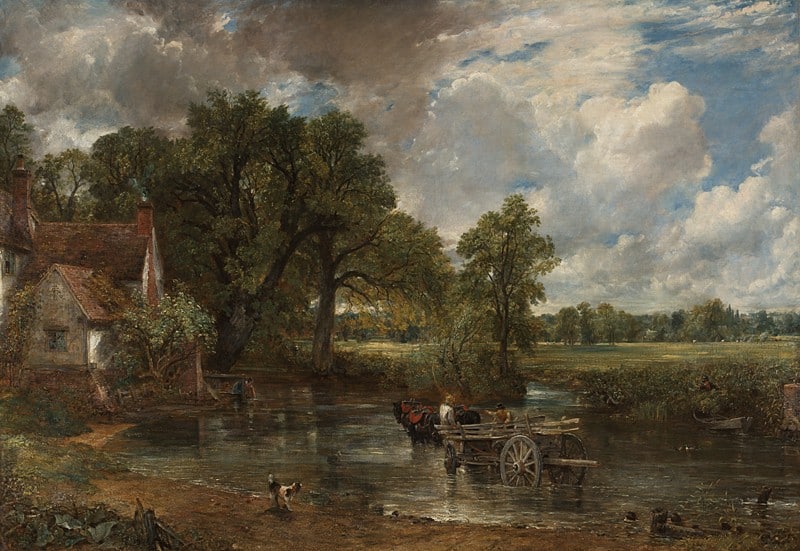
John Constable, 1776 – 1837. The Hay Wain, 1821. © The National Gallery, London
‘The Hay Wain: Walking Constable’s Landscape’ brings unprecedented key loans from the National Gallery, Tate, V&A, Royal Academy, National Galleries of Scotland to Suffolk for the very first time to explore themes of landscape, place and walking. These historic loans, which include ‘Dedham Vale’ (1828, National Galleries of Scotland), can be seen alongside Colchester + Ipswich Museum’s own Constable collection, including the two most personal paintings from his childhood home, ’ Golding Constable’s Flower Garden’ and ’ Golding Constable’s Kitchen Garden’ (both 1815). A highlight is Constable’s iconic masterpiece, ’The Hay Wain’ (1821, The National Gallery), making its first-ever visit to the county it depicts. The exhibition also includes ‘Constable Ambisonic’, a sound artwork of field recordings from the locations of Constable’s most famous artworks, today developed by artist Stuart Bowditch.
Constable commended the understanding that we are “endowed with minds capable of comprehending the ‘beauty and sublimity of the material world’ only as the means of leading us to religious sentiment”. Bendor Grosvenor describes works such as ‘Salisbury Cathedral from the Meadows’ as “an emphatic demonstration of the religious sublime”.
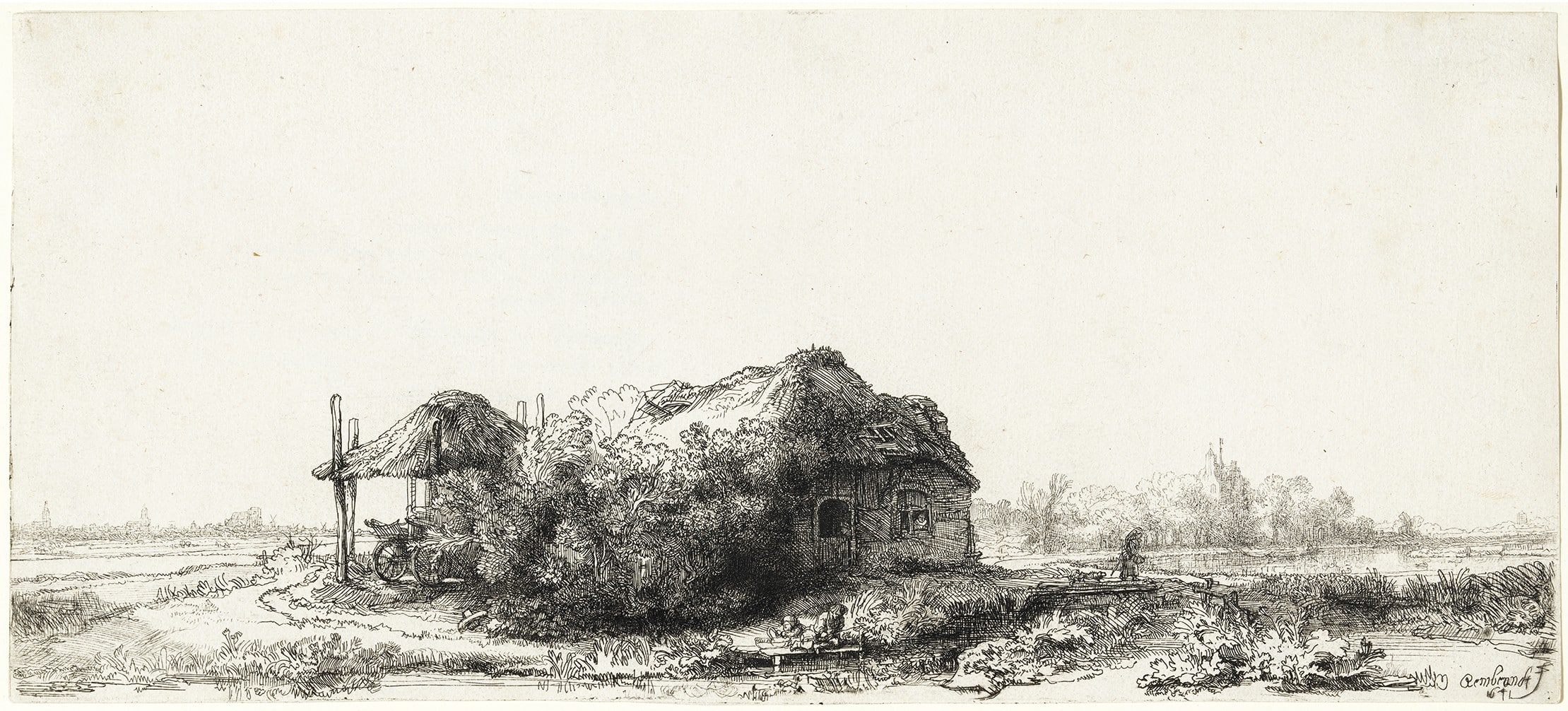
Rembrandt van Rijn (1606–1669)
Landscape with Cottages and a Hay Barn: Oblong, 1641, National Gallery of Ireland Collection
‘Rembrandt to Matisse – A Celebration of European works on paper’ at the National Gallery of Ireland showcases some of the greatest European artists through their works on paper. 57 works from the Gallery’s world-leading collection are on display, including drawings, prints, watercolours, pastels, photographs and miniatures. Visitors get an intimate opportunity to see the dedication to craft that works on paper reveal, where artists explore and refine their own technique and compositions, drawing inspiration from those that have gone before, and creating fully formed works of art in their own right.
Ranging from the 15th century to the present day, the exhibition explores the work of European artists across various schools and movements, from the Italian Renaissance to German Expressionism. The exhibition also highlights contributions from all corners of the continent, featuring artists hailing from Italy, Spain, France, Germany, the Netherlands, Belgium, Czechia, Poland, Finland, Britain, and Ireland. Within this context, it highlights those Irish artists who were drawn to mainland Europe for inspiration, and conversely how Ireland has inspired artists of other nationalities.
Several works from the Italian Renaissance are on display, including works by Raphael. Linked to his most famous fresco, ‘A Standing Philosopher and Hand Detail’ (1509) shows Raphael working on the classical drapery and monumental poise that would appear in the Vatican’s ‘The School of Athens’ (1509-11) later that year. The figure, who does not appear in the final work, demonstrates the careful detail that the great artist employed. Parmigianino’s Mannerism is seen in a preparatory drawing executed while decorating the Parma church of San Giovanni Evangelista.
Another master of the Renaissance period, this time from Germany, is included with ‘Saint Catherine of Alexandria’ (1513). It depicts the Christian martyr holding the sword that would later be used to behead her. While the monogram on this sheet points to Dürer, the authorship of this drawing remains inconclusive; Dürer and von Kulmbach – deft draughtsmen in pen and ink – were both active in Nuremberg at this time. Counter-Reformation imagery is seen in two expressive drawings by early Baroque practitioner Ludovico Carracci depicting the stigmata in ‘St Francis of Assisi’ (1588-9) and the assumption in ‘The Apostles Carrying the Body of the Virgin to the Tomb’ (1605-9).
Specialists in portraiture are on display, demonstrating the vogues and fashions of their times. Two portraits by the Italian portraitist Rosalba Carriera show how she used thick blue paper for its chromatic vibrancy when applying radiant pastels to depict either a female head in the allegorical work ‘Winter’ (1742/3) or the mythological goddess Diana (1742/43). German miniature portraitist Christian Friedrich Zincke employed a stipple technique of tiny red dots to create skin tones as seen in his portrait of ‘The Hon Thomas Foley’ (1723). The archetypical Pre-Raphaelite muse, Jane Burden, appears in a work of ink, graphite and wash with white highlights on paper by Dante Gabriel Rossetti. A preliminary study for a mural on Arthurian legend that was never executed, here Burden is depicted as Queen Guinevere.
Landscapes across the continent and throughout the centuries are included, such as French Post-Impressionist and Gauguin associate Armand Seguin, who, while based in Le Pouldu in Brittany, created his ‘Trees above the estuary’ (1892). A graphite and watercolour work by Paul Cézanne shows ‘La Montagne Sainte-Victoire from Les Lauves, near Aix-en-Provence’ (1902-04), a place which became a focal point for some of his later masterpieces. An exquisite etching by Rembrandt shows him combining imagination and realism in a scene of contrasting dwellings. A watercolour work by Joseph Mallord William Turner shows ‘Bregenz, Lake Constance, Austria’ (1840), a place full of ancient monasteries and churches that the artist visited on a journey from Rotterdam to Venice.
With a focus on Ireland, there is the exalting of classical antiquity with ‘The Parthenon, Athens’ (1891-1892) by Irish realist artist Nathaniel Hone the Younger, Roderic O’Conor’s post-impressionist rendering of ‘The Cliff’ (1893), and a 2006 photograph of the ancient, dry-stone walls of the Aran Islands by fellow Irish artist Sean Scully evoking his iconic stripes.
Capturing those at work are also seen through the centuries, from the Dutch painter Constantijn Verhout’s depiction of ‘An Old Woman Frying Pancakes’ (1660s), to German artist Kathe Kollwitz’s ‘Working Woman with a Blue Shawl’ (1903). This colour lithograph evokes sympathy for the plight of the working labour movement.
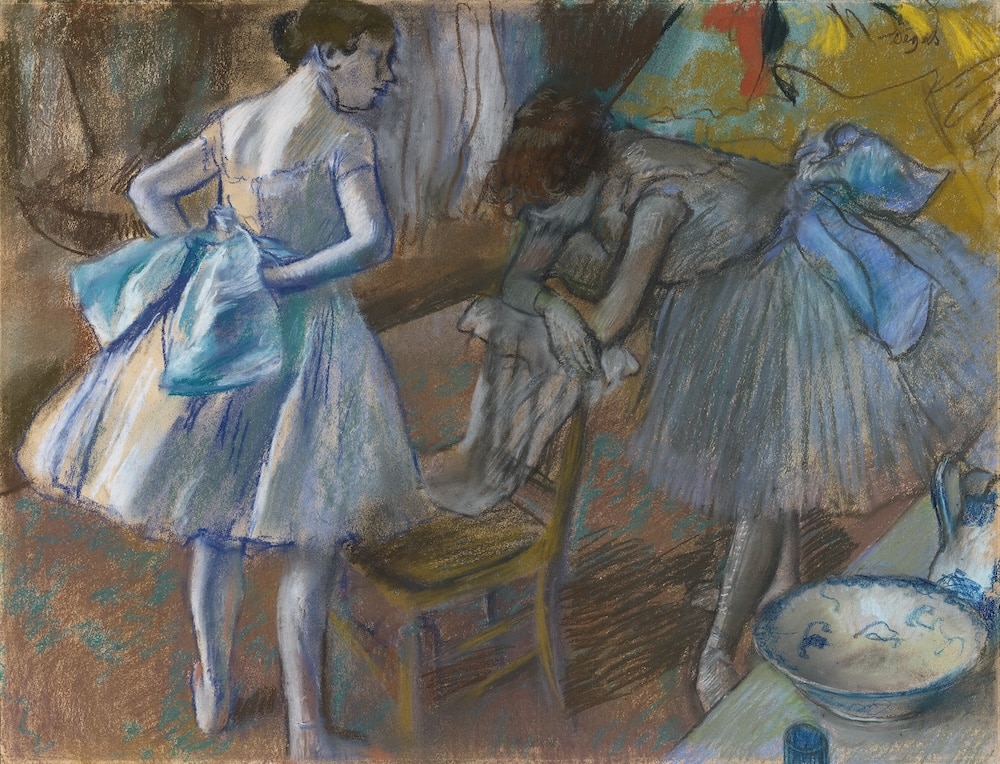
Edgar Degas (1834-1917)
Two Ballet Dancers in a Dressing Room, c.1880
Leisure and cultural pursuits have also been a particular focus of works on paper throughout the centuries. Famous for his depictions of ballet scenes, a pastel by Edgar Degas is on display with ‘Two Ballet Dancers in a Dressing Room’ (1880) conveying the tumult behind the scenes of a ballet company, while Pablo Picasso’s own take a few decades later in ‘Two Seated Dancers of Les Ballets Russes, Monte Carlo’ (1925) shows a more relaxed scene with two dancers reading a newspaper on a break.
Visitors can also see how draughtsmanship and drawing changed at the beginning of the 20th century, when new and radical art movements were forming. Although it lacks the colour of his fauvist works, Henri Matisse’s lithograph on Chinese paper ‘Dancer Reflected in the Mirror’ (1927) contains his expressive style, as a dancer observes her reflection in a mirror. The influence of Fauvism on one of Ireland’s first abstract artists, Mary Swanzy, can be seen in her colourful pencil sketch ‘Panoramic Landscape View over a Plain’ (1920). German Expressionism is represented through three of its major proponents. Ludwig Meidner depicts his own poverty in a reed pen and ink illustration ‘Bettler’ (1916), the moodiness of Max Beckmann can be seen in the drypoint etching ‘Family Scene (The Beckmann Family)’ (1918), and one of the founding members of the movement, Karl Schmidt-Rottluff, is represented by his woodcut on paper ‘At the Nets (Bei den Netzen)’ (1914).
CARAVAN’s newest contemporary art exhibition titled ‘NOAH: A Future Hope’ is being showcased in New York at The Galleries of The Interchurch Center as part of its three-year global tour. Having premiered in Houston, Texas in November 2025, and then been showcased in Washington, D.C. and Hartford, CT, the exhibition is an artistic exploration focused on the importance of caretaking the earth.
The exhibition features three contemporary artists, Yona Verwer, Brian Whelan, and Hady Boraey, from the faith traditions of Judaism, Christianity, and Islam, respectively, who have been inspired by the story of Noah, the ancient flood narrative shared by all the Abrahamic faiths. Each artist uniquely blends their spiritual, cultural and creative expression as they visually inspire our imaginations to heal our world by honouring our intricate connection to the earth as our sustainer, and by maintaining a sacred balance with all of life that is upon it.
At a time when our world is experiencing a climate catastrophe with far-reaching consequences, ‘NOAH: A Future Hope’ is an artistic call on the need to unite and proactively participate in ensuring a sustainable future for the earth and all its life forms. The exhibition visually demonstrates how the epic story of Noah’s flood, one of the most well-known flood stories in history, has much to teach us about humanity’s role as a protector, steward and caretaker of the earth.
Two of the participating artists are holding associated solo exhibitions opening at the same time: ‘Fluid Futures – Living Waters’ – Yona Verwer, and ’40 Days & 40 Nights’ – Brian Whelan. CARAVAN is an international arts nonprofit recognised as a global leader in using the arts to build bridges between diverse cultures, peoples, and spiritual traditions.
‘Paintings to Revisit & to Discover: Summer Mode’ at Benjamin Rhodes Arts features work by Michael Crowther, Sharon Hall, Vik Winter, and Tricia Gillman.
Crowther’s book-sized panels are imbued with thinking about painting, writing, history and landscape, each its own work of visual poetry that continues from his solo installation of last year, ‘Bollihope and Others’. This loudly declared an integrated vision at home in an enigmatic and painterly strangeness. Hall includes key works from her prominent solo ‘Meeting Points’ at Benjamin Rhodes Arts in 2024 and adds a group of small canvases – these resonate together and underline her highly tuned and practised ability to combine a balance of colour, tone, and light with innovations in spatial shift, mostly happening without our noticing.
Winter only recently embarked on the group of paintings she is showing. Earlier formal ‘desk-bound’ paper studies have given way to a broader vocabulary of familiar landscapes and everyday signifiers that remain subject to her unerring rightness and enact her ‘attempt at resetting to what might have been if life had a more peaceful path’. Gillman’s Rubicon series marks a shift in her practice over the last ten years, returning to the use of paint, partly due to re-encountering her own large-scale 1980s canvases with their free-flowing painterly aliveness that stood out at the time and led to her first collaborations with Rhodes. A re-engagement on her part with the pleasures and complexities of the medium, exploring new and ongoing concerns, can be seen.
Previously known as the Laudamus Award, the Faith Art Prize returns to celebrate contemporary art exploring faith, devotion and spirituality. Open to artists worldwide, working across all disciplines, media and techniques, the Prize encourages new interpretations of sacred narratives, symbols, and devotional imagery. Artists at all stages of their careers can enter, from amateur to professional, emerging to established.
Artworks will be shortlisted by a leading panel including: Mario Tavella (Chairman, Sotheby’s Europe), Jemila Isa (painter) and Nic Fiddian-Green (sculptor), chaired by Father Patrick van der Vorst. Up to 100 works will be shortlisted for exhibition, in a central London location. Prizes totalling £30,000 will be awarded to outstanding works in the exhibition: a First Prize of £25,000 and a People’s Choice Award of £5,000. The Prize will coincide with the Christian Art Conference, a one-day gathering of artists, theologians and cultural leaders to explore the relationship between beauty and faith. Artists entering The Faith Art Prize will be offered a discounted ticket to the conference. Up to 15 shortlisted works will be reproduced and displayed at the conference at the QEII Centre, London on Saturday 14 November 2026.
‘Rothko in Florence’, 14 March – 23 August 2026, Fondazione Palazzo Strozzi, Florence –
Visit Here
‘Paul Thek: Dream of Vanishing’, through 14 August 2026, Pace Gallery, New York –
Visit Here
‘NOW & THEN: An exhibition by Peter S Smith’, THEN: 13 July – 16 August 2026 and NOW: 20 August – 27 September 2026, Bridewell Theatre Bar, London – Visit Here
‘John Piper in the South Country’, 4 July – 26 September 2026, Museum & Art Swindon –
Visit Here
‘The Hay Wain: Walking Constable’s Landscape’, 11 July – 4 October 2026, Christchurch Mansion, Ipswich – Visit Here
‘Rembrandt to Matisse – A Celebration of European works on paper’, 18 July – 6 December 2026, National Gallery of Ireland – Visit Here
‘NOAH: A FUTURE HOPE’ and Associated Exhibitions (‘Fluid Futures – Living Waters’ – Yona Verwer, ’40 Days & 40 Nights’ – Brian Whelan), 9 July – 26 August 2026, The Galleries of The Interchurch Center in the Upper West Side of Manhattan –
Visit Here
‘Paintings to Revisit & to Discover: Summer Mode’, 16 July — 19 September 2026, Benjamin Rhodes Arts – Visit Here
The Faith Art Prize – Visit Here