
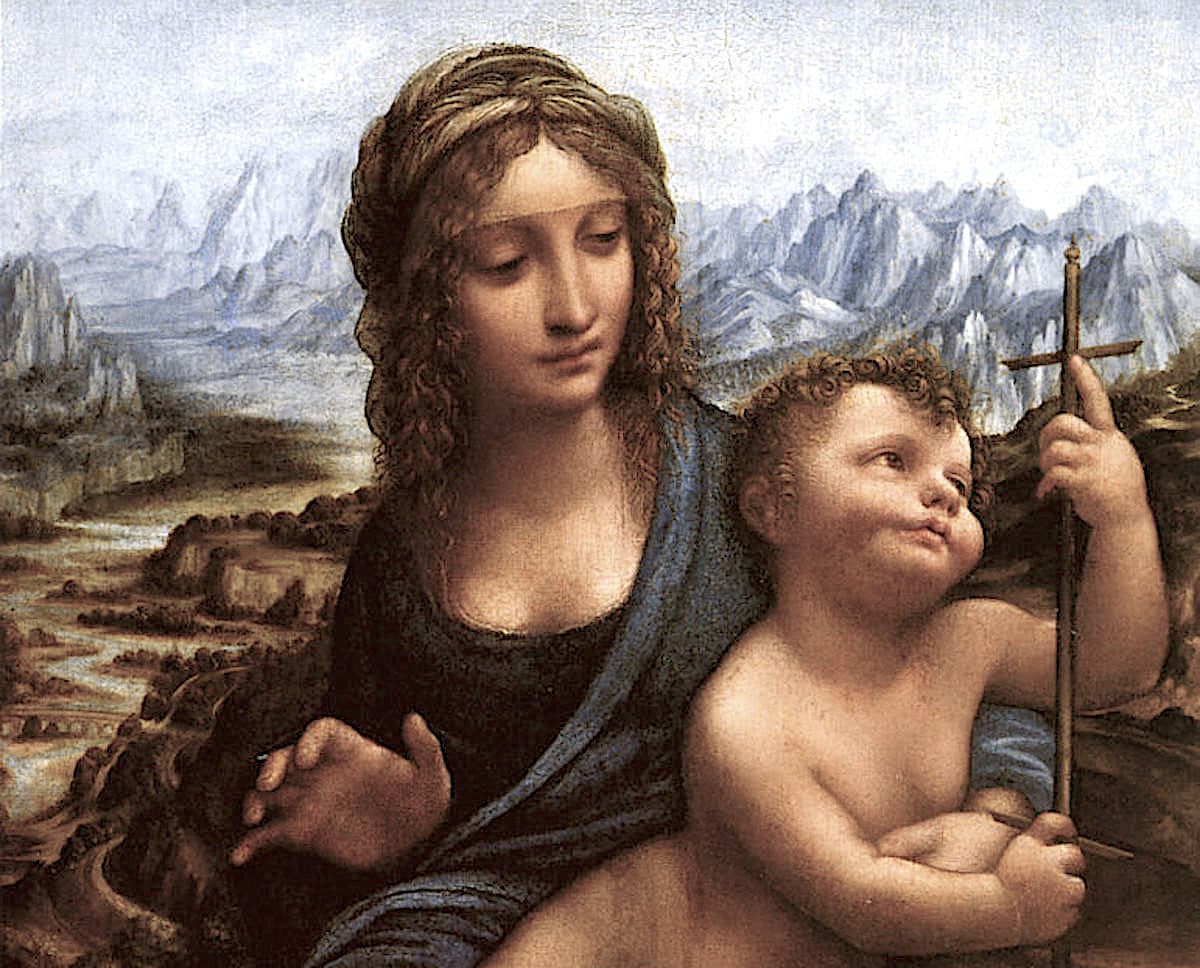
The Metropolitan Museum of Art has hung a painting attributed to the studio of Leonardo da Vinci in gallery 609 of its European paintings department without making any public announcement. Madonna of the Yarnwinder, also known as the Lansdowne Madonna, is one of two principal versions. The Buccleuch Madonna and the Lansdowne Madonna both feature underdrawings that show shared, experimental changes from Leonardo’s workshop. The painting is now on view from the collection of the financier Kenneth C. Griffin; this work represents a rare opportunity to see a work connected to one of the most studied and most contested bodies of art in history.
The label attributes the artwork to Leonardo and his studio and dates it to approximately 1505, while the museum’s own website gives a date of around 1501. That small discrepancy is itself a telling detail, reflecting the broader uncertainty that surrounds this particular work and the question of how much of it Leonardo actually painted himself.
The painting is of a small in scale, measuring roughly 20 inches high, and shows the Virgin Mary and the Christ Child seated among rocky outcrops, a setting characteristic of Leonardo’s compositional thinking. The child holds a yarnwinder, a cross-shaped tool used to wind loose yarn, which functions here not as a domestic prop but as a theological premonition, its four spokes anticipating the Crucifixion. The child looks at it with an intensity that seems to exceed the ordinary curiosity of an infant. At the same time, Mary’s hand and unsettled expression suggest she understands the object’s darker significance. The emotional charge in that exchange between mother and child is the kind of psychological complexity that contemporary accounts associated with Leonardo’s approach to religious painting.
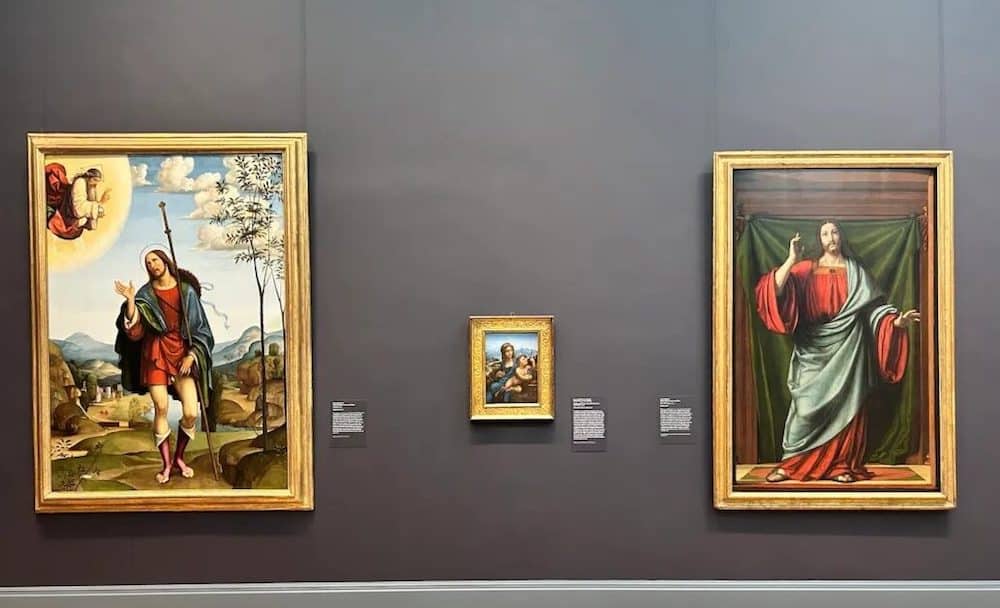
Madonna of the Yarnwinder Da Vinci Met Museum
A 1501 letter from Fra Pietro da Novarellara to Isabella d’Este describes Leonardo working on just such a composition, with a Madonna whose child grasps the yarnwinder and resists his mother’s attempts to take it from him. The letter is one of the few documentary records linking Leonardo to this subject in that period, and it was written for Florimond Robertet, a French royal secretary and significant Renaissance patron with ties to the French court’s interest in Italian art.
The question of which painting, or paintings, resulted from that commission has occupied scholars for decades. At least two versions of the Madonna of the Yarnwinder circulate as serious candidates for autograph or near-autograph status. The other principal version belongs to the National Galleries of Scotland and carries its own dramatic history: it was stolen from Drumlanrig Castle in 2003 and not recovered until four years later. Leonardo scholar Martin Kemp, in his 2011 catalogue essay for a National Galleries of Scotland exhibition, described both paintings as the two strongest versions made for Robertet. He argued that the New York picture was completed in Leonardo’s studio somewhat later than the Scottish version, under the master’s direct oversight and possibly with his active participation in the design and execution of the figures.
That position sits between the two poles of attribution historically applied to this work. At one end, it has been described as a copy by a later follower; at the other, as the original painting. The range of scholarly opinion between those positions, from studio replica to substantially autograph work completed under Leonardo’s supervision, reflects the difficulties inherent in attributing Renaissance paintings produced in workshop conditions, where the boundary between the master’s hand and a gifted assistant’s was not always clearly maintained or even clearly intended to be.
In Leonardo’s case that boundary carries particular weight, partly because his surviving paintings are so few and partly because the stakes of attribution, critical, historical and financial, are so extraordinarily high. The National Gallery of Art’s Ginevra de’ Benci remains the only Leonardo painting on permanent public display in the Americas. The Salvator Mundi, whose own attribution has generated fierce debate, sold at Christie’s in 2017 for $450.3 million, the highest auction price ever recorded for a single work. Even a painting attributed to Leonardo and his studio, rather than to Leonardo alone, carries a significance that most Renaissance works cannot approach.
The Met’s decision to hang the painting without a press release or announcements is in keeping with how major loans sometimes enter public institutions, quietly and without fanfare, allowing the work to find its audience without the distorting pressure of a media moment.
The painting rewards sustained attention. Whatever the precise balance of hands involved in its making, the image operates with a psychological and compositional intelligence that connects it to the Leonardo tradition in ways that go beyond surface resemblance. The child’s grip on the yarnwinder, Mary’s reaching hand, the rocky landscape behind them: these are not the products of routine workshop production but of a pictorial intelligence thinking seriously about what the scene means and how to make a viewer feel it.
The Lansdowne Madonna is on view now in gallery 609 at the Metropolitan Museum of Art.