
Four paintings by the Renaissance master Antonello da Messina have been stolen from the Accascina Regional Museum in Messina, Sicily, timed to coincide with one of the city’s largest annual religious gatherings.
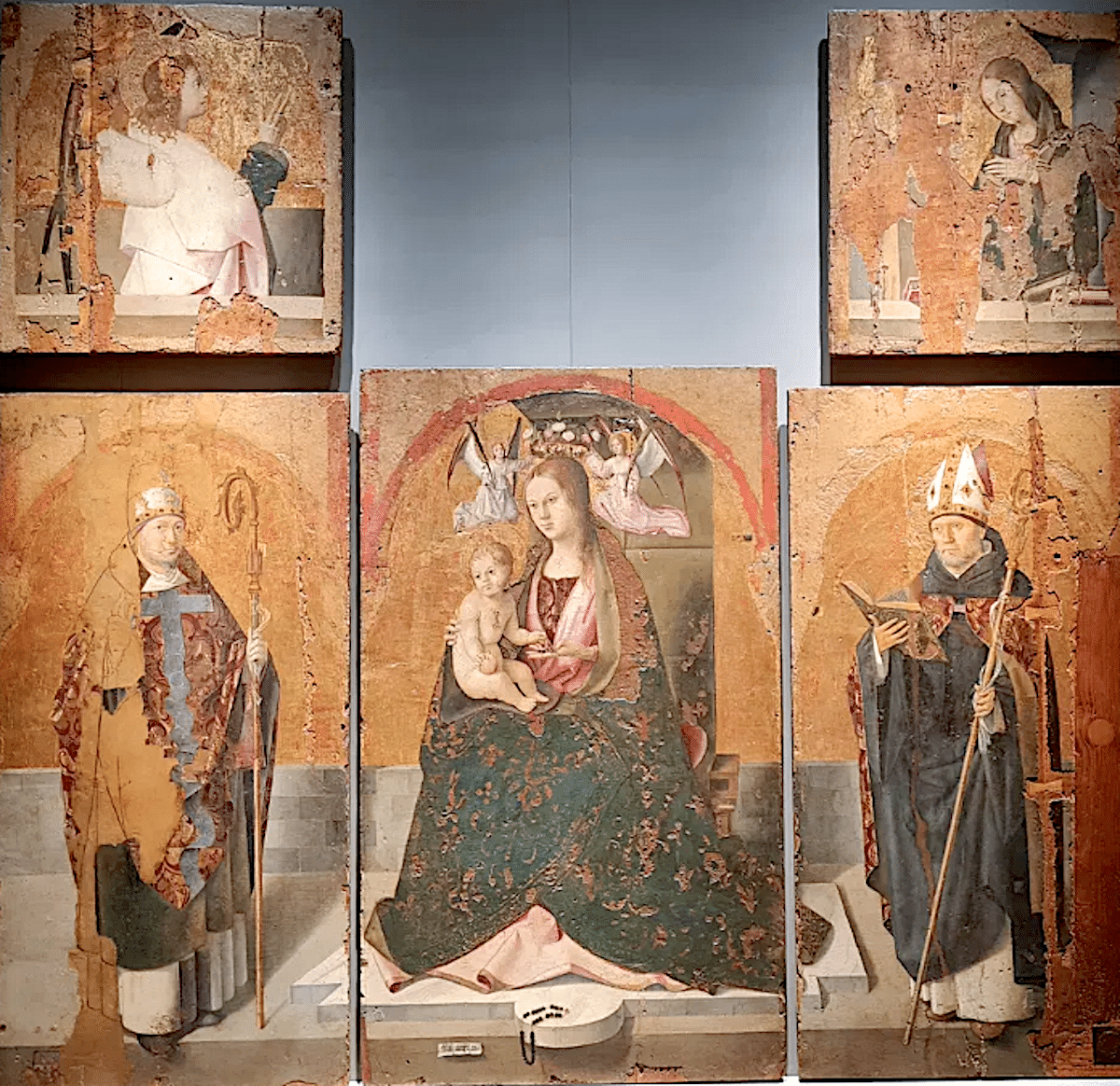
The thieves took three of the five surviving panels from the Polyptych of San Gregorio, a fifteenth-century altarpiece originally commissioned for the church of San Gregorio, which was destroyed in the catastrophic 1908 earthquake, along with a small double-sided devotional panel depicting the Madonna and Child with a Franciscan saint on one side and Christ in Pietà on the reverse. The works stolen are the only paintings by Antonello that remained in his native city.
The theft occurred on Saturday, 15 August, as Messina held the Procession of the Vara, an annual religious celebration that draws approximately 100,000 people to the city’s streets. City law enforcement was concentrated on crowd management for the procession, and Mayor Federico Basile was direct about the implication: “Coinciding with la Vara, it was certainly a planned theft,” he said.
The thieves initially removed all five surviving panels of the San Gregorio polyptych but abandoned two near a fence outside the museum, apparently in their haste to leave. Passers-by noticed suspicious activity at the museum and alerted the police. The small devotional panel required additional effort to take: Vincenzo Caruso, Messina’s chief cultural official, said the thieves smashed a sealed protective case to reach it. Police are reviewing security footage from inside and outside the building, and Caruso noted that some witnesses may have photographed what they saw. Museum director Marisa Mercurio, who declined to be interviewed in full, told Sky News Italia that the museum’s alarms and security systems had been operational and that guards were present at the time of the theft.
The loss is severe by any measure. Antonello da Messina is regarded as one of the most significant painters of the Italian Renaissance, with a body of work of only around forty definitively attributed paintings. Art historian Grazia Musolino, who recently curated a catalogue on the artist, described his importance in terms of his synthesis of two distinct traditions: “He made a crucial contribution to the Renaissance by unifying two very important aspects of Renaissance art: the work of Flemish artists and Italian art.” His command of oil technique, believed to have been absorbed from Flemish sources, and his extraordinary abilities as a portraitist place him among the defining figures of fifteenth-century painting in Italy.
Born in Messina around 1430 and living there on and off until he died in 1479, Antonello had given his native city its strongest claim to art-historical significance. The San Gregorio polyptych is signed and dated 1473. The double-sided devotional panel was acquired more recently, purchased by the Sicilian Region at a Christie’s auction in 2003. Together, they were the last Antonello paintings to remain in the city where he was born, and their loss has hit the city hard.
Caruso put it plainly: “Antonello is the greatest ambassador of our city because he has Messina in his name.” Mayor Basile noted that the city had been developing a cultural identity around the Messina, City of Antonello brand for several years and was working toward establishing a virtual museum in the artist’s former home. The theft arrives at a moment when interest in Antonello had been growing nationally, with the Italian government purchasing a painting by the artist for $15 million earlier this year.
Francesco Finocchiaro, coordinator of Archeoclub d’Italia in Sicily, said he feared that intermediaries and unscrupulous collectors could be behind a theft of this scale and cultural significance. Specialists in art crime consistently note that works stolen directly from museums are among the most difficult to sell through any legitimate channel. Once registered in international databases of stolen art, they become effectively untradeable on the open market, raising the question of what the thieves intended to do with them.
An official with Italy’s art theft squad confirmed that investigations were underway but declined to give further details. The news comes just one day after Italian authorities announced the recovery of three paintings by Cézanne, Renoir and Matisse stolen from the Magnani Rocca Foundation near Parma earlier this year. This result will offer some encouragement to those hoping for a swift resolution in Messina.
Top Photograph: Museo Regionale Accascina Messina