
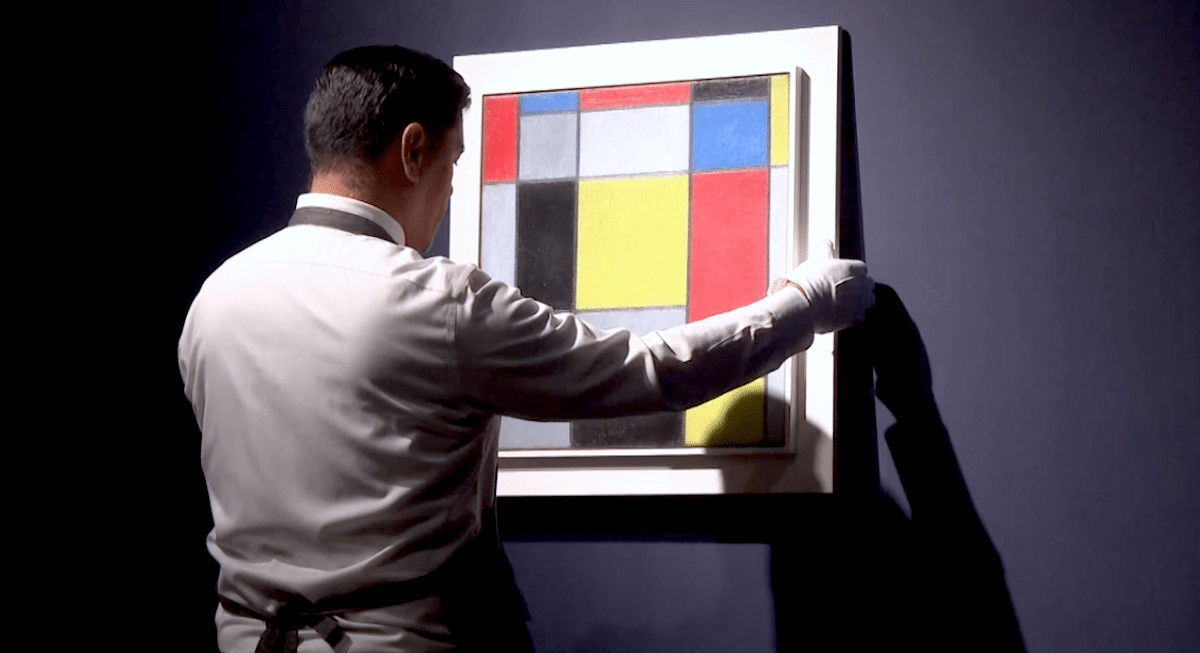
Piet Mondrian’s Composition III, painted in 1920 and never previously offered at auction, will appear at Christie’s 20th/21st Century London Evening Sale on 14 October 2026, carrying an estimate of £20 million to £30 million. The sale takes place during Frieze Week, and the Mondrian is the most significant work by the artist to come to auction in Europe since 2009, when two major paintings from the collection of Yves Saint Laurent and Pierre Bergé sold at Christie’s Paris.
The painting dates to one of the most concentrated and consequential periods in Mondrian’s career. Returning to Paris in late 1919 after spending the First World War years in the Netherlands, he re-engaged with the city’s avant-garde scene and in 1920 completed just eight paintings, five of which are now in museum collections: Tate in London, MoMA in New York, the Stedelijk Museum in Amsterdam, the Galleria Nazionale d’Arte Moderna e Contemporanea in Rome, and the Wilhelm-Hack Museum in Ludwigshafen. Composition III is among the three that remain in private hands.
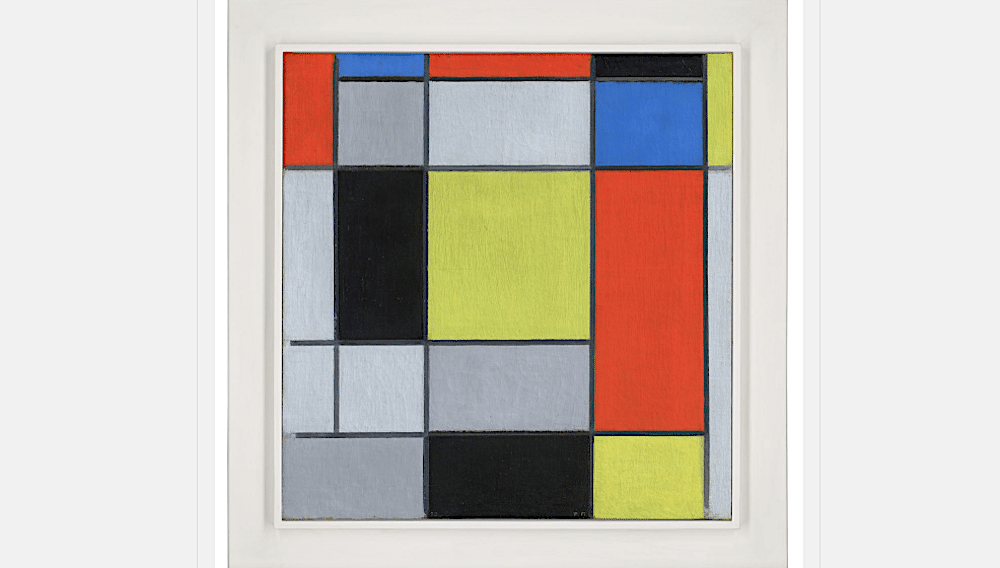
Mondrian’s Composition III Christie’s
“The essential characteristic of the New Plastic in painting … is a composition of rectangular colour planes that expresses the most profound reality.”
Piet Mondrian, 1920
That year also marked the moment when Mondrian systematically established the principles of Neo-Plasticism, the visual language he had been moving toward for several years and that would define the rest of his working life. He was simultaneously writing his seminal essay, Le Néo-Plasticisme: Principe général de l’équivalence plastique, which Léonce Rosenberg published the following year as the first French-language formulation of his theoretical ideas.
The painting embodies those ideas with particular clarity. Mondrian restricted his palette to the three primary colours, red, yellow and blue, together with black, white and grey, arranged across a dynamic grid of lines whose tone shifts subtly as they traverse the canvas surface. Bold passages of red and blue are counterbalanced by an almost acidic yellow and carefully gradated greys, each panel built up through multiple layers of pigment that retain visible traces of brushwork. He added varnish only to the black panels, intensifying their saturation and creating a deliberate contrast with the unvarnished colour planes alongside them. At the centre, a yellow square positioned on the axis of symmetry generates an outward-moving energy that gives the whole composition its balance and rhythm.
The working process behind his 1920 paintings was methodical. Mondrian spread the canvas flat on a table positioned near a window for the best available light. He used an easel to review the finished stages, stepping back to assess what he had done and considering alterations over weeks and sometimes months, letting paint dry fully between sessions.
Composition III was held for a significant period by the architect and Modernist collector Armand P. Bartos and his wife Celeste, among the notable custodians in its provenance. It has never appeared at public auction before.
Mondrian’s trademark reduction of painting to its most essential components is clearly evident in this example. He believed that pure colour and line, freed from representation, could express universal harmony and point toward the fundamental laws underlying the visible world. The 1920 paintings are where that conviction first found fully coherent form, and Composition III is as clear a statement of that moment as any work he produced that year.
The painting will travel to Christie’s Zurich from 2 to 4 September, Paris from 9 to 12 September, New York from 17 to 20 September and Hong Kong from 25 to 29 September before arriving in London, where it will be on public view from 8 October ahead of the 14 October sale.
Top Photo: Mondrian’s Composition III Courtesy Christie’s