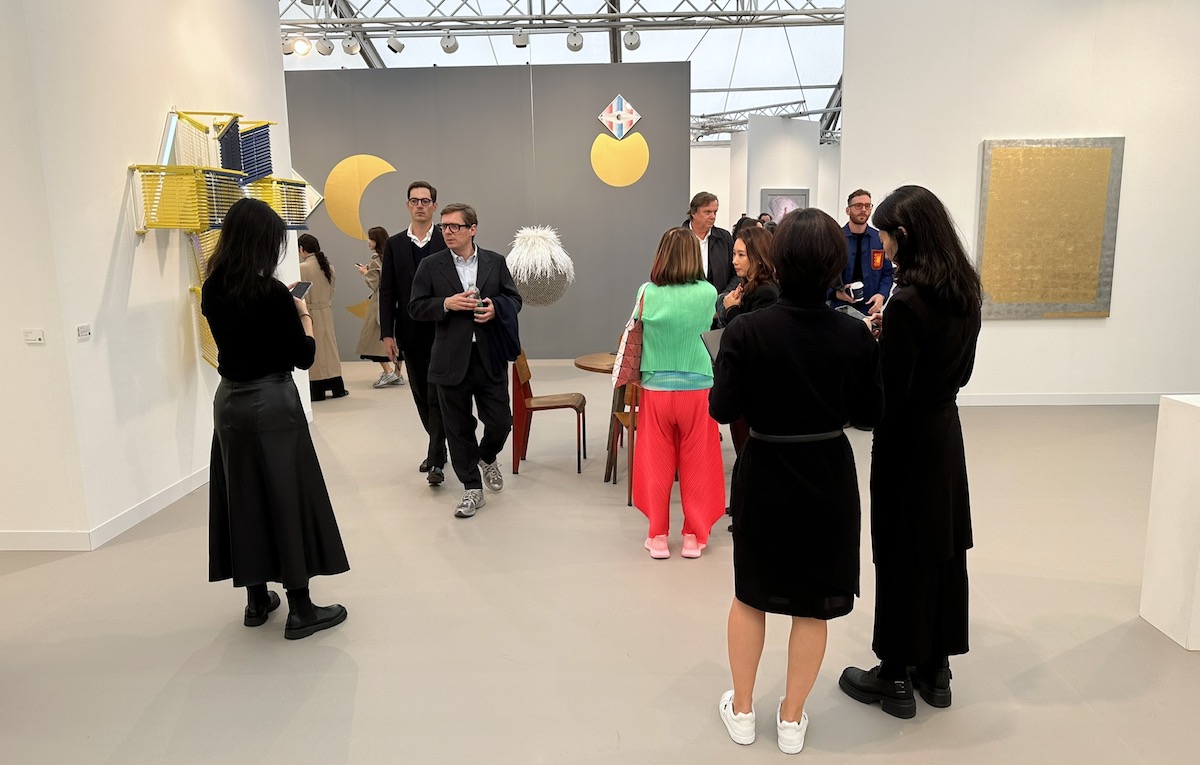
The Art Basel and UBS Survey of Global Collecting 2026 finds a market recovering in confidence, with younger buyers spending aggressively, galleries retaining their central role and AI beginning to alter how collectors discover and assess art.
The art market has spent the past couple of years adjusting to a more cautious climate. The spectacular prices of the pandemic boom have receded, buyers have become more selective, and the appetite for speculative purchases has weakened. But the latest Art Basel and UBS Survey of Global Collecting suggests that the mood among serious collectors is improving.
The survey, conducted by Arts Economics and Dr Clare McAndrew, questioned 3,100 high-net-worth individuals across ten major markets, representing a key segment of the collecting public whose behaviour often signals broader market directions, especially since wealthy buyers account for a disproportionate share of spending at the upper end of the market.
The picture that emerges is not of a market racing back to the excesses of 2021 or 2022. It is more measured than that. Collectors are buying, but they are paying closer attention to quality, rarity, and the artist’s reputation. They are researching more carefully and using more sources of information before committing. At the same time, they are discovering art through a wider range of channels, from Instagram and online platforms to direct contact with artists.
The gallery, however, has not been displaced. Quite the opposite. Nearly nine out of ten collectors bought through a dealer during the period covered by the survey, with galleries and art fairs together accounting for the largest share of expenditure. Collectors may now begin their research online, but the relationship with a dealer remains central to the actual business of collecting.
There is a generational change underway too. Gen Z collectors were the highest spenders across virtually every category surveyed. That is a striking finding given that they are the newest generation to enter the market. They are buying paintings and sculptures, as well as jewellery, watches, sneakers and other luxury collectables. Their collecting habits are broader than those of older generations and, at the very top end, a small group of young buyers is already spending serious money.
The survey also complicates some familiar assumptions about younger collectors. Gen Z may have grown up with social media, but they were among the most private about their collections. They were more selective about who could see what they owned and what they were prepared to share online. The idea that younger collectors automatically want their possessions displayed publicly does not hold up in the data.
The other major change is technological. Artificial intelligence is beginning to influence the collecting process by enabling digital tools to research artists, compare works, and analyse markets, with many collectors viewing AI as useful for discovering artists, verifying provenance, and assessing prices, despite concerns about forgery and manipulation.
This matters because the art market has traditionally depended on unevenly distributed information. Dealers, advisers, auction houses and established collectors have often held knowledge that is difficult for newcomers to access. AI could change that. A collector who once needed several conversations with specialists to build up a picture of an artist can now assemble a considerable amount of information in minutes.
There is a catch. Better information does not necessarily mean better judgement. An algorithm can widen the field of discovery, but it can also narrow it by repeatedly recommending the kind of work a collector already likes. The report identifies this tension clearly. AI could bring overlooked artists into view, or it could reinforce existing tastes and make the market even more concentrated around familiar names.
This matters because the art market has traditionally depended on the uneven distribution of information. Still, with UBS estimating that over $83 trillion will pass between generations over the next 20 to 25 years, art collections are poised to accompany this wealth transfer, potentially shaping future market trends.
That transfer could become one of the defining forces in the market. Some heirs will keep what they inherit. Others will sell. The difference will matter. Among collectors who have inherited art, those works currently account for about 31% of both the number and value of their collections. The wealthiest heirs are also more likely to retain inherited works, suggesting that the decision to sell is often driven by financial pressure rather than by a lack of interest in the objects themselves.
There is therefore a market becoming more sophisticated while simultaneously becoming more concentrated. Wealth is growing at the top, younger buyers are entering with confidence, and galleries remain powerful. But the report also shows how dependent the market is on a relatively small pool of wealthy participants.
The good news for dealers and galleries is that collectors remain optimistic. Fifty-seven per cent expect the fine art market to grow over the next six months, while only 13% expect a decline. Looking twelve months ahead, 58% expect growth and 27% stability. Over the next 10 years, 60% believe the market will expand. The United States and Brazil are particularly confident, while Japan remains considerably more cautious.
For an industry that has become accustomed to reading every auction result as a referendum on its health, the most revealing finding may be simpler. Collectors intend to keep buying.
A Market Shaped by Wealth
The economic backdrop is important. Global wealth rose by almost 11% in 2025, according to UBS, although the gains were uneven. Average wealth increased sharply, while median wealth fell in many markets, underscoring the widening gap between the richest individuals and everyone else. Europe and the Middle East recorded the strongest growth, both at 18%, compared with just under 9% in North America and 6% in Asia Pacific.
For the collectors surveyed, the average allocation to art was 15% of overall wealth. That figure has fallen from 24% in 2022, reflecting a more cautious approach. But the wealthiest collectors remain heavily exposed to art. Those with more than $50 million in wealth allocated an average of 23% to art, compared with 12% among those with less than $5 million. Almost a third of the ultra-wealthy allocated at least 30% of their wealth to art.
The next major shift will come through inheritance. More than $83 trillion is expected to change hands globally over the next quarter century. Because wealth is so concentrated, much of it will pass among people who are already wealthy. That could strengthen the high end of the art market while doing little to broaden its base.
There is also a gender shift taking place. Women are becoming increasingly important controllers of wealth, particularly as inherited and family wealth moves between generations. Female billionaires remain a minority, but their numbers and wealth are growing faster from a smaller base. The implications for the art market are considerable.
How Collectors Start
Family remains the most common route into collecting. 28% of respondents identified family influence as the main reason they first became interested in art. Among Gen Z, the figure was close to 40%. Cultural exposure was the second most important route, accounting for 22%. In China, however, museums, galleries and other cultural experiences were more important than family connections.
The way people research art is changing. Collectors still rely heavily on personal advice, but digital sources are now part of the process. Only 12% relied entirely on digital information. Most combined online research with advice from dealers, advisers, and others in the art world.
AI is the next stage. Sixty-seven per cent of collectors surveyed thought it could improve the visibility and discoverability of artists and artworks. 66% saw potential in personalised recommendations, 65% in provenance and authenticity checks, and 64% in pricing and valuation.
The enthusiasm is not unconditional. Twenty per cent were concerned that AI could worsen fraud, forgery and manipulation. Yet almost 60% believed its overall effect in this area would be positive.
What They Are Buying
Painting remains king. 76% of collectors bought paintings, accounting for 31% of fine art expenditure. Sculpture followed with 15%, works on paper with 10% and digital art with 9%.
The market is not, however, simply a game of million-dollar purchases. 86% of respondents bought at least one work priced below $50,000 in 2025, while 85% did so in the first half of 2026. Only 1% bought at the $1 million plus level. The high end remains extraordinarily thin, even among wealthy collectors.
One of the more surprising findings concerns Gen Z. They were the highest spenders across most categories and accounted for almost half of those making purchases above $1 million. Around 5% of Gen Z respondents had bought a work above that level in 2025 and the first half of 2026, compared with 1% or less among other generations.
Their interest also extends beyond traditional fine art. Jewellery, watches, fashion-related collectables, and other luxury categories are part of the same collecting landscape for many younger buyers.
Dealers Still Matter
Despite all the talk about disintermediation, galleries remain central to the market—eighty-seven per cent of collectors bought from a dealer during the period covered by the survey. Dealers accounted for 27% of spending through direct sales, rising to 42% when purchases at art fairs are included.
Artist direct sales are growing quickly. Sixty-nine per cent of collectors bought directly from artists, up 6% year on year and more than twice the level recorded in 2024. Studios, commissions and Instagram are all part of this increasingly important route.
Auctions, meanwhile, have lost some ground. Only 10% of collectors named them as their preferred first choice, down for the third consecutive year. Five years ago that figure was considerably higher.
The art fair remains important, particularly for wealthier collectors. 16% named fairs as their preferred purchasing channel, rising to 27% among those with more than $50 million in wealth.
Collectors are also still showing up. They attended an average of 46 art events in 2025 and expect to attend 44 in 2026. That remains above the pre-pandemic figure of 41. Women attended around 20% more events than men, while collectors who first entered the market through online channels and social media were among the most active overall.
The Collection Itself Is Changing
72% of works in the collections surveyed were by living artists. But the balance has shifted towards established names. Established or top-tier artists accounted for 46% of works, compared with just 25% in 2024. New artists accounted for 16%, while emerging artists made up 18%.
Gender remains one of the clearest imbalances. Works by male artists made up 56% of collections, compared with 44% by women. That is an improvement from previous years, but the gap remains substantial.
Women collectors had slightly more female artists in their collections than men, at 46% compared with 43%. They also collected more broadly across different media and were more likely to own works by new and emerging artists.
The primary market is moving faster than the auction market on this front. Female artists represented by galleries reached 45% in 2025, while women accounted for only 11% of artists among the top 200 across all fine art auction sectors. Their works represented 8% of sales by value.
That discrepancy remains one of the market’s stubborn problems.
Privacy, Inheritance and the Next Market
The report’s new focus on privacy reveals another change. Collectors are not necessarily interested in making their collections public, even as social media makes it easier to display them.
Gen Z is particularly private. That is perhaps less surprising than it first appears. The same generation that has grown up with constant digital exposure may be more aware than anyone of the value of controlling what remains visible.
Inheritance will bring another layer of complexity. Fifty-four per cent of respondents held inherited works. Among those collectors, inherited pieces represented around 32% of the value of their collections. Heirs also account for the majority of collectors planning to donate works to museums or charities over the next year.
This makes the next 20 years difficult to predict. Some collections will remain intact and pass into another generation. Others will enter the market through auction houses, dealers or private sales. The scale of the coming wealth transfer means that even a small change in heirs’ behaviour could have significant consequences.
For now, however, the direction is broadly positive. Fifty-seven per cent of collectors expect the fine art market to grow in the next six months. The figure rises slightly when the horizon extends to twelve months and reaches 60% for the next decade.
The Art Basel and UBS survey does not describe a market returning to its old habits. It describes something more interesting. Collectors are becoming more informed, more international and more comfortable using technology, while still relying on galleries, advisers, fairs and personal relationships.
The art market may be changing its machinery, but the essential transaction remains much the same. Someone encounters a work, decides that they want to live with it and finds a way to buy it. Everything around that decision is becoming more complicated. The desire itself remains remarkably simple. – Compiled by P C Robinson Artlyst © 2026