The Star of Hope Foundation, the organisation established by Robert Indiana to preserve his legacy, has listed the artist’s longtime home on the Maine island of Vinalhaven for $1.4 million, along with a second building he owned on the same street for $210,000. The decision has prompted criticism from those who say it directly contradicts the artist’s clearly expressed intentions.
Indiana moved to Vinalhaven in 1978 and spent the final forty years of his life in the Star of Hope, a sprawling nineteenth-century Odd Fellows lodge overlooking the island’s harbour. He died there in 2018 at the age of 89. His will was specific: the building was to be restored to museum quality. It opened to the public for visits, classes and lectures, serving as an environment for the preservation and exhibition of his collection. He had established the Star of Hope Foundation precisely to carry out that vision, and the organisation inherited his estate after his death.
The foundation initially worked toward that goal, stabilising the building and carrying out partial renovations. It has since changed direction. The foundation’s managing director, Carole Martin, told the New York Times that selling the properties would allow the organisation to convert its assets into philanthropic capital and direct resources more broadly toward Maine’s arts community. “These properties are not our purpose; supporting artists is,” she said.
Not everyone accepts that framing. Kevin Lipson, a lawyer who represented Indiana’s estate in litigation, described the decision as “a remarkable repudiation of Robert Indiana’s testamentary intent,” adding that Indiana had clearly wanted and expected some form of museum on Vinalhaven. Marjorie Stratton, the town manager of Vinalhaven and someone who knew Indiana personally, said the artist had spoken to her about using the building for art, education and research and about creating space where young people could work and learn. “It just makes me sad that this foundation doesn’t seem to be following through with what he told me he wanted that to be,” she said.
Photographs accompanying the current listing show an interior in considerable disrepair, with peeling paint, exposed framing and lath visible throughout. The foundation acknowledges that the building has posed ongoing structural and regulatory challenges and says that selling it is the most practical path forward.
The question of what happens to an artist’s home and estate after their death sits uncomfortably between legal obligation, institutional pragmatism and artistic legacy. In Indiana’s case, the gap between his expressed wishes and the foundation’s current course of action is stark, raising questions that will not be easily resolved once the building passes into private hands.
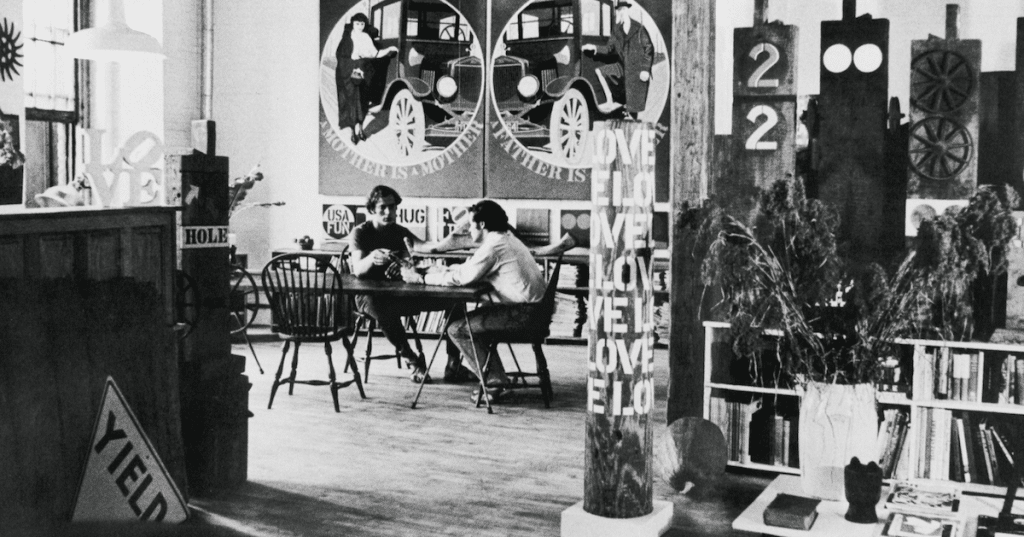
Robert Indiana Image courtesy of the Estate of Basil Langton
Indiana was born Robert Clark in New Castle, Indiana, in 1928, adopted as an infant and moved frequently throughout the state that would eventually give him his name. He showed artistic ability from an early age, attended Arsenal Technical High School in Indianapolis, served in the US Air Force, and studied at the Art Institute of Chicago, the Skowhegan School of Sculpture and Painting in Maine and the Edinburgh College of Art in Scotland before arriving in New York in 1954.
Two years later, on the recommendation of Ellsworth Kelly, he took a studio at Coenties Slip, a former port at the southeast tip of Manhattan where an extraordinary community of artists gathered, including Kelly, Agnes Martin, James Rosenquist and Jack Youngerman. The Slip was a place of genuine material poverty and genuine artistic invention. Indiana scavenged abandoned warehouses for old wooden beams, metal wheels and salvaged materials, constructing freestanding assemblages he called herms, after the boundary-marker sculptures of ancient Greece and Rome. The discovery of nineteenth-century brass stencils in the area introduced numbers and words into his work, establishing the visual vocabulary he would develop for the rest of his career.
His early paintings included hard-edge compositions featuring ginkgo leaves inspired by trees in a nearby park. He incorporated the form into a nineteen-foot crucifixion mural made from forty-four sheets of paper found in his loft, a work whose completion prompted him to adopt the name of his home state formally. By 1961, MoMA had acquired The American Dream I, placing him firmly among the generation of Pop artists then displacing the New York School. He was included in Art of Assemblage at MoMA that same year and in the International Exhibition of the New Realists at Sidney Janis Gallery in 1962.
Indiana distinguished himself from his Pop contemporaries by taking social and political subjects seriously and by weaving dense literary and historical references into his work. American literary figures appeared in paintings referencing Melville and Whitman. His 1964 EAT sign for the New York World’s Fair was made of flashing lights twenty feet high. He collaborated with Andy Warhol on the film Eat, a silent portrait of Indiana consuming a mushroom in his Coenties Slip studio. His first European solo show took place in 1966 at Galerie Schmela in Düsseldorf.
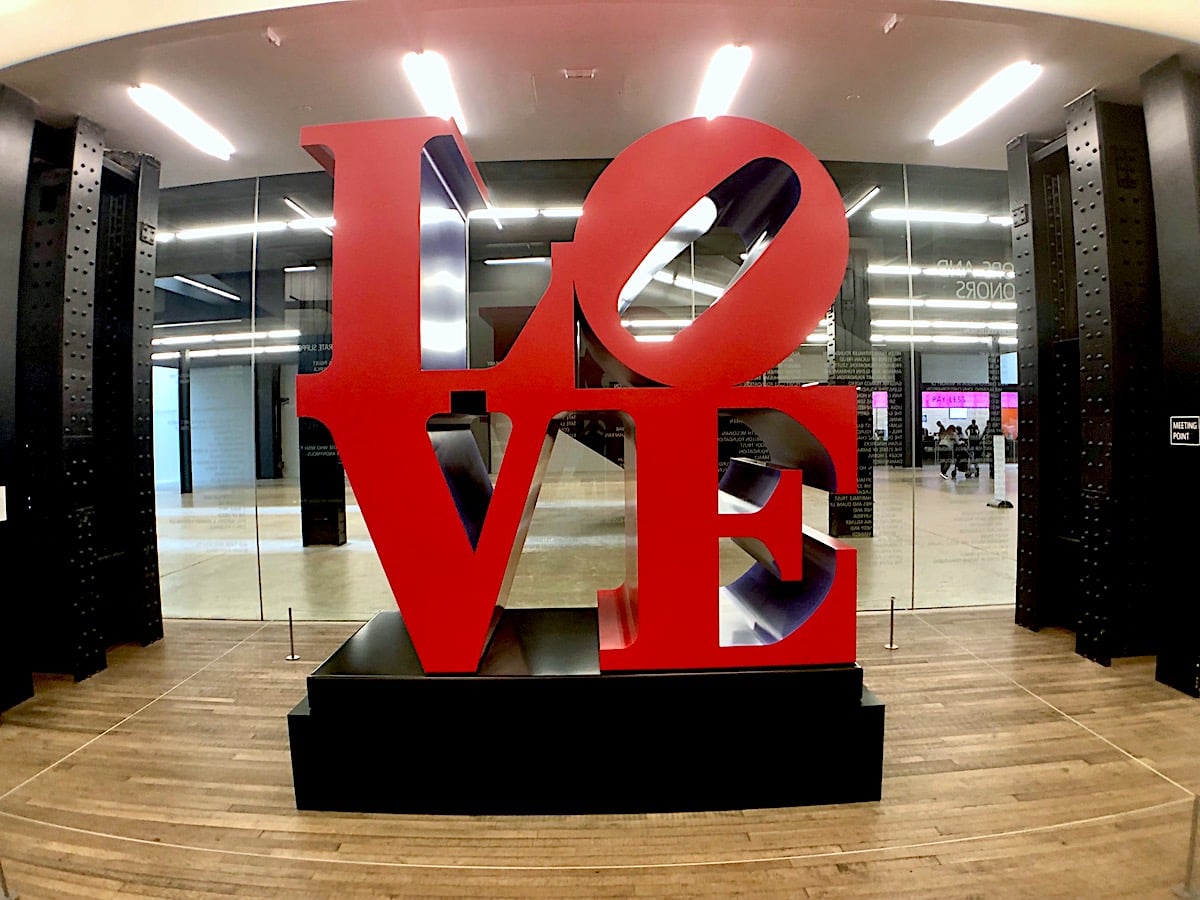
That same year, the LOVE image broke into the wider culture. The stacked letters with their tilted O had begun appearing in his work in the early 1960s, first in a 1961 painting and then in a series of 1964 rubbings before developing into the hard-edged colour variations that became his most recognised works. MoMA selected it for its 1965 Christmas card. It appeared on a US Postal Service stamp in 1973. Indiana subsequently translated the composition into Hebrew as AHAVA and Spanish as AMOR, extending the universality of the subject across languages. The image’s popularity was also a source of frustration: unauthorised reproductions proliferated, and Indiana spent years dealing with the legal and reputational consequences of an image that had escaped his control even as it defined his public identity.
He moved to Vinalhaven in 1978, effectively withdrawing from the New York art world while continuing to work. The island provided isolation and, eventually, the kind of rootedness he had never had in a peripatetic childhood. The Star of Hope became both studio and sanctuary. He appears to have believed it would outlast him as a living artistic environment.
Whether any buyer will honour that intention, or whether a building that already bears the marks of decades of deferred maintenance will be brought back into any public use, remains to be seen. The foundation’s position is that practical realities made the original plan unworkable. Those who knew Indiana are less convinced.
Robert Indiana ‘Love’ Tate London Photo © Artlyst