Michael Landy’s wildly imaginative, meticulously intricate and detailed drawings of iconic and often infamous buildings in ruins showcase his incredible draughtsmanship. The setting of Sir John Soane’s Museum, itself containing an overwhelming collection of reminders of the past, is an apt location for these works. Landy and Will Gompertz, Director of the Museum, started a conversation two years ago, culminating in this exhibition, to expand on Landy’s Future Ruins series, which highlights the passage of time, nostalgia, and loss through imagined conceits, follies, and Piranesi-esque fantasy.
Gompertz shared an “extraordinarily bonkers text” with Landy, written by Soane himself in 1812 and entitled ‘Crude Hints towards an History of my House in Lincoln’s Inn Fields’. “Soane is going around this house, fashioning it as a ruin. And he’s imagining now, so he’s 200 years hence. He’s thinking, who made this place and what sort of crazy magician would live here? He creates his narrative, one that Landy connects with completely. Architects, poets, and artists kind of project their own faults and feelings onto a ruin, in a sense.”
Artist Joseph Michael Gandy did the same when he imagined the Bank of England as a ruin in Architectural Ruins: A Vision (1798), a work in the museum’s collection. Soane was surveyor to the Bank from 1788-1833, responsible for its alterations and additions, including the creation of its rotunda, and he collaborated with Gandy for around 40 years, with the artist rendering his projects and ideas in watercolour for potential clients and for public viewing at the Royal Academy.
Landy’s own version of the Bank of England in Ruins is shown here alongside Gandy’s, the similarity of their surnames not lost on him or me. “Artists love to make a connection with a collection, and then once you’ve made a connection, then you’re kind of in, and then you can kind of harvest it, and that’s what I’ve been doing for the last 9 months here. Someone once said that to look at a ruin, you’re basically contemplating your own future. Soane saw the ruin as romantic, and I guess even he, in some respects, is questioning his own legacy. So that idea about things eventually turning to dust, and the only thing that’s left is time, I think that’s how I like to see them.”
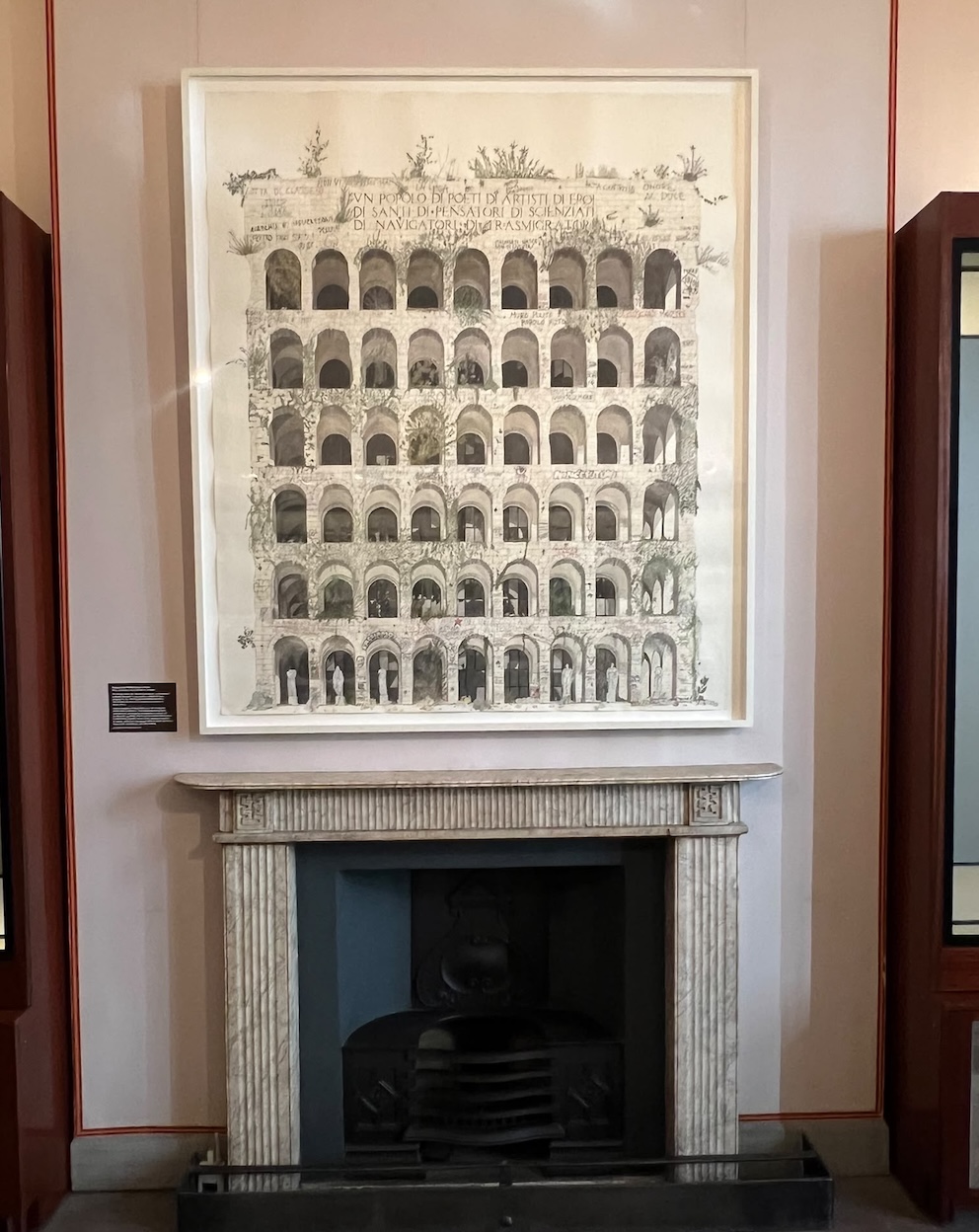
Michael Landy, Palazzo della Civiltà Italiana in Ruins , 2024
There’s a monumental drawing above the fireplace of the Palazzo della Civiltà Italiana in Rome, also known as the Square Colosseum. In 1936, Benito Mussolini planned and commissioned a district known as EUR (Esposizione Universale Roma) for the 1942 World’s Fair, to showcase the ‘imperial’ power of the fascist regime. Construction was halted by WWII, and the Fair was cancelled, but EUR was completed in the 1950s and ’60s and served as a venue for the 1960 Rome Olympics. The Palazzo is now home to Fendi HQ. In this rendition, the building is covered in graffiti and a ‘Muss-Meloni’ poster referring to the current Italian Prime Minister’s comparisons to the former fascist dictator. I attended an open-air concert in the massive square here many years ago; the travertine facade featuring relentless and threatening arches looming above felt like being trapped in a De Chirico painting. Landy tells me this was the final work he made for this exhibition and that he had to take time out afterwards. I can understand why.
The idea of civic architecture built in a classical style to impose so-called order and power continues in a series of works that includes Trump’s Mar-a-Lago seen as an abandoned building, his ‘triumphal’ arch, and ‘library’. Such hubris speaks volumes. “I mean, he keeps giving so I keep having to make another ruin.”
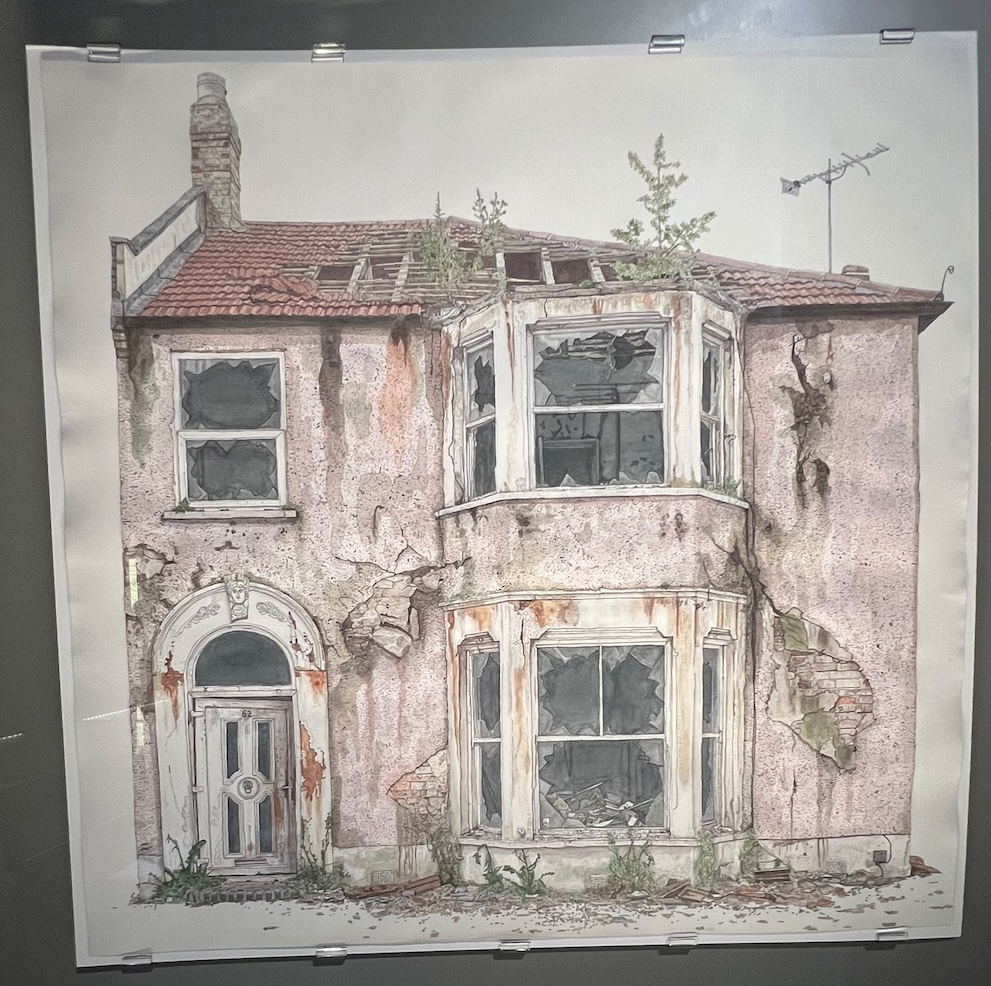
Michael Landy, drawing of former family home in Ilford
On a more personal and nostalgic level are places from Landy’s past, including Owen Clark’s shop in Essex, where he spent most Saturday mornings of his childhood buying pens and other art materials, which is now permanently closed. Here also is a touching drawing of his former family home in Ilford, so dramatically reconstructed to scale at Tate Britain’s Semi Detached in 2004. There’s a series of beautiful, colourful works depicting Irish cottages where creeping moss consumes the thatch and nature threatens to engulf and reclaim the former dwellings. These relics of English colonisation and stark reminders of the Great Hunger resonated with me as my childhood summers were, like Landy’s, spent in rural Ireland. “I drew the Family Ruins during lockdown in 2020, so the images were just drawn off the internet. My parents were from Ireland, and I remember, as a child, these stone cottages without roofs, slowly sinking into the ground. One idea I had was to transport one of those ruins somewhere else, as we did in the 18th century, taking ruins and re-housing them back in this country. So I became interested in fake ruins, sham ruins, images of hermits and poets in ruins. I mean, I’m hoping to start a whole new fashion.”
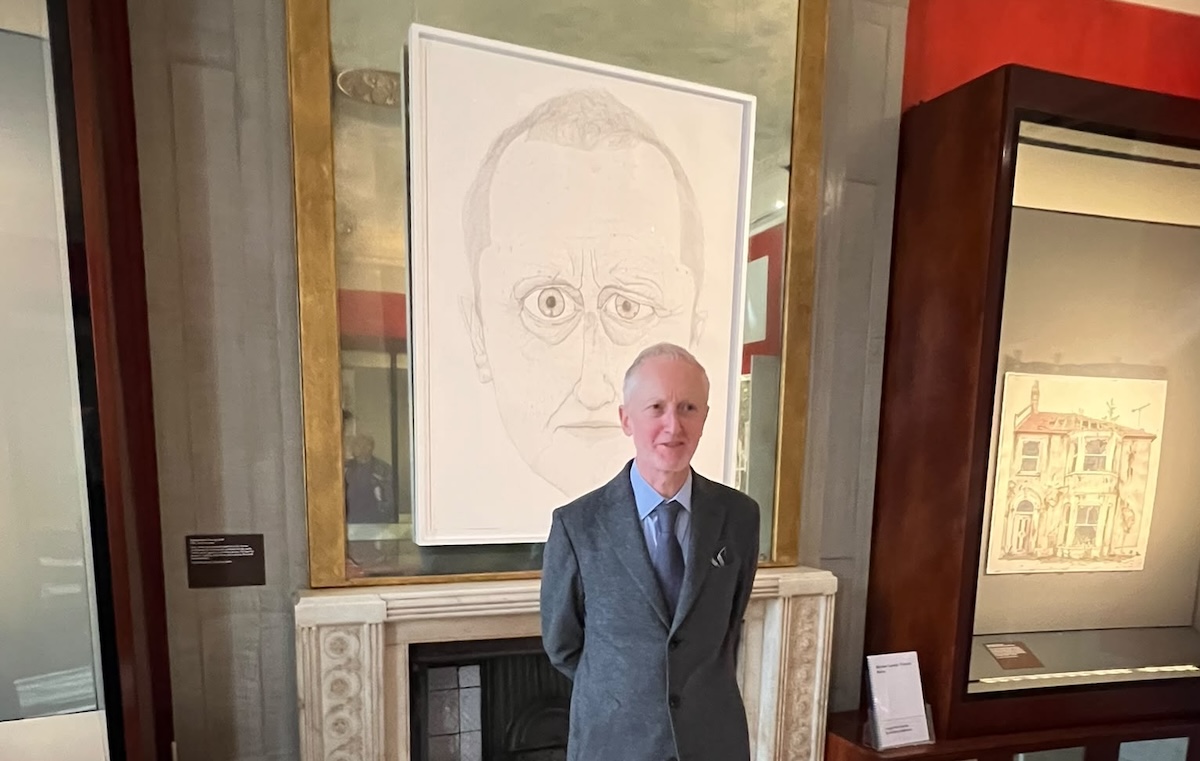
An arresting self-portrait confronts the visitor on entering the exhibition space, hung above a fireplace. “That’s just literally me, warts and all. Once you’ve spent two and a half months with your own face, with a mirror, I wasn’t used to working to that scale, so it was just about getting as much information down on the piece of paper as possible. I should have called it Self Portrait as a Ruin.”
Sketching London in Ruins after Gustave Doré (2026) shows a view across the Thames. It’s a beautiful and covetable capriccio and a re-imagining of a work by Doré showing a visitor from New Zealand sketching a future London in ruins, yet here Landy himself is the artist. It seems likely to me that the spot where Landy sits sketching is by the house in Cardinal Cap Alley where Wren lived while building St Paul’s Cathedral.
Downstairs, Broken Column (2026) stands teetering under an oculus close to Soane’s own random pastiche or conceit of a column made up from various fragments from the past. “I have an interest in rubbish and society’s ideas about what kind of value we give to things. It’s a column made out of rubbish bins.” This sculptural work with stickers on the bins, like the graffiti on the ruins in the drawings upstairs, speaks to urban destruction and decay in a similar fashion.
Michael Landy: Future Ruins, Sir John Soane’s Museum, 14 October 2026 – 17 January 2027
Visit Here