Yiran Zhang’s multidisciplinary practice investigates what remains of a community in the aftermath of war. Rather than representing war through familiar tropes of combat, heroism or weaponry, Zhang examines the voids, memories and ghosts that conflict leaves behind. His work considers war as a condition that determines who gets to belong to a place, while leaving psychological and material imprints long after its events have entered the history books.
This distinctive approach is evident in ‘WARWORK: We Will Return One Day’, Zhang’s recent exhibition at 67 York Street Gallery in London and can be traced back to ‘Fortified Nihility’, his Royal College of Art graduate exhibition in 2024. Although he graduated from the RCA only two years ago, WARWORK demonstrates an impressive maturity, combining rigorous historical research with a sophisticated conceptual language.
Among the exhibition’s standout works are ‘Spectral Remnants’ (2025), ‘Strewn Field’ (2026), and ‘Waiting, Still’ (2026). Zhang demonstrates considerable skill in working across unexpected media, from rice paper and graphite to fumage, archival documents, photographs and sandbags. He uses materials not simply for their aesthetic qualities but for their historical and symbolic associations.
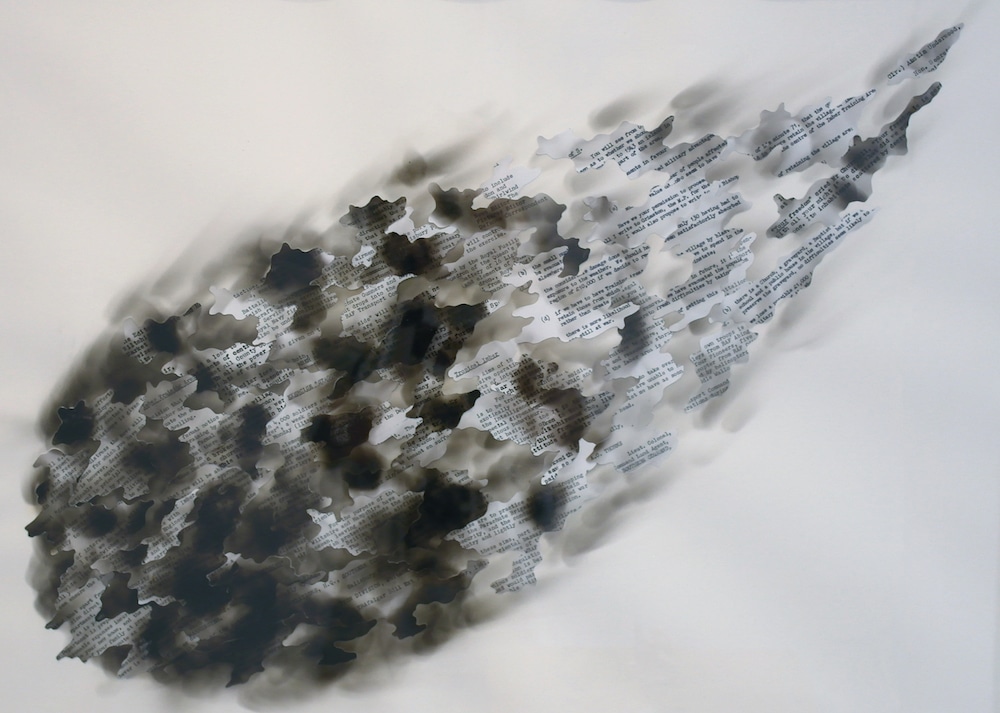
In ‘Strewn Field’, fumage – a technique used to create an image by painting with smoke from a lighted candle – is applied to archival documents collaged onto paper, transforming documentary evidence into something ghostly and transient. ‘Strewn Field’ recalls Cai Guo-Qiang’s use of gunpowder – a traditional weapon of war – to create spectral artworks.
‘Waiting, Still’ combines graphite frottage on rice paper and inkjet printing with sandbags, bringing together fragile traces of memory and the physical apparatus of military defence.
There is an innovative subtlety to Zhang’s approach. His work reframes familiar narratives of war through a conceptual and philosophical lens, drawing on the anti-war minimalism and conceptualism of Yoko Ono, the politically charged protest art of Ai Weiwei and Cornelia Parker’s minimalist approach rooted in extensive research. Zhang’s dedication to archival research also recalls the practices of Michael Rakowitz and Kader Attia.
Yet Zhang does not merely imitate these precedents, instead he synthesises references from contemporary artists or art history by inventing his own understated visual language comprised of fragments, absences and material evidence.
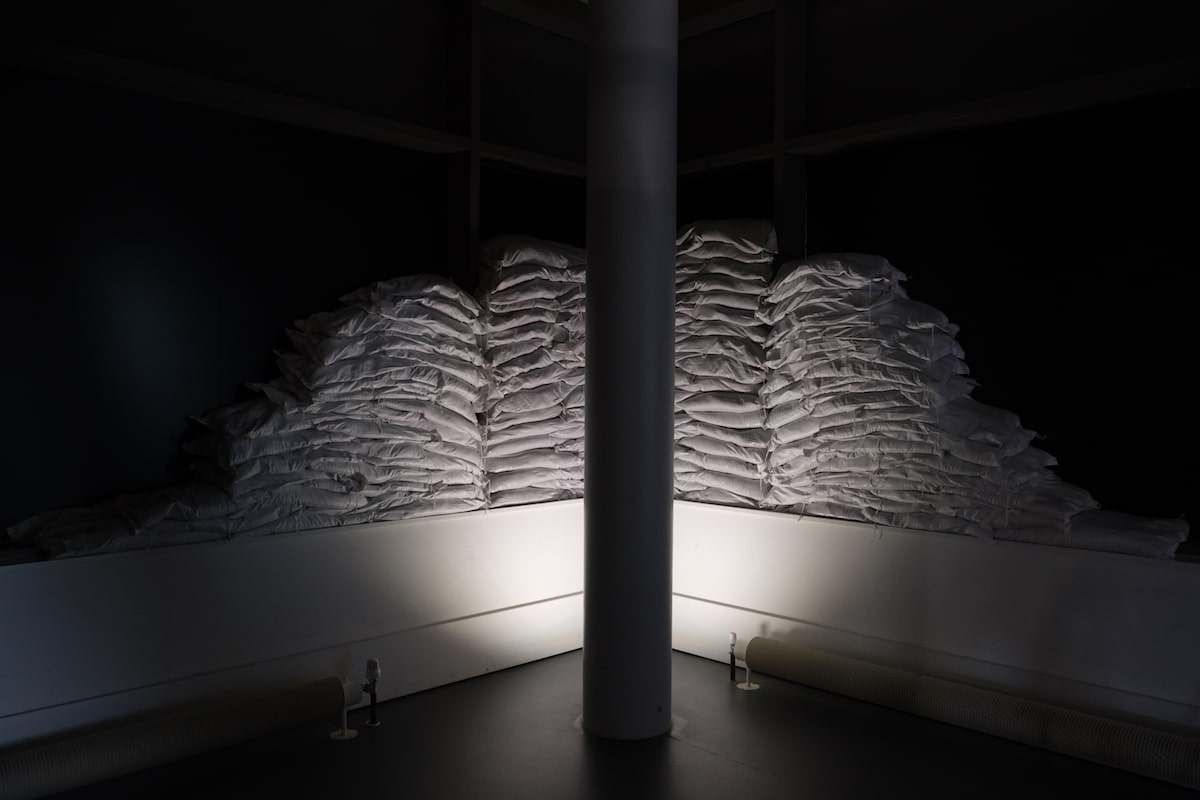
A particularly poignant early work is the sandbag installation conceived for ‘Fortified Nihility’. Zhang takes the sandbag – an immediately recognisable object associated with military defence – and by placing it within a gallery setting, transforms an inanimate object into a sculptural metaphor for protecting bodies, reinforcing boundaries and preparing for violence.
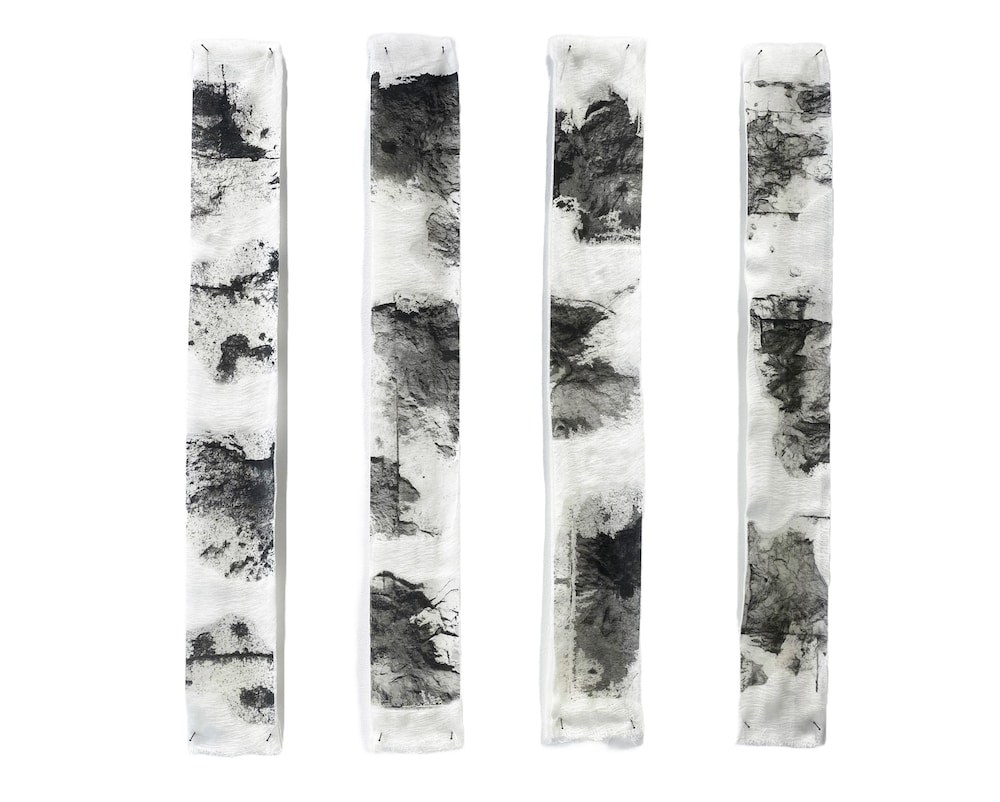
Yiran Zhang Mixed Agency Dilemma (2025)
Here, Zhang demonstrates an almost Duchampian ability to transform a mundane utilitarian object into a philosophical proposition. ‘Mixed-Agency Dilemma’ can be viewed as another example of how Zhang represents the tension between protection and violence in his practice. The work uses sterile gauze printed with images of wartime shrapnel damage still visible on London buildings, turning a material associated with healing into a carrier of historical violence.
The title ‘Fortified Nihility’ is characteristic of Zhang’s use of Nietzschean titles for his artworks. ‘Fortified’ implies security, resistance and preparation, while “nihility” suggests emptiness, futility or the absence of meaning. Their juxtaposition generates a productive tension, questioning what are we protecting ourselves from, and what happens when preparation for war becomes an everyday condition?
Across history, civilians caught in conflict have been forced to exist in precisely this state of suspended anticipation.
Zhang develops this exploration in his thoughtful exhibition ‘WARWORK: We Will Return One Day’, which references Imber and Tyneham, two English villages whose inhabitants were forcibly evacuated by the War Office during the Second World War. Residents were promised they would eventually be able to return, but that promise proved empty.
The installation is compelling precisely because Zhang refuses to compete with the drama of conventional war imagery.
Instead, he focuses on absence: abandoned domestic spaces, traces on walls, archival documents and objects registering lives interrupted by military intervention. He reconstructs a fireplace filled with wood to suggest a memory of domestic life without attempting to recreate it completely. These fragments of time lost occupy a space between evidence and memorial, archaeology and imagination.
This suspended quality is central to Zhang’s practice. His extensive archival investigations give the work a sense of historical authority, but he avoids allowing research to overwhelm its poetic dimension.
Documents, historical fragments and material traces become transformed into a critique of geopolitical trauma. The result is an art that communicates through suggestion rather than spectacle.
At the heart of ‘WARWORK’ is Zhang’s refusal to treat displacement as a historical footnote. His work restores attention to people rendered invisible by bureaucratic and military decision-making. ‘We Will Return One Day’ is therefore a loaded title, promising eventual return while simultaneously acknowledging how often the displaced never get to go home.
Through Zhang’s intellectual, thoughtful multimedia practice, he has created a distinctive visual vocabulary for examining the impact of war. This unique approach of combining archival research and material transformation with visual restraint offers food for thought. His installations suggest that when the explosions stop, the consequences do not. They remain embedded in objects, architecture, memory and the contested geography of belonging.
Top Photo: Fortified Nihility (2024) Yiran Zhang Text by Lee Sharrock Additional Photos © Yiran Zhang