

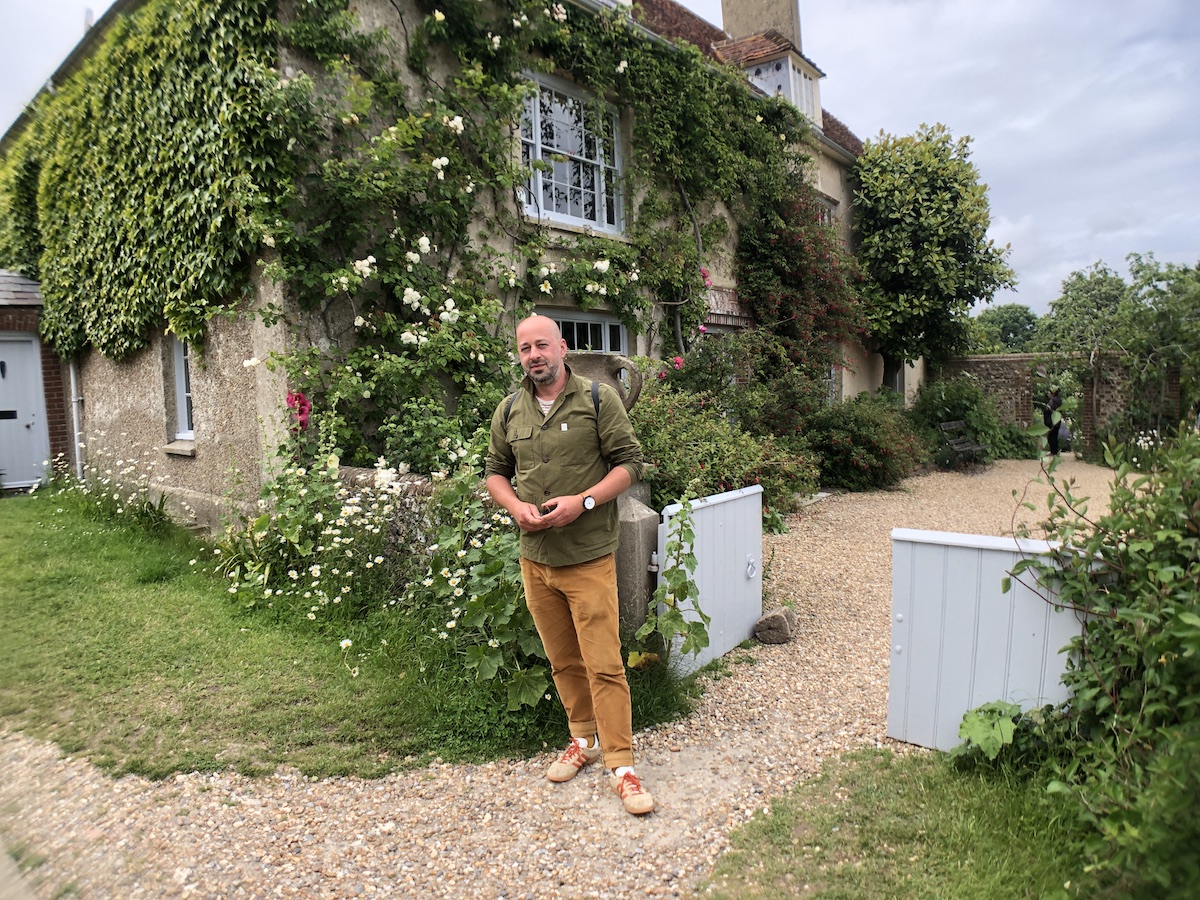
Charleston, the former Sussex home and studio of Vanessa Bell and Duncan Grant, has been awarded Designated status by Arts Council England, recognising the national and international importance of its collection.
The designation is among the highest honours available to museums, libraries and archives in England. It is reserved for collections considered outstanding in terms of their quality, significance and contribution to cultural life. Charleston now joins a group that includes the Courtauld, the Fitzwilliam Museum, Dulwich Picture Gallery and the Royal Academy of Arts.
For Charleston, the award is particularly significant because of the breadth of its holdings. The organisation cares for around 20,000 works of art, objects, books and archival materials, forming the largest and most comprehensive collection in the world relating to the lives and work of Bell and Grant.
At its centre is the house itself. Charleston is more than a historic building containing works by two important British artists. It is an artwork in its own right, shaped over more than six decades by Bell and Grant, who covered its walls, furniture and domestic objects with paintings, patterns and decoration. The result is the only complete surviving Bloomsbury interior of its kind.
The house offers a rare insight into the working methods and relationships that defined the Bloomsbury Group. Bell and Grant lived and worked at Charleston for much of their lives, turning an ordinary Sussex farmhouse into an intensely personal environment where painting, decoration and everyday life became inseparable.
The importance of the collection extends well beyond Firle. Works and archival material from Charleston are regularly requested by museums and galleries internationally. Recent loans have travelled to institutions in Paris, Rome, Copenhagen, Massachusetts, New York and Chicago. The collection will have an even greater presence this autumn when more than 500 works are due to travel to Tate Britain for a major exhibition devoted to Bell and Grant.
Among the material being lent to Tate is much of the contents of the Studio at Charleston. The loans will allow Tate to reconstruct the artists’ working environment in London, offering visitors an unusually direct connection to the space where their ideas and paintings developed.
The Designation award comes at a moment of considerable expansion for Charleston. With support from the National Lottery Heritage Fund, the organisation is preparing to establish a new Collection Store at its second site in central Lewes. The facility is intended to provide improved conditions for the long-term conservation of the collection while also allowing greater public access to materials that cannot always be displayed at the historic house.
The project forms part of a much larger ambition to establish what Charleston describes as the UK’s first National Bloomsbury Gallery. The proposed gallery is being developed in partnership with Tate, the V&A and the National Portrait Gallery, creating a permanent focus for the study and presentation of Bloomsbury art and culture.
The move towards a dedicated collection facility reflects a broader shift in how Charleston sees its role. Its holdings are not simply objects to be preserved. They provide a substantial archive through which the development of British modernism, the history of Bloomsbury and the personal networks surrounding Bell and Grant can be examined.
Access is also central to the organisation’s plans. Charleston says that one in four visitors currently enters either for free or with a subsidised ticket. The aim is to extend that approach as the collection develops across its two sites.
More than 120,000 people visit Charleston each year in Firle and Lewes. Its programme extends beyond the historic house, encompassing exhibitions, festivals, workshops and events, as well as educational work with schools, colleges and local communities. Researchers also use the collection, ensuring that Charleston remains an active centre for scholarship rather than simply a preserved historic site.
The designation therefore arrives at an important point in Charleston’s development. It confirms the significance of a collection that has long attracted international attention, while providing an official recognition of its value within England’s cultural heritage.
There is also something fitting about the timing. Charleston was a place where established ideas were questioned and where art moved freely between painting, design, literature and domestic life. Bell and Grant rejected many of the conventional boundaries between fine art and decoration, making the house itself part of their artistic practice.
That legacy continues to shape Charleston today. The organisation now faces the challenge of preserving an unusually rich collection while making it available to a much wider audience. The new Collection Store and proposed National Bloomsbury Gallery are intended to provide the infrastructure for that next stage.
Arts Council England’s decision acknowledges that Charleston’s importance is no longer confined to the house in Sussex. Its collection has become an essential record of one of the most influential artistic circles in twentieth-century Britain.
For Charleston, Designated status marks recognition of that achievement. More importantly, it signals the beginning of a new chapter in which the collection can be conserved, researched and seen by a far larger public.
Photo: Nathaniel Hepburn, Director and Chief Executive, Charleston © Artlyst 2026