
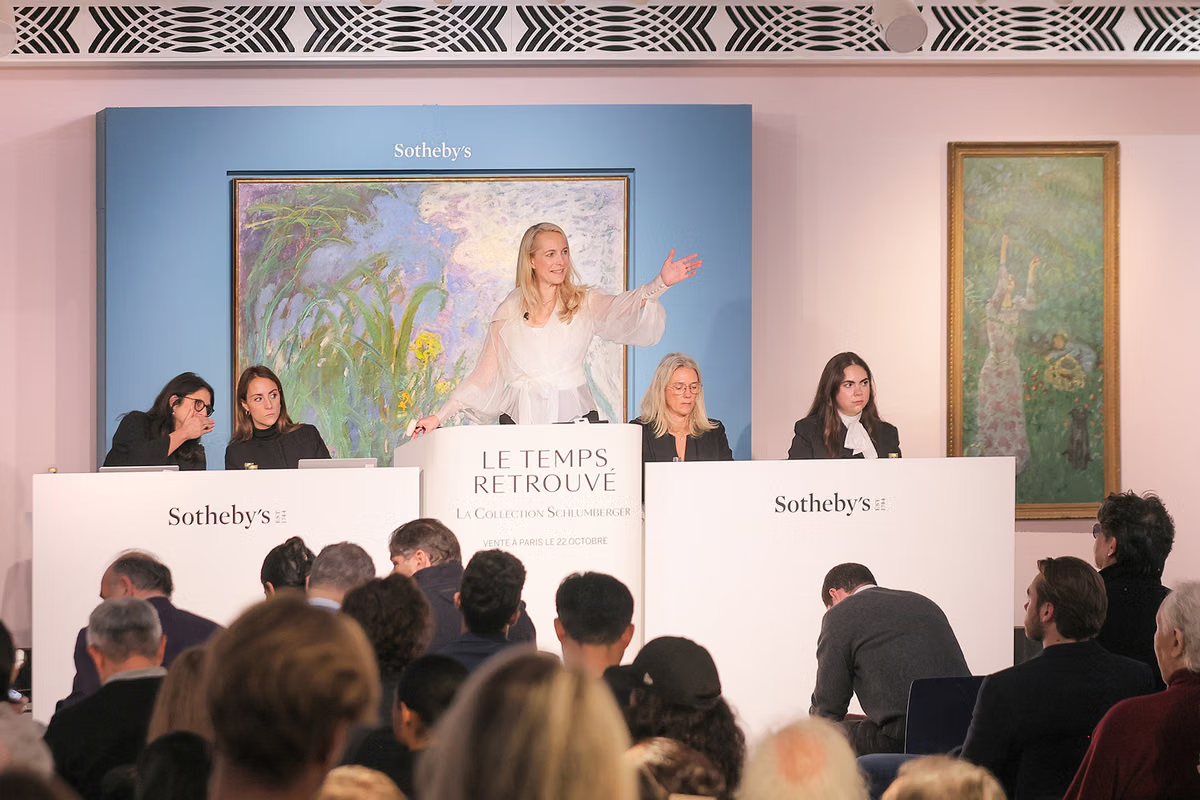
Claude Monet’s Iris sold on Thursday at Sotheby’s Paris for €50 million with fees, about $56 million. No Monet has fetched more in France. The estimate was €22 million to €30 million. The price blew past it. Six bidders fought for nearly 45 minutes before the painting went to a client on the phone with Jen Hua, deputy chairman of Sotheby’s Asia.
Iris also becomes the highest price paid for any artwork at auction in France, if inflation is ignored. Adjust for it, and the record stays with Picasso. His Les Noces de Pierrette sold at Drouot in 1989 for 314.9 million French francs, or €48 million. In today’s money, that is €104.2 million. Monet’s global record is still $110.7 million, set in 2019 at Sotheby’s New York for Meules.
The painting came from the collection of Jeanne Schlumberger, an heir to the oil services fortune. Twenty-seven works from her estate were offered. Every one sold, and three-quarters of them beat their high estimates. Three other Monets were in the group. The sale made €74.4 million, or $83.7 million, with fees. Sotheby’s had hoped for €40 million before fees.
Iris is the largest of Monet’s Iris series. It was painted around 1924 and 1925 and has never been shown in public.
The story of how it reached Schlumberger says a lot about Monet’s standing at the time. In the 1950s, his late canvases were often written off as the work of an old man losing his sight. Two women disagreed. Katia Granoff, a dealer born in Russia who opened her Paris gallery in 1926, had built her reputation on Chaïm Soutine and Pierre Bonnard. Schlumberger was the widow of Marcel Schlumberger, an early pioneer of modern oil exploration. She disliked Parisian society and filled the family townhouse on rue Las Cases with art she loved.
Granoff met Michel Monet, the painter’s son, in 1950. Six years later, he sold her a large group of the Giverny canvases. She mortgaged her assets to pay for them and borrowed from Schlumberger, who got first pick. Schlumberger chose Iris.
America was coming round too. In 1955 Alfred H. Barr Jr., founding director of the Museum of Modern Art in New York, bought a huge Nymphéas panel, the first to enter an American museum. Its loose, covering brushwork spoke to the abstract painters of the day. Sam Francis, a Californian who moved to Paris in 1950, studied Monet’s late work at Granoff’s gallery.
The painting itself is almost six feet across. Dark green leaves rise from the bank, touched with violet and yellow. Some blooms on the left can still be picked out. Elsewhere, shapes melt into streaks of paint. There is no horizon. A broad field of blue sits behind the flowers and looks like sky. It is sky, but reflected in water, a subject Monet had circled since Impression, Sunrise in 1872.
Cataracts had badly damaged his eyesight by then. He was chasing something larger than a passing glimpse, a timeless garden that could surround the viewer. The ambition echoes Mark Rothko and Barnett Newman.
Schlumberger rarely lent her pictures. Iris hung in her house for decades and was seldom handled. The canvas has never been lined. The surface carries no varnish, and some colours are barely mixed. Close up, the brushwork is startlingly free. From a distance, the irises, water and sky settle into place.
Sotheby’s also offered Monet’s Saule pleureur, from about 1918 to 1919, along with works by Cézanne, Gustave Moreau and Camille Claudel.