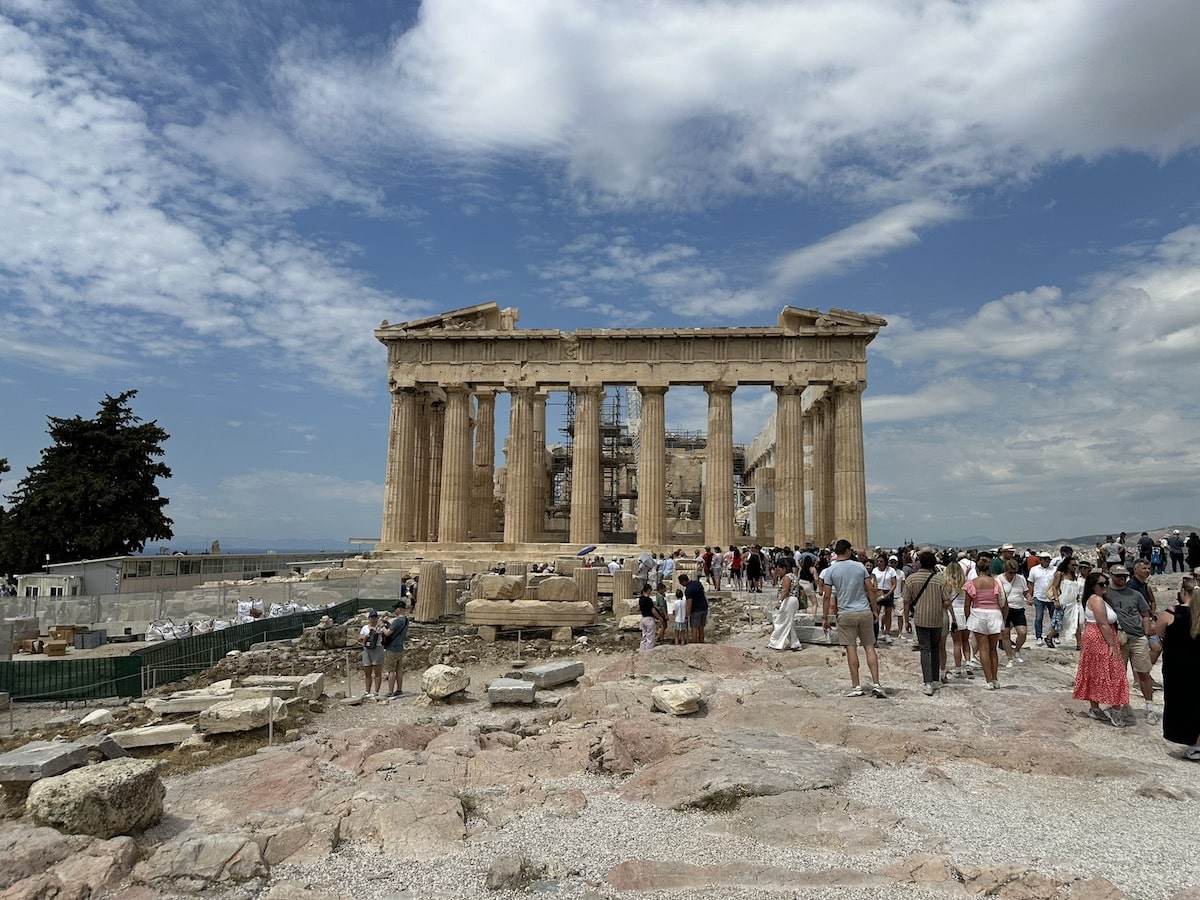
Greece has refused to lend nine fragments of the Parthenon marbles to a Frankfurt exhibition that would have marked the first attempt to fully reconstruct the temple’s east pediment, after learning the show would also include pieces held by the British Museum, the institution Athens has spent decades trying to persuade to give its own Parthenon holdings back.
The exhibition in question, Athena, the Stage is Yours: The Parthenon Puzzle, opens at the Liebieghaus Skulpturensammlung on November 18 and runs through July of next year. According to Greek media reports, the request for the nine fragments from the Acropolis Museum in Athens was reviewed by the country’s Central Archaeological Council, which issued a unanimous recommendation against the loan. The reasoning, as reported, came down largely to context. Displaying Greek-held fragments beside pieces removed by Lord Elgin in the nineteenth century and now sitting in London would have meant showing the two collections side by side in a German gallery, an arrangement Athens was apparently unwilling to sanction given its long-running campaign for reunification.
The Greek culture ministry did not respond to a request for confirmation. A spokesperson for the British Museum, meanwhile, confirmed that its own loan is proceeding as planned, with two fragments heading to Frankfurt regardless of the Greek decision.
Greece’s Parthenon Fragments Photo © Artlyst
For the Liebieghaus, the setback is real but apparently not fatal to the project. “The cancellation of the loans from Greece does not detract from the exhibition’s concept, or its scholarly significance,” wrote Elisabeth Pallentin, a spokeswoman for the museum, in an email, adding that the show rests primarily on original research conducted at the Liebieghaus itself over a period of years rather than on any single set of borrowed objects.
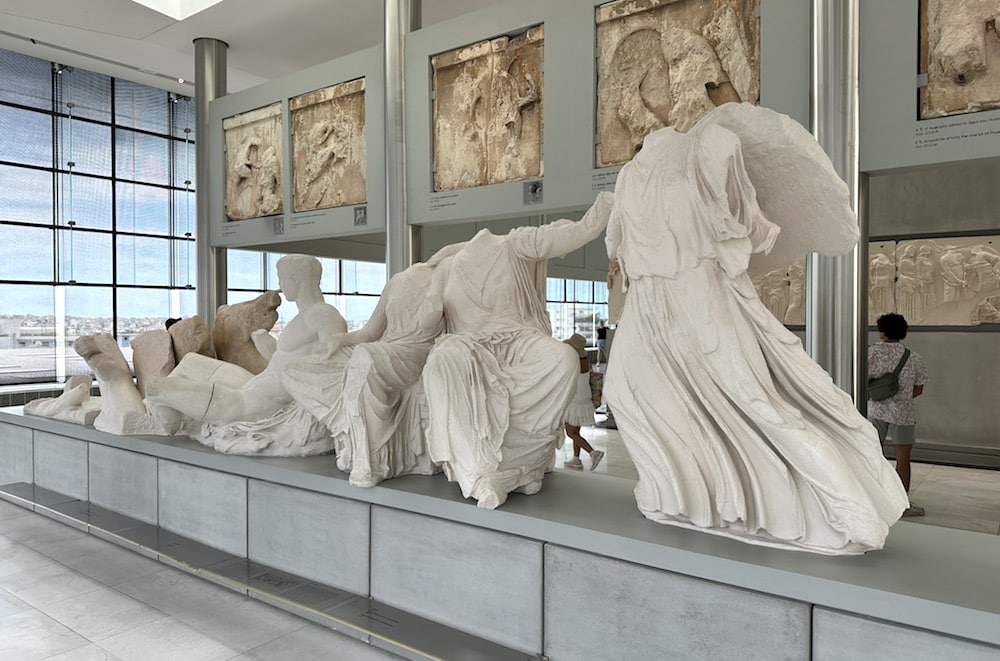
That research forms the actual spine of the exhibition, and it is considerable. The east pediment of the Parthenon depicted the birth of Athena from the head of Zeus, a scene comprising 39 figures in total, including central figures of Athena and Zeus, each standing three and a half metres tall. Vinzenz Brinkmann, who curates the show and heads the Liebieghaus Department of Antiquities, calls it probably the most famous image to survive from antiquity, though survive is a generous word for what actually remains. The pediment was destroyed sometime between the fifth century and 1670, and nobody knows exactly when or why, despite a shortage of theories over the years. Roughly eighty per cent of it is gone. What remains exists as fragments scattered across museum collections around the world, and until now nobody had managed to put the whole group back together in a way that scholars found convincing.
Brinkmann has described the process as assembling a jigsaw puzzle without all the pieces, which seems like an understatement given the numbers involved. His team reassessed the surviving fragments alongside secondary evidence, including depictions of the pediment that appear on Roman sarcophagus reliefs, and used 3D scanning to reconstruct the sculptural group at true scale digitally. “In the past 200 years, there have been a lot of proposals, but we saw that there were always gaps,” Brinkmann said, framing the Frankfurt reconstruction as the first to genuinely close them, or at least come closer than anyone previously managed.
The exhibition will still bring together loans from a range of international collections alongside the Liebieghaus’s own holdings, and the two British Museum fragments remain part of that mix. What it will not have is the additional context that nine pieces from the Acropolis Museum might have provided, a gap that is likely to be more noticeable to specialists than to the general public walking through the galleries.
The Greek culture minister’s decision is a policy that has not shifted in decades. Athens has consistently pushed for the reunification of the Parthenon Sculptures, arguing that pieces removed from the monument and now held in London belong beside those preserved at the Acropolis Museum rather than scattered across separate institutions.
The minister reiterated that position at UNESCO as recently as May, formally backing calls for permanent reunification. The British Museum, for its part, continues to describe the objects in its own collection simply as part of the Parthenon Sculptures, maintaining its long-standing position on ownership and declining to treat the dispute as settled in either direction.
Seen in that light, the Frankfurt exhibition becomes something slightly more complicated than a straightforward showcase of new archaeological research. It sits, whether by design or accident, directly inside one of the most stubborn disputes in the museum world, a disagreement that has outlasted multiple British governments and shows no obvious sign of resolving itself soon. Greece’s refusal to let its fragments appear alongside the British Museum’s holdings reads less as a rejection of the Liebieghaus’s scholarship and more as a pointed reminder that questions of ownership have not gone away simply because a German museum has found a clever new way to reconstruct a two and a half thousand year old sculptural group.
The show will go ahead regardless, built around Brinkmann’s reconstruction and the loans still coming in, including those two fragments from London. Whether visitors walking through the Liebieghaus this winter will sense the diplomatic friction sitting just beneath the surface of the display cases is another matter entirely. However, for anyone following the Parthenon question even loosely, it will be hard to miss.