The human toll of September 11, 2001 remains, and should remain, the central fact of that day. Nearly three thousand people died when the World Trade Centre fell, and no accounting of lost paintings or sculptures belongs anywhere near the same sentence as that number without acknowledging as much first. But the collapse of the towers also destroyed something else, something that gets mentioned far less often twenty-five years on: an extraordinary concentration of art, spread across public plazas, corporate boardrooms and fireproof vaults, that vanished into dust along with everything else that morning.
Estimates put the total loss at around $110 million, split roughly between $10 million in public sculpture and murals and well over $100 million sitting quietly in private collections most New Yorkers never knew existed. The public face of that loss was Austin J. Tobin Plaza, the outdoor space between the towers that Saul Wenegrat, then director of the Port Authority’s art program, had spent years turning into something closer to an open-air sculpture garden than a corporate forecourt.
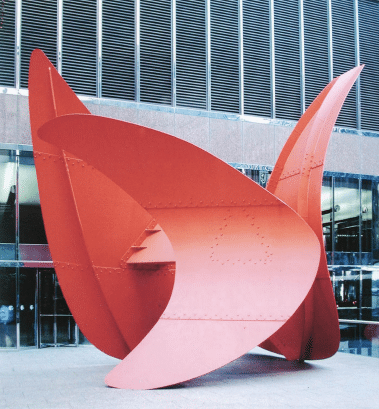
Alexander Calder, Bent Propeller, 1971.
Alexander Calder’s Bent Propeller stood there, a twenty-five-foot steel stabile painted in Calder’s signature red, its swooping curves deliberately at odds with the rigid verticals rising behind it. Commissioned in 1969, it had already been moved once, from the North Tower entrance to a spot in front of 7 World Trade Centre, before the towers came down, taking most of it with them. Only about forty per cent of the structure was ever pulled from the wreckage, too mangled to restore, and what survived now sits with the Calder Foundation, with fragments eventually finding their way into the National September 11 Memorial and Museum.
Inside the South Tower lobby hung something even larger and, in its way, even more unlikely. Joan Miró had turned the commission down at first, having never worked in tapestry, and only relented later as a gesture of thanks after his daughter recovered from a serious illness. What he and his collaborator Josep Royo eventually produced, a wool and hemp piece measuring twenty by thirty-five feet and weighing over four tons, greeted thousands of commuters every single day for nearly three decades. It was gone in seconds.
The plaza held other losses, each significant enough on its own to have anchored a museum collection elsewhere. Louise Nevelson’s Sky Gate, New York, a dark wooden relief meant to evoke the city skyline as seen from an aeroplane window, hung in the North Tower mezzanine. James Rosati’s Ideogram, a twenty-three-foot stainless steel piece, caught shifting daylight on the plaza. Masayuki Nagare’s black granite Cloud Fortress actually survived the initial collapse intact, only to be destroyed weeks later by heavy machinery during the recovery effort. This detail still seems almost unbearably cruel in hindsight. Elyn Zimmerman’s Memorial Fountain, itself built to honour victims of the 1993 bombing, was pulverised along with everything around it.
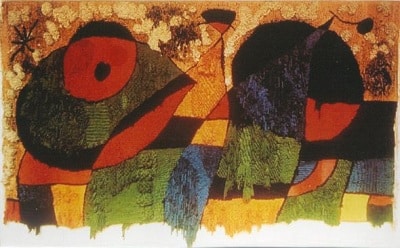
A large tapestry by Joan Miró, 1974. It was displayed in the lobby of 2 World Trade Centre (the South Tower)
What sat above the plaza, floor after floor of private corporate offices, held its own hidden museum. Cantor Fitzgerald, occupying floors 101 through 105 of the North Tower, lost 658 employees that day, a devastation that dwarfs any conversation about objects. But the firm’s offices also held what press coverage at the time dubbed a museum in the sky, a collection of Rodin sculptures and drawings that early reports wildly exaggerated into hundreds of bronzes before later assessments settled on a more modest, though still remarkable, number of physical pieces alongside an extensive trove of drawings. A cast of The Thinker was among them. Fragments of Rodin bronzes were later recovered from the Fresh Kills landfill on Staten Island, including a piece of that same sculpture. However, it surfaced only briefly before disappearing again into the sheer chaos of the recovery period.
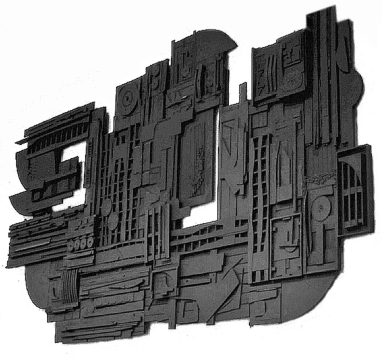
Louise Nevelson’s Sky Gate, New York
Other tenants held their own private holdings, works by Picasso, Roy Lichtenstein, Paul Klee, Romare Bearden, scattered through offices most of their neighbours never saw inside. On the 91st and 92nd floors, the Lower Manhattan Cultural Council ran a residency program called World Views, and its studios were full of unfinished work by artists from around the world. Michael Richards, a sculptor from Brooklyn, was working through the night in his studio when the first plane struck. He died in the attack, and with him went a body of work built over an entire career.
The destruction reached well beyond fine art. A vault at 5 World Trade Centre held roughly 40,000 negatives shot by Jacques Lowe, Kennedy’s personal photographer, an entire visual record of a presidency reduced to nothing. The basement of 6 World Trade Centre stored nearly a million archaeological artefacts from the old Five Points neighbourhood along with material from the African Burial Ground excavation. Some African Burial Ground boxes were saved. Almost none of the Five Points collection was.
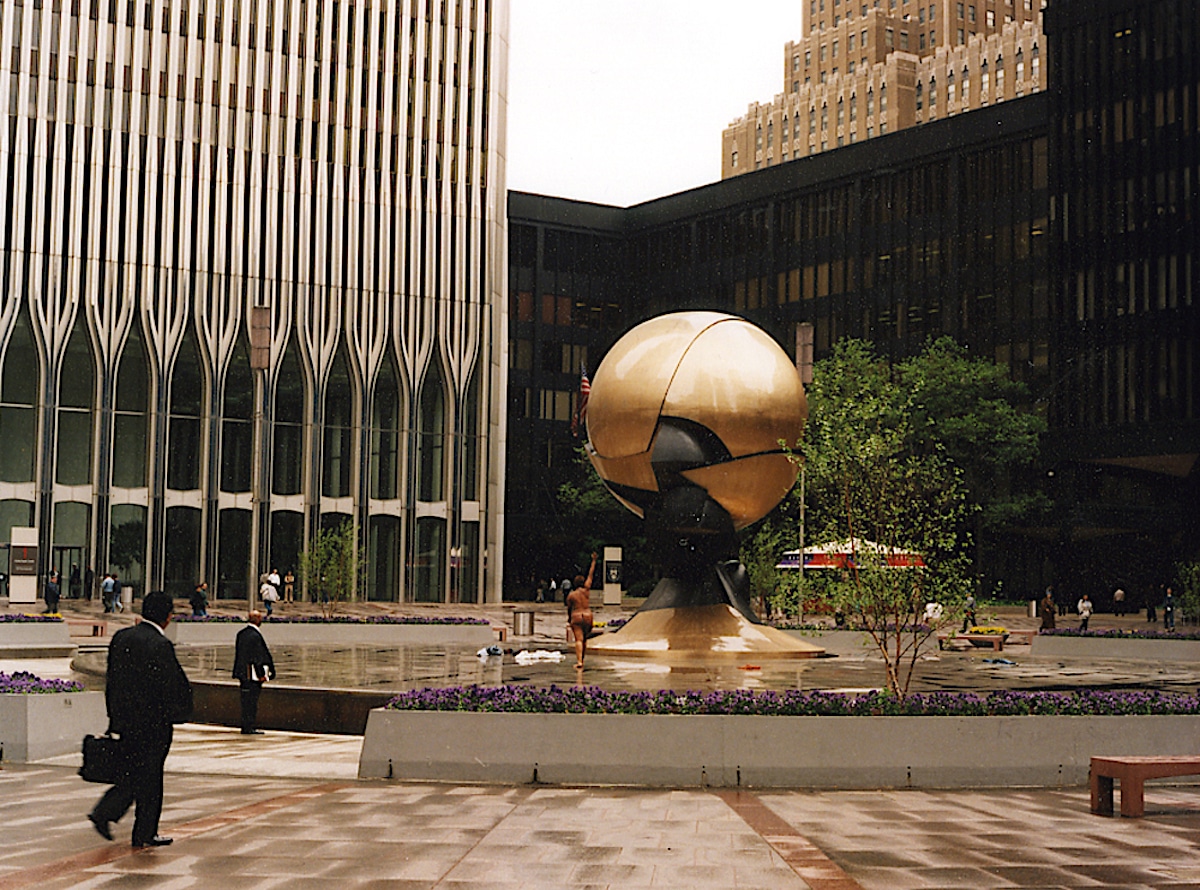
Only one major public work made it through more or less intact. Fritz Koenig’s Sphere (Top Photo), battered, torn open, scorched black in places, refused to fall. It stands today in Liberty Park, deliberately left unrestored, dents and all, a piece of bronze that would not go the way everything around it went. Twenty-five years later, it remains defiant.
Photo: Wikimedia Commons