
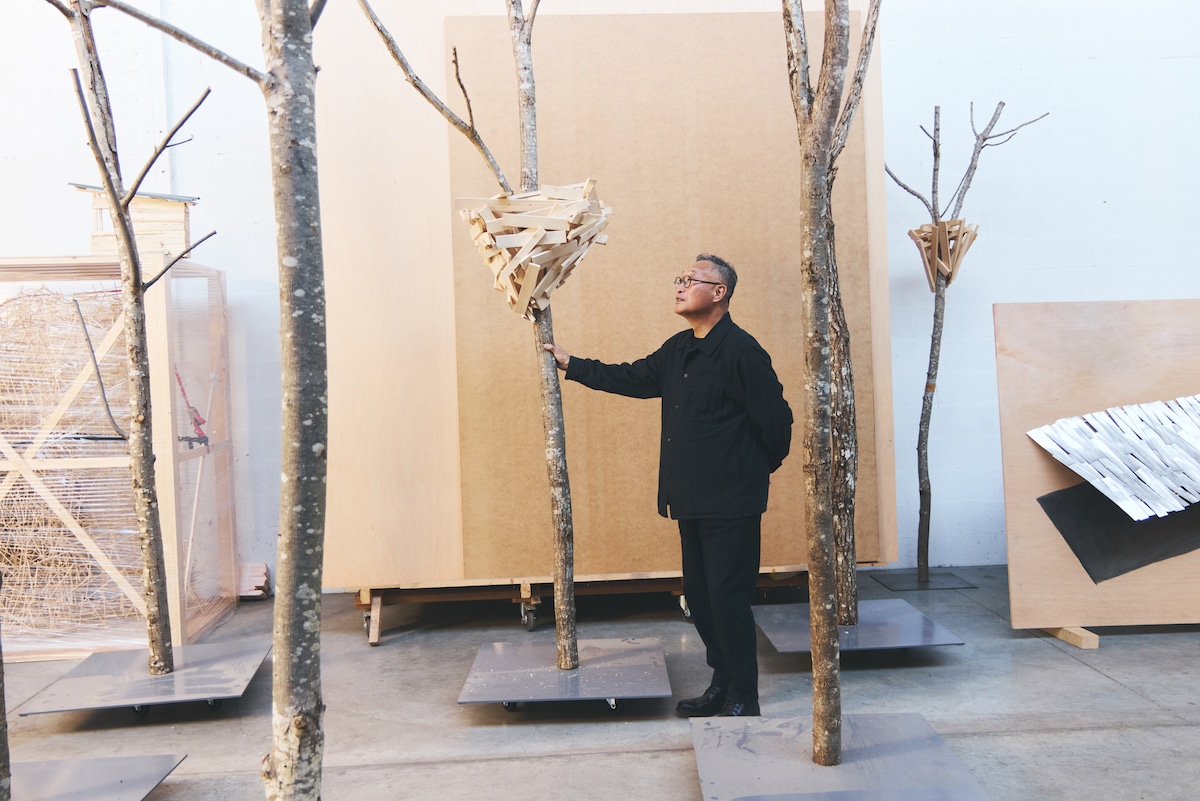
Maison Ruinart has picked its latest collaborator for Conversations with Nature, the ongoing art programme the champagne house has been running for several years now, and this time the choice is Tadashi Kawamata, the Japanese artist known for building sprawling, temporary structures out of scrap wood and salvaged furniture. His project will first appear at the Palais de Tokyo in Paris this coming February, before eventually settling into a more permanent home at 4 Rue des Crayères, Ruinart’s historic address in the Champagne region, with elements of the work also travelling to art fairs where the Maison maintains a partner presence throughout the year.
Kawamata’s reputation rests on site-specific installations that visitors are meant to climb through, wander around, or stand beneath. Pyramids assembled from timber offcuts, walkways that hover above the ground, shelters that look half built and half collapsing, though the effect is always deliberate. What he is really after, by his own account, is a shift in vantage point. Seen from five metres up, he has said, the world behaves differently. Wind sounds different. Light lands differently on the skin. It is a fairly simple idea executed with considerable patience, and it has carried him through decades of major biennales and museum shows, from Documenta in the late eighties and early nineties to the Venice Biennale as far back as 1982, right through to more recent appearances at the Centre Pompidou and Berlin’s HKW.
Conversations with Nature, the art programme Ruinart has been running for several years.
When Kawamata first visited the Maison in Reims, he noted the way the boundary between the vineyard and the working buildings seemed to dissolve at certain hours. He has described noticing the morning mist settling over the vines and the warmth of early sunlight. He was also drawn, he says, to the quieter ecosystem running underneath all of that, the birds and insects that anyone who actually works the land comes to know intimately but that remain largely invisible to everyone else. Out of that first encounter came a body of drawings and scale models, which Kawamata treats less as preparatory sketches in the traditional sense and more as a method of thinking through a problem, working out in miniature what will eventually need to exist at full size.
The process of scaling up and down turned out to be central to how he works generally. “I like the idea of miniaturisation,” he explains. “Big things become small, in situ installations become objects. This changes the relationship with scale and the hand.” An object, in his framing, is closed off, self-contained, finished. An installation, by contrast, stays in constant negotiation with wherever it happens to sit, responding to climate, to the particular contours of a site, to scale itself as a variable rather than a fixed constraint. Working small first, he says, lets him test balance and tension before anything becomes monumental, provided the underlying spirit, focused on the hand, on wood, on the slow
accumulation of time, stays consistent across both registers.
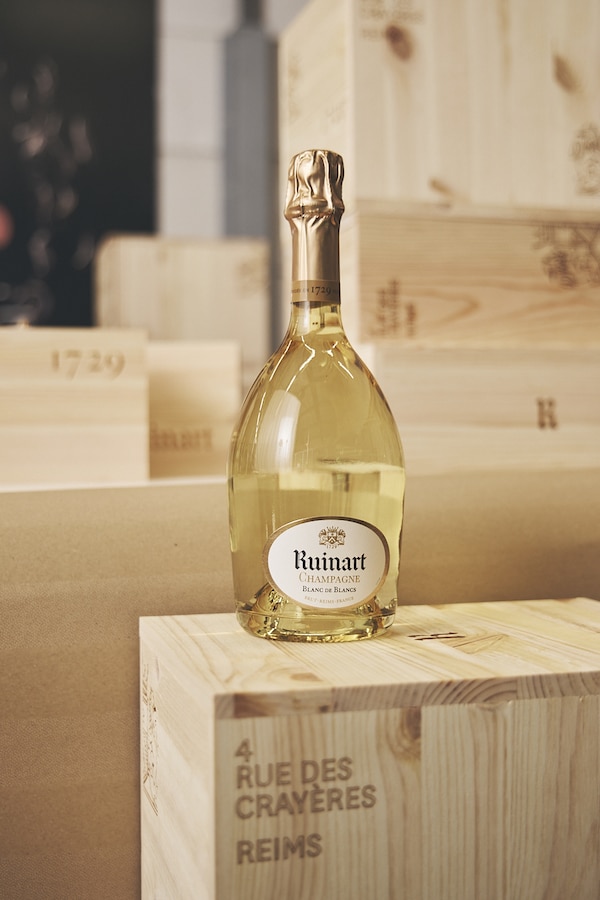
The Reims project will eventually take the form of three permanent installations built specifically for 4 Rue des Crayères: a structure called Tree Hut, another called Nest, and a third named Observatory. Visitors passing through will, at least in theory, be nudged toward paying closer attention to the natural rhythms that actually govern how champagne gets made, the weather patterns, the seasonal shifts, the quiet churn of biodiversity that underwrites the whole enterprise. Kawamata will also design a limited edition object meant to hold a Jeroboam of Ruinart Blanc de Blancs, extending his practice of miniaturisation into something closer to functional design.
This is, notably, not Ruinart’s first outing into contemporary art. The Maison’s relationship with visual culture stretches back further than most people probably assume, to a poster Alphonse Mucha designed for Ruinart in 1896, generally regarded as the first advertisement ever produced for a champagne house. Conversations with Nature has, in recent years, brought in artists including Tomás Saraceno, whose 2021 performance piece Movement addressed ecological fragility directly, land art figure Nils Udo, whose Habitats installation has stood in the Maison’s Taissy vineyard since 2022, Eva Jospin, who built a cardboard sculpture tracing the layered history of the Champagne landscape in 2023, and Marcus Coates, whose Nature Calendar arrived in 2024 in step with the Maison’s biodiversity initiatives.
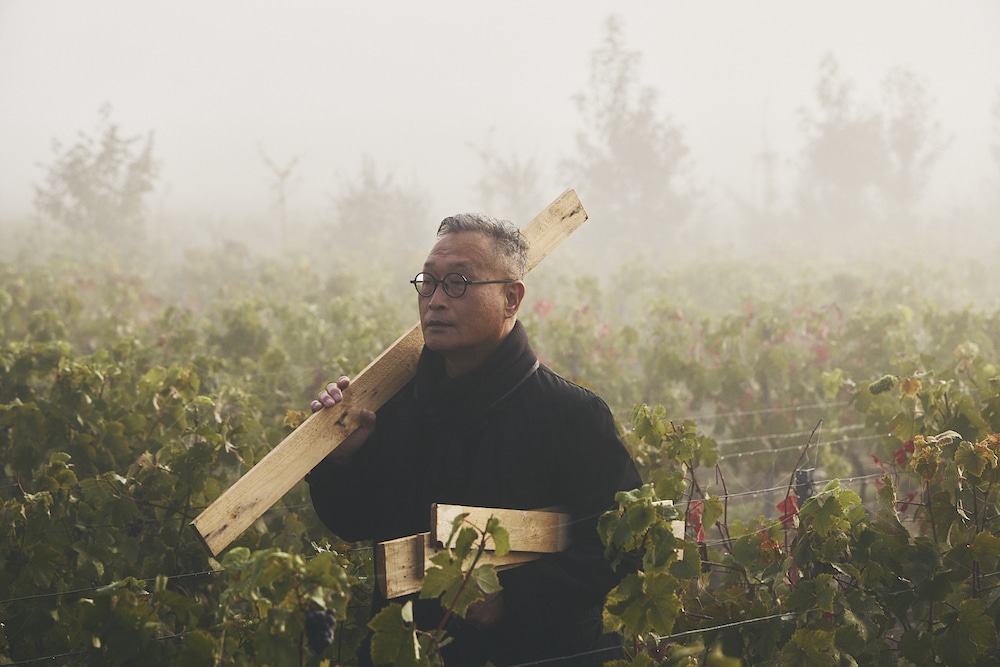
Tadashi Kawamata Ruinart’s Conversations With Nature 2026
Much of this activity now converges at 4 Rue des Crayères itself, a site the Maison substantially reworked in 2024, adding a contemporary pavilion designed by the Japanese architect Sou Fujimoto. Built from stone and glass and set against buildings three centuries old, the pavilion sits within grounds redesigned by landscape architect Christophe Gautrand. Visitors can move between the underground cellars, which have carried UNESCO heritage status since 2015, and more than twenty separate art installations scattered across the courtyard and garden paths, a fairly unusual arrangement for a working champagne house, though one that increasingly defines how Ruinart wants to present itself.
Kawamata’s contribution joins the collection later this year, adding wood, shadow, and a certain deliberate fragility to grounds that have, over the past few seasons, become an open-air sculpture park.