

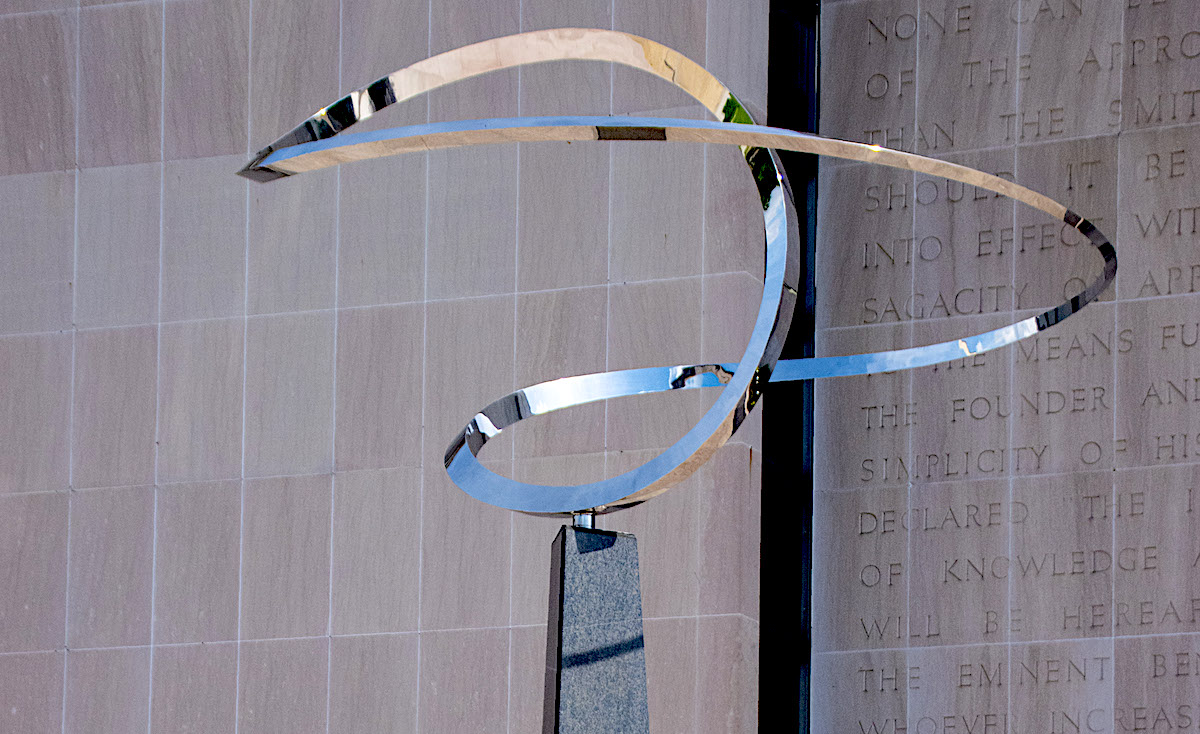
President Donald Trump has issued a fresh round of demands aimed at the Smithsonian Institution, this time centred on removing José de Rivera’s Infinity, a modernist sculpture, located at the National Museum of American History, where he wants a monumental statue of George Washington installed outside the building and a dedicated exhibition honouring the first president to be opened without delay.
The demands arrived, as so many of Trump’s cultural directives have lately, through a late-night spew of posts on Truth Social. He specified that the exhibition should open imminently and run all the way through February 22, 2032, which happens to mark the 300th anniversary of Washington’s birth, a date far enough in the future that it effectively commits the museum to a multi-year commemorative programme rather than a temporary display. As for the statue itself, Trump wants it erected specifically on September 17, which is Constitution Day in the United States, lending the timing a symbolic weight that seems entirely deliberate.
The work in question is not new to Washington audiences, at least not entirely. Standing 11 feet tall, the statue recently appeared at the Freedom 250 IndyCar race, where it was displayed in the museum’s Flag Hall, a space already associated with some of the most recognisable objects in the Smithsonian’s collection. Moving it permanently outside the building, facing the National Mall, would place it in fairly rarefied company among the handful of large-scale sculptures that have historically occupied that stretch of ground.
One of those existing works offers something of a contrast worth noting. José de Rivera’s Infinity has stood facing the Mall since 1967, a thin stainless steel ribbon that rotates atop a granite pedestal with a quiet, almost improbable stability. The sculpture stands thirteen and a half feet tall. It completes a full revolution roughly every six minutes, its form built as a Möbius strip, a surface with only one continuous side, achieved by twisting one end 180 degrees before joining it back to the other. The effect is a loop that appears to have no beginning or end, which was rather the point. Infinity was the first abstract work ever commissioned by the federal government in Washington, and its subject matter, an ongoing meditation on time and technological progress, made particular sense at the moment of its unveiling, when the museum itself was still known as the National Museum of History and Technology rather than its current name.
Trump’s proposed Washington statue would sit in a very different register from de Rivera’s abstraction, trading ambiguity and open interpretation for a direct, figurative tribute to a specific historical figure, which is broadly consistent with the administration’s approach to public art and museum programming more generally over the past year. Where Infinity asks viewers to consider motion and continuity in the abstract, a Washington statue asks for something closer to reverence, a fixed point rather than a moving one.
The demand fits into a broader pattern of instructions Trump has issued to Smithsonian institutions since returning to office, part of an ongoing effort to reshape how federally funded cultural spaces present American history. This effort has already reached other institutions, including the Kennedy Centre. Whether the Smithsonian will comply with the specific September 17 installation date or the multi-year exhibition timeline stretching to 2032 remains to be seen, and the Institution has not yet issued a formal public response to the latest set of demands.
Washington’s public sculpture landscape, of which the museum grounds form just one small part, has long included a considerable number of abstract works scattered across the city’s parks, plazas and street corners, pieces that exist entirely apart from the more familiar commemorative statues and war memorials that dominate most visitors’ mental map of the capital. Many of these abstract installations were never tied to a specific historical event or person as traditional monuments are. As a result, they rarely receive the same level of public attention or protection, despite having been commissioned by the city itself, private businesses, or federal agencies over the decades.
Infinity is one of the more prominent examples still standing in its original location, a survivor of sorts among installations that are frequently relocated, deaccessioned, or absorbed into museum collections once the buildings or plazas that hosted them are redeveloped.
Against that backdrop, the prospect of a new eleven-foot figurative Washington statue joining the grounds outside the National Museum of American History would mark a fairly significant departure from the more experimental tradition that pieces like Infinity represent, even as both would, at least for a time, occupy the same stretch of the National Mall.
Photo: Wiki media commons