
There is something eerily familiar about Xin Huang’s sculptures. At first glance, their forms appear familiar: a mushroom, an architectural fragment, a piece of infrastructure. Yet the longer one looks, the more difficult these forms become to categorise. Organic forms acquire the hardness of construction materials; architectural structures start to morph into bodies, and objects appear less like isolated sculptures than as fragments of an unseen ecological framework. Huang’s work inhabits this uncertain territory between the natural and the manufactured, the biological and the architectural, inviting us to reconsider the networks that connect seemingly unrelated forms.
Huang is a distinctive emerging voice working across sculpture and installation, whose practice is concerned with displacement, repetition, adaptation and coexistence. Her interest in fungal ecologies provides an especially fertile starting point. Rather than simply depicting mushrooms, she considers the larger systems from which they emerge: underground networks, processes of growth and decay, circulation, attachment and exchange. The mushroom becomes not an endpoint but a visible manifestation of something much larger and largely invisible.
This distinction is important. Fungi inhabit almost every environment on Earth and perform extraordinary chemical and ecological functions, underpinning ecosystems while providing humans with food and medicine. In Entangled Life, Merlin Sheldrake has explored the extraordinary complexity of fungal networks and the ways fungi challenge conventional ideas of individuality, hierarchy and communication. Huang’s sculptures similarly encourage us to look beyond the visible organism towards the network that sustains it.
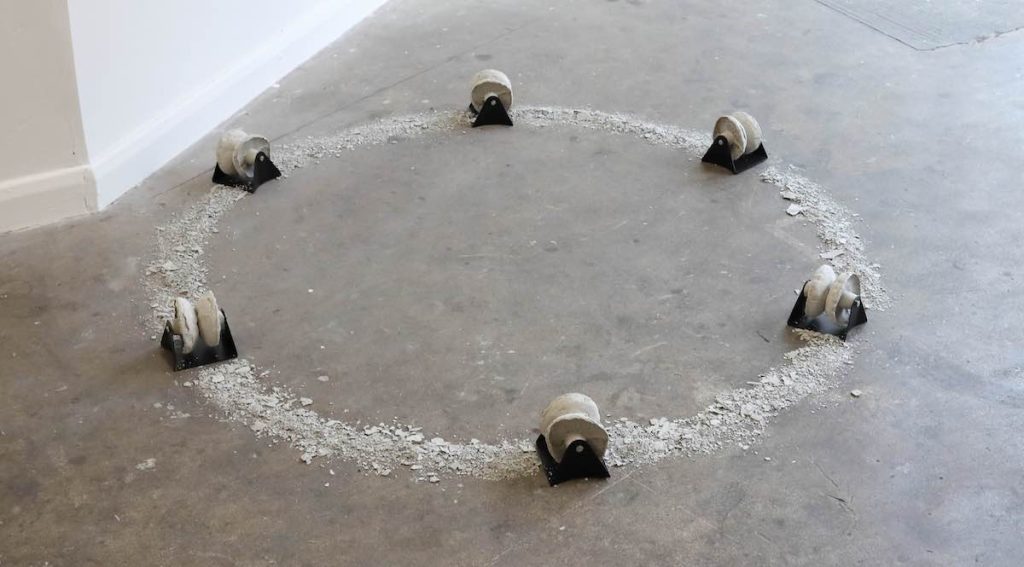
Fairy Ring, 2024 Installation view, I and Thou, 133 Bethnal Green, London, 2024 Photography: Xin Huang
In Fairy Ring (2024), this idea is distilled into an elegant sculptural proposition. Six mushroom forms are arranged in a loose circle alongside concrete fragments, creating a composition that is simultaneously delicate and monumental. Made from concrete, steel and bolts, the work translates fungal morphology into the vocabulary of construction. The mushroom is no longer simply a natural object; it becomes architectural, engineered and strangely infrastructural.
The circular formation evokes the mysterious patterns of a fairy ring, in which mushrooms appear to emerge in a circle above an underground fungal network. Such formations have long carried an almost magical significance in folklore, and Huang’s work retains something of that enchantment. There is a surreal quality to the sculptures, as though these chalky forms have somehow surfaced from another world. The fairy ring becomes both a natural phenomenon and an image of an invisible system made momentarily visible.
There are echoes here of Arthur Rackham’s fantastical illustrations for Lewis Carroll’s Alice’s Adventures in Wonderland, particularly his iconic 1907 image of the Caterpillar perched upon a mushroom. Rackham transformed the mushroom into a portal to an alternative logic, a threshold between the recognisable and the strange. Huang’s sculptures possess a comparable fairytale sensibility, although hers is tempered by the industrial austerity of concrete and steel.
The visual language also resonates with Yayoi Kusama’s fascination with mushrooms and their repetition within her broader visual vocabulary. Where Kusama’s fungal forms can become psychedelic, proliferating and hallucinatory, Huang approaches the mushroom through material tension and spatial construction. Her repetitions are not simply decorative, for they suggest reproduction, growth and the possibility of an organism existing as part of a larger collective.
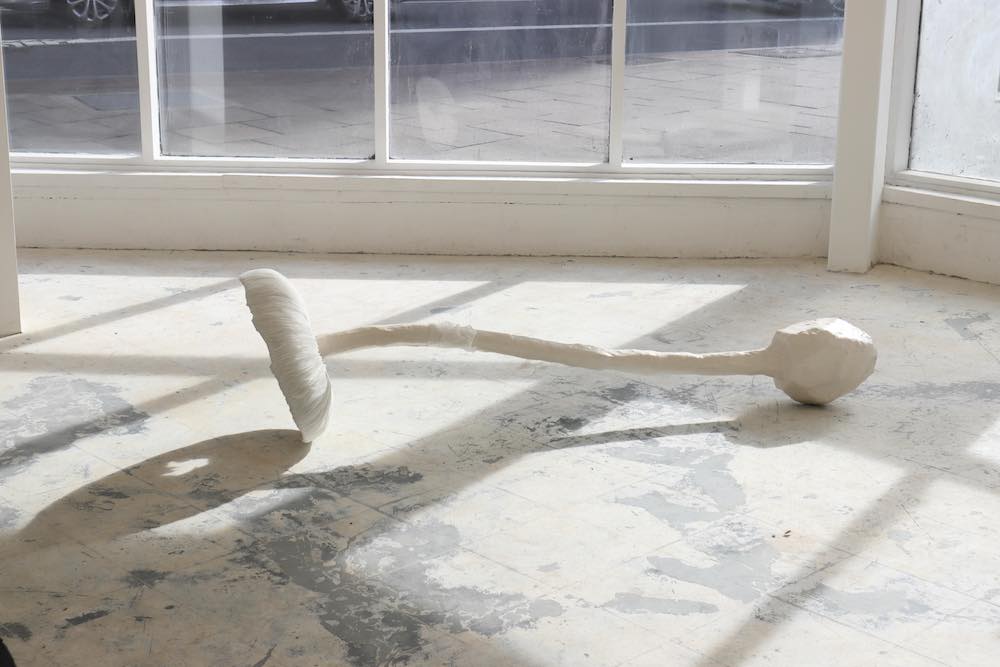
Lingering, 2025 Installation view, Elsewhere elsewhen, SET Lewisham, London, 2025 Photography: Xin Huang
This tension between the soft and the hard becomes particularly compelling in Lingering (2025). Constructed from Jesmonite, resin, non-woven fabric, and epoxy putty, the elongated white sculpture was inspired by a poisonous mushroom Huang encountered while hiking, one that had been partially eaten by insects. Enlarged to approximately human scale, the mushroom becomes bodily and ambiguous. Its enlarged proportions shift it from the category of botanical specimen towards something more psychologically charged.
The work poses a deceptively simple question: what constitutes danger when viewed from outside the human perspective? A mushroom that appears poisonous and threatening to us can simultaneously be food for another organism. Huang’s sculpture therefore destabilises anthropocentric ideas of value and utility. The poisonous mushroom is not simply poisonous; it occupies a complex ecological relationship in which one organism’s threat may be another’s nourishment.
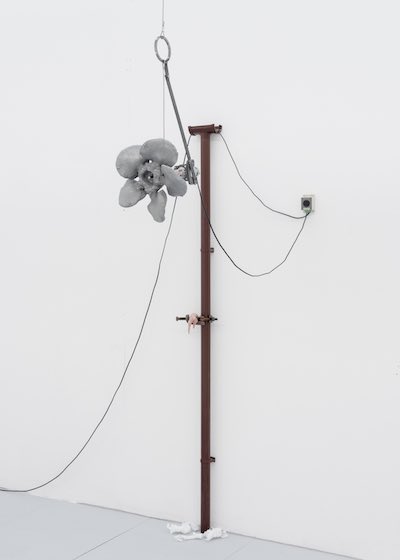
Maintenance Access, 2026 Detail
Lingering is also materially unresolved. Its rigid cast elements encounter softer, folded surfaces, producing a tension between structure and fragility, support and attachment, growth and containment. Huang’s sculptures may originate in organic forms, but she does not attempt to reproduce nature faithfully. Instead, she creates a translation: a mushroom becomes a body, a body becomes a structure, and a natural morphology is reimagined through the language of sculpture.
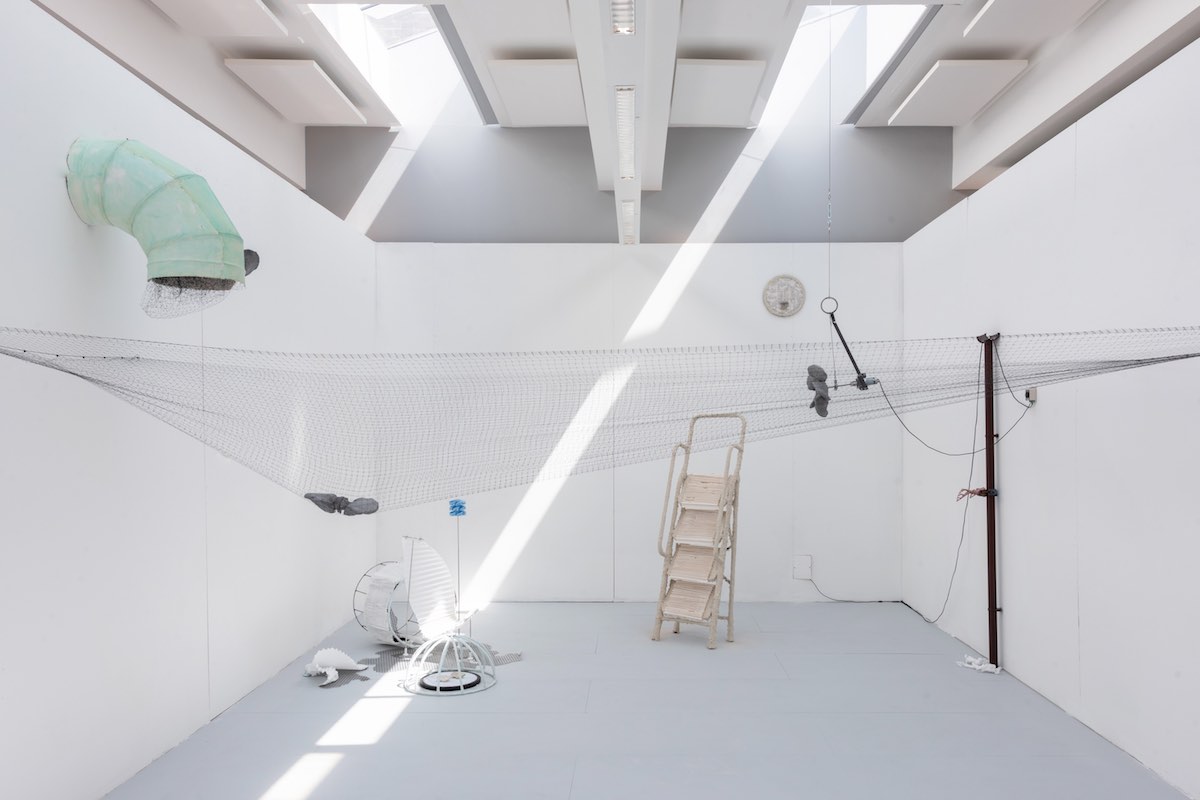
That translation expands significantly in Maintenance Access (2026), a larger installation conceived not as a collection of individual sculptures but as a single spatial system. Based on bracket fungi developed through moulding and casting, the work moves beyond the image of the mushroom towards the infrastructure of the fungal network itself.
Here Huang draws a loose parallel between fungal systems and urban infrastructure: ducts, pipes, filters, grids and maintenance structures. It is a particularly productive collision. Both systems are networks of circulation and exchange, although one is biological and the other manufactured. By allowing them to overlap, Huang creates an environment in which it becomes difficult to determine where architecture ends, and the organism begins.
The title Maintenance Access is revealing. It introduces the functional language of infrastructure into an environment that otherwise seems organic and fantastical. Maintenance implies hidden systems, access points and mechanisms that require continual intervention to keep a structure operational. The phrase therefore becomes almost metaphorical: beneath the visible surface of a city, an organism or an artwork exists a complex network of relationships.
Huang’s work belongs to a wider contemporary movement in which artists look to ecological systems not simply as subjects but as alternative models of thought. There are productive parallels with Beverley Duckworth’s delicate root drawings and sculptural installations, which foreground the unseen networks connecting ecological and social systems. Huang similarly suggests that the fungal network might offer a metaphor for collective action: a distributed system in which individual organisms gain significance through their relationships with others.
Her sculptures also invite comparison with artists such as Carsten Höller, whose hyper-realistic mushrooms have been deployed within surreal installations to question perception, psychology and altered states, and Xiaojing Yan, whose Lingzhi works use living fungi to create dreamlike hybrid figures. Yet Huang’s approach is distinct. Rather than incorporating living fungi or pursuing botanical realism, she uses industrial and synthetic materials to construct an imagined fungal architecture.
This is perhaps what makes her work so compelling. There is an inherent contradiction between her subject matter and her materials, but it is precisely this contradiction that generates meaning. Concrete, steel, resin and Jesmonite are materials associated with permanence, construction and human intervention; fungi suggest transformation, decay, adaptation and interconnectedness. Huang places these worlds into conversation without resolving the tension between them.
Huang is an artist on a clear upward trajectory whose intriguing artistic practice combines sculptural skill with philosophical metaphors. After graduating with a BFA in Public Art in Shanghai in 2023, she completed an MFA in Fine Art at Goldsmiths, University of London, in 2026. Her work has subsequently appeared in exhibitions in London and Vienna, including at Schwindel LLC, as well as at London Design Festival 2026.
What is most promising is the sense that Huang is not merely interested in representing nature, but in learning from its structures. Her mushrooms are not illustrations of fungi; they are sculptural propositions about networks, adaptation and interdependence. In translating the hidden intelligence of mycelium into the visible language of sculpture, she asks us to look beneath the surface of things.
Huang is a young artist quietly innovating at the intersection of sculpture, environmental thinking and psychology. Her work reminds us that the most extraordinary worlds may exist beneath our feet, largely unseen. Like the fungal networks that inspire her, her practice is still developing underground, but the forms beginning to surface suggest an artist with considerable potential. Xin Huang is one to watch.
Top Photo: Maintenance Access, 2026, Running Unattended Installation view, Goldsmiths MFA Fine Art Degree Show, London, 2026 Photography: Rene Lazovy
Visit