
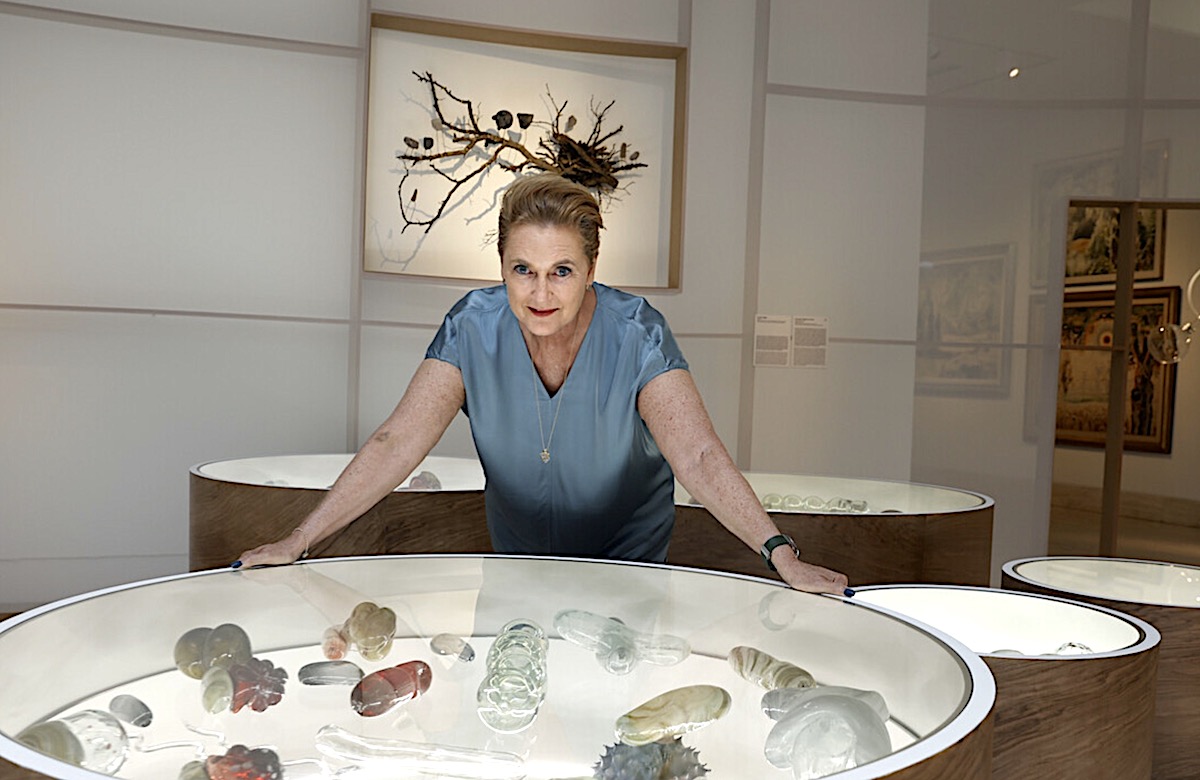
Madrid’s Museo Nacional Thyssen-Bornemisza announced this week that it is opening a new chapter, quite literally, by expanding into a former ice-skating rink and car showroom on Calle Duque de Medinaceli. This building has sat unused since 2007. The expansion, made possible by a substantial donation from Francesca Thyssen-Bornemisza’s TBA21 Foundation, will give the museum a second, publicly owned venue dedicated specifically to contemporary art, ecology and public participation.
The announcement came from the museum’s own auditorium, with Spain’s Minister of Finance, Arcadi España García, and Minister of Culture, Ernest Urtasun, both present alongside Evelio Acevedo and Guillermo Solana, the museum’s managing and artistic directors, as well as Francesca Thyssen-Bornemisza herself and her half-brother Borja. España confirmed that the Spanish government will formally transfer the old Palacio del Hielo y del Automóvil to the Thyssen-Bornemisza Collection Foundation, calling it a building that is finally regaining a purpose worthy of its history after nearly two decades of sitting empty.
Urtasun thanked Francesca for what he called an extraordinary contribution, framing the moment as an opportunity not simply to make the museum bigger but to make it considerably more open. Guillermo Solana, the artistic director, situated the announcement within a much longer effort, one that stretches back to 2008, when museum leadership first began pushing to bring living artists back into the institution through a partnership with Francesca and TBA21. It took more than a decade to bring the board of trustees around to the idea, Solana noted dryly, adding that these things take time. The first joint exhibition between the museum and TBA21 finally happened in 2018.
Borja Thyssen-Bornemisza also spoke, reflecting on how proud his father would likely be to see the family’s legacy not just preserved but actively expanded, and reaffirming his own commitment to carrying that legacy forward.
What is being proposed here is not simply bolt-on square footage. The museum has long struggled with a structural problem: cramped by the physical limits of its historic home, the Palacio de Villahermosa, which leaves little dedicated space for education, research, conservation, or genuine public participation. The new site is meant to relieve that pressure directly, following a path already taken by both the Prado and the Reina Sofía, which expanded their physical footprints to fulfil their public mandates better.
Francesca Thyssen-Bornemisza spoke at length about what the Donation actually represents to her personally. “The announcement we are making here today is more than a donation,” she said. “It is a commitment that my family has been keeping, in one form or another, for over a century.” She credited her father with instilling in her the belief that a collection is never really a possession but rather a conversation with the world, held only briefly, in trust. That philosophy, she explained, has shaped TBA21 from its earliest days. Within the foundation’s first two years, she said, it made an unusual decision to commission new work rather than acquire existing pieces. This choice meant accepting genuine risk, since the outcome of a commissioned work is never entirely predictable for either the artist or the foundation itself.
She framed the Donation as the meeting point of two very different but complementary records of how humans see the world. The museum’s existing collection, she noted, documents seven centuries of largely Western perspective. At the same time, TBA21 represents something closer to a living record of how the world understands itself right now, through ecological thinking, oceanic knowledge, Indigenous cosmologies and political ecology. Bringing both together under one roof, she suggested, closes a kind of generational loop. If her great-grandfather’s generation asked what art could reveal about beauty, and her father’s generation asked what art could do for peace between nations, her own generation is asking what art can do to help people collectively imagine how to live well together on a rapidly changing planet.
The Donation itself comprises more than 180 works from the TBA21 Collection, gifted outright by Francesca and her heirs with no financial return whatsoever, alongside a further long-term loan of nearly 180 additional contemporary works. Combined, the Donation adds roughly €16 million in assets to Spain’s public art holdings, on top of a €10 million loan and an existing long-term loan of Francesca’s own collection valued at approximately €70 million, bringing the total commitment to the Spanish state to nearly €100 million.
The collection spans an unusually wide range of major international artists, including Ai Weiwei, Marina Abramović, Olafur Eliasson, Pierre Huyghe, Bill Viola and Rashid Johnson, whose work touches nearly every contemporary medium: painting, sculpture, installation, performance, sound and film. TBA21 itself, founded in 2002 and relocated to Madrid as a Spanish foundation in 2019, has built one of the more influential private collections of contemporary art in the world, with a particular emphasis on artists from the Global South and Indigenous practitioners historically excluded from European institutional narratives.
The new building will not be devoted entirely to art. It will share space with the Madrid headquarters of the Victims of Terrorism Memorial Centre, and an open listening process with residents is planned to help shape how the space is ultimately used. Perhaps most strikingly, the building itself has been designed to function as a climate shelter during periods of extreme heat, a direct, almost literal translation of the ecological themes running through TBA21’s collection into immediate civic use. At a moment when public space so often feels squeezed on every side, the reopening of a long-abandoned building for exactly this purpose reads as a fairly rare thing: an institution putting its stated values into brick and mortar rather than simply a mission statement.