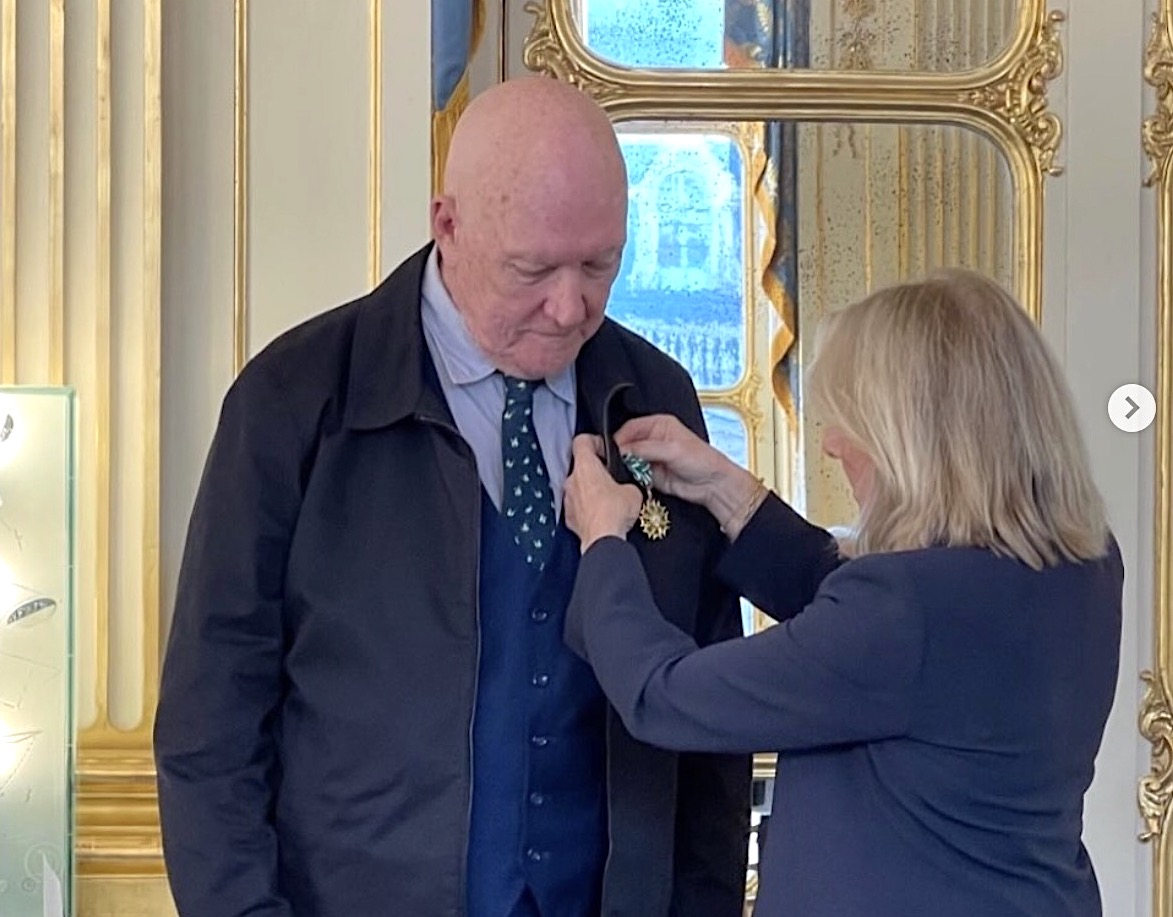
Sean Scully has been named an Officier de l’Ordre des Arts et des Lettres, one of France’s highest cultural honours. The ceremony was held at the Ministry of Culture in Paris. Minister of Culture Catherine Pégard presented the title personally, recognising what the ministry described as Scully’s profound contribution to contemporary abstraction and his sustained influence on the visual arts over a career now spanning more than five decades.
It is difficult to overstate how central Scully has become to the story of postwar painting, particularly the long, slow evolution of abstraction away from its more austere Minimalist roots and toward something considerably warmer and more emotionally charged. His work fuses European painterly tradition with the scale and confidence of American abstraction, producing paintings that manage to hold painterly drama and real visual delicacy in the same frame. Structured, more often than not, around stripes or layered blocks of colour arranged along horizontal and vertical axes, his canvases strike an unusual balance between stillness and an underlying, almost restless energy.
Scully has always worked as a fundamentally physical artist, someone whose engagement with materials feels less like technique and more like confrontation. His compositions are built through acute concentration, a constant negotiation between the monumental and the intimate, and beneath their rigorous structure sits something closer to raw emotional variation than pure formal exercise, an approach animated throughout by a broader belief in art’s capacity to speak to human betterment.
The Paris honour caps a career defined by a handful of genuinely pivotal moments, each one visibly present in the work that followed. A trip to Morocco in 1969 exposed the young artist to the region’s saturated colour palette. This experience fed directly into the broad horizontal and vertical stripes and deep earth tones that would eventually define his mature style. Fellowships at Harvard in 1972 and 1975 led to a permanent move to New York, and in the early 1980s a series of trips to Mexico proved similarly transformative. It was there that Scully first began working in watercolour, drawn to the interplay of light and shadow across the stacked stone walls of ancient ruins, an encounter that pushed him decisively away from Minimalism and toward the more humanistic, emotionally driven abstraction that would come to define his output.
Those Mexican trips eventually gave rise, in 1998, to the landmark Wall of Light series, which toured major American institutions between 2005 and 2007, including the Phillips Collection in Washington, the Modern Art Museum of Fort Worth, the Cincinnati Art Museum and the Metropolitan Museum of Art in New York. More recently, Scully has expanded significantly into sculpture, producing monumental structures built from stacked coins, steel beams, rusted grids and interlocking brick walls, work that extends his long-running exploration of colour and material into genuine three-dimensional space, engaging directly with the specific energy and history of wherever each piece is sited.
Born in Dublin, Scully trained at the Croydon School of Art before continuing his studies at Newcastle University in the UK, where he first began experimenting seriously with abstraction. Since then his work has been shown at an extraordinary range of major institutions worldwide, including the Bibliothèque Nationale de France, the Museum of Modern Art in New York, the National Gallery in London, the National Gallery of Ireland in Dublin, the Philadelphia Museum of Art, and the Smithsonian American Art Museum, among numerous others. In 2014 he became the first Western artist ever granted a major retrospective at both the Shanghai Himalayas Museum and the Central Academy of Fine Arts in Beijing, a milestone that underscored just how far his influence had travelled beyond the European and American contexts that originally shaped him.
Now well into his eighth decade, and honoured with one of France’s most prestigious cultural distinctions, Scully remains one of the very few living painters whose work continues to be discussed in the same breath as the postwar movements that first formed him, not as a historical footnote but as an artist still actively extending the conversation those movements began.
Photo: Benoit Minou, courtesy Instagram